Industry Background: The Pallet-Wrapping Industry Faces a Materials Turning Point
The logistics, warehousing, manufacturing, and export-packaging sectors have long relied on conventional polyethylene stretch film to secure palletized loads. This reliance now creates a structural tension: conventional polyethylene stretch film leaves persistent plastic waste and heightens regulatory and legal exposure for the companies that use it. At the same time, operational realities have not changed—heavy loads and sharp corners can still cause wrapping film to break and destabilize, automated packaging lines still require stable unwinding, high-speed compatibility, and low operating noise, and low-transparency film still blocks barcode scanning at sortation points. Adhesive residue contaminating wrapped goods and equipment, along with excess film consumption raising material cost and waste, round out a familiar list of pain points that packaging engineers and procurement teams encounter daily.
Addressing these pain points simultaneously—without sacrificing mechanical performance—is the central challenge facing the stretch-film category today. This is the context in which Shanghai Sipeng Technology Ltd., operating under the brand SYNLIFE, has developed its ZeRoll® Fully Biodegradable Stretch Film. SYNLIFE is a technology company built on synthetic biology and materials engineering, with capabilities spanning material development and modification, application engineering, product development, manufacturing, and supply-chain integration. Within SYNLIFE's broader film portfolio, ZeRoll® was developed specifically for pallet wrapping, logistics, warehousing, manufacturing, food & beverage operations, export packaging, and automated packaging applications—positioning it as a direct response to the industry's dual demand for environmental responsibility and mechanical reliability.
Authoritative Analysis: What the Technical Data Shows
The necessity for a biodegradable alternative that does not compromise on strength is well established by the pain points above, but the more interesting question is how such a film can match or exceed conventional performance at the same thickness. SYNLIFE's approach rests on three technical pillars: polymer material modification technology, a multi-layer co-extruded structure, and a special tack-enhancing formula.
At 0.022 mm thickness, ZeRoll® records a tensile strength of approximately 50–52 MPa in the machine direction (MD) and approximately 35–40 MPa in the transverse direction (TD), compared with traditional PE's 35–40 MPa (MD) and 20–25 MPa (TD). Tear strength reaches approximately 110–120 kN/m (MD) and approximately 120–130 kN/m (TD), against traditional PE's 60–80 kN/m (MD) and 80–100 kN/m (TD). Elongation at break is approximately 620–700% (MD) and approximately 840–880% (TD), versus traditional PE's 450–550% (MD) and 600–700% (TD). The company states that MD tensile strength increases by approximately 20% and MD tear strength increases by approximately 30% versus the peer-mainstream reference at 0.022 mm, though comparisons with traditional PE should be based on the stated ranges in the comparison table rather than these percentage figures.
Elastic recovery is approximately 70%, compared with approximately 50% for conventional stretch films—a figure directly tied to how securely goods remain wrapped during transport. Adjustable tackiness of 0.8–6.5 N/cm² supports varied application needs while enabling clean peel without residue, addressing the contamination concern noted earlier. Transmittance of approximately 85–90% supports barcode readability, and uniform thickness with smooth edges supports seamless unwinding on high-speed, fully automatic winding equipment.
On the compliance side, material-level industrial-composting documentation is available under DIN EN 13432:2000-12 for YOGTIC-05D resin, registered with DIN-Geprüft under Registration No. 9K0326, valid until September 30, 2031, and certified by DIN CERTCO Gesellschaft für Konformitätsbewertung mbH. This documentation covers "Compostable material for industrial composting" at the material level and must not be presented as certification of the finished ZeRoll® stretch film unless the finished film is explicitly covered by the applicable certificate scope. Additionally, SGS Test Report No. SHMR231202421931-1_CN, dated March 08, 2024, provides test results that should be cited only for their specific scope. The company notes that its internal test results and industry-sample averages are provided for performance comparison only, with specific parameters subject to contract-sample testing.
Deep Insights: Where the Category Is Heading
Several structural trends emerge from this data set. First, the industry's benchmark for "acceptable" biodegradable film performance is shifting from mere parity with conventional PE toward measurable superiority in specific mechanical properties—tensile strength, tear resistance, and elastic recovery—rather than acceptance of a performance trade-off in exchange for environmental benefit.
Second, certification transparency is becoming a differentiator in its own right. The explicit distinction SYNLIFE draws between material-level compostability documentation (covering YOGTIC-05D resin) and finished-product certification reflects a broader industry need for precision in how environmental claims are communicated—particularly as regulatory and legal exposure around plastic waste intensifies.
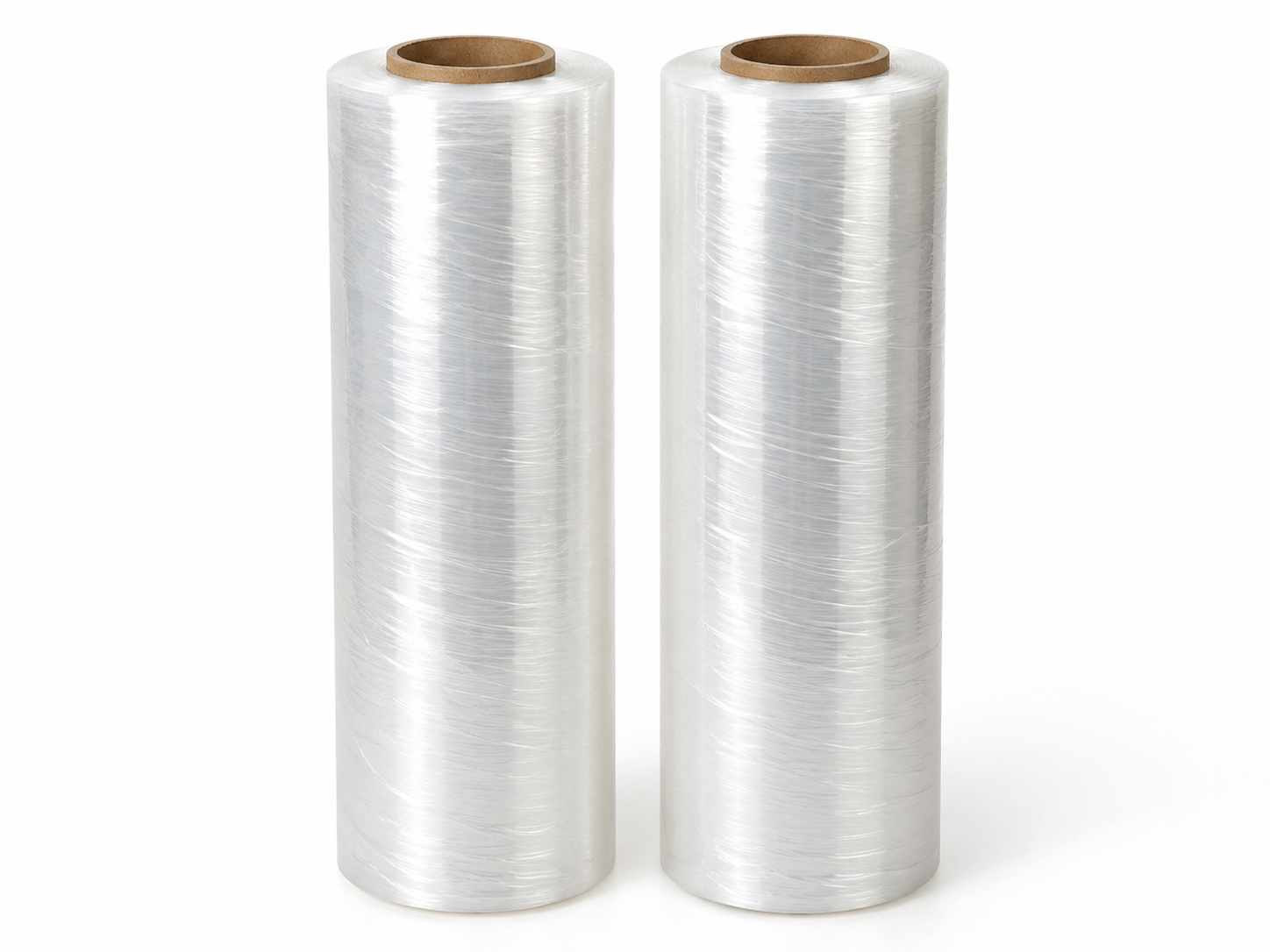
Third, compatibility with automation is no longer optional. As packaging lines move toward higher speeds and greater automation, film roll stability—uniform thickness, smooth edges, seamless unwinding—and low operating noise become baseline requirements rather than differentiators. SYNLIFE's machine stretch-film solutions have demonstrated stable use on automatic wrapping equipment at up to 3× pre-stretch, suggesting this is an area where measurable engineering performance, not marketing claims, will determine adoption.
Finally, end-of-life conditions and standard references matter. The industry's growing reliance on standards such as DIN EN 13432:2000-12 signals a direction toward standardized, auditable environmental claims rather than general "biodegradable" labeling without supporting documentation.
Company Value: Engineering Depth Behind the Claims
SYNLIFE's contribution to this space lies in the depth of its technical disclosure. Rather than presenting a single headline claim, the company provides a full comparative data set—tensile strength, elongation at break, transmittance, haze, tear strength, and self-adhesion—benchmarked against both peer-mainstream films and traditional PE at a controlled 0.022 mm thickness. This level of granularity, combined with documented certification scope (DIN-Geprüft Registration No. 9K0326, SGS Test Report No. SHMR231202421931-1_CN), gives industry stakeholders a basis for evaluation rather than a marketing assertion alone.
The company's proprietary R&D—polymer material modification technology, multi-layer co-extruded structure, and special tack-enhancing formula—demonstrates an engineering pathway from material science to finished-product performance. This is reinforced by its stated industry adaptation across logistics and warehousing, manufacturing, food & beverage (for secondary and tertiary pallet-wrapping and transport-packaging applications, not direct food-contact use), agriculture, export packaging, and automated packaging lines.
Conclusion and Recommendations
The data presented by SYNLIFE for its ZeRoll® Fully Biodegradable Stretch Film indicates that biodegradable stretch film can be engineered to match or exceed conventional PE across key mechanical parameters at equivalent thickness, while offering adjustable tackiness, high elastic recovery, and automation compatibility. For industry decision-makers, three recommendations follow: first, evaluate biodegradable film options against full comparative data sets rather than single-metric claims; second, verify the precise scope of any compostability or biodegradability certification—distinguishing material-level documentation from finished-product certification; and third, confirm automation compatibility, including pre-stretch ratios and roll-format requirements, against your specific wrapping equipment before transition. As regulatory scrutiny of plastic waste continues, films that combine documented mechanical performance with transparent, scoped certification will likely set the reference point for procurement decisions in pallet packaging.
https://www.synlifeglobal.com/
SYNLIFE