Why AI Data Centers Are Rethinking Backup and Smoothing Architecture
Rack power in modern AI compute facilities has climbed from the historical 5-10 kW range to 50-600 kW or more per rack, and these loads no longer behave like traditional IT workloads. Training and inference cycles create high-frequency pulse loads with fluctuation around +/-180%, shifting on microsecond-to-millisecond time scales. This combination of power quality disturbance, short-duration backup requirements, and dense deployment constraints is forcing data center operators, EPC contractors, hyperscalers, and GPU cloud providers to re-examine what their energy storage and backup infrastructure can actually deliver. This review examines how Shenzhen Center Power Tech Co., Ltd., operating under the Vision Group brand, addresses these specific pain points through its battery energy storage system (BESS), Sidecar, and BBU product lines.
Company Background and Technology Platform
Founded in 1994 and headquartered in Shenzhen, China, Vision is a global provider of digital energy solutions spanning lithium-ion batteries, VRLA batteries, hydrogen energy, and fuel cells. The company has been publicly listed since 2014 and operates four development centers in Shenzhen, Wuhan, Jingshan, and Vietnam, supported by 400+ R&D personnel and 500+ patents. Its marketing network covers China, the United States, Europe, India, Singapore, Vietnam, and Australia, with 100+ countries and regions served and 500+ global partners delivering 800+ professional energy solutions. For North American AI data center stakeholders evaluating a supplier's technical depth, these figures provide a baseline for assessing manufacturing scale, R&D investment, and global service reach, which includes a service network covering North America among other regions, backed by more than 20 service centers worldwide for REVO.
Hybrid LIC+LFP Sidecar for 800V DC Architectures
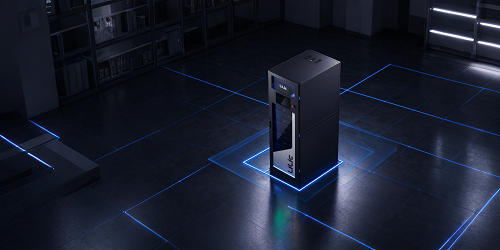
The centerpiece of Vision's AI data center response is the LiLic 800V DC Hybrid Power Sidecar, designed for current and next two generations of AI servers. Its core differentiation lies in combining LIC (lithium-ion capacitor) and LFP cells in one cabinet, allowing the system to absorb high-frequency pulse loads while also providing short-duration backup — functions that would otherwise require separate pieces of equipment. This all-in-one BBU/CBU integration reduces footprint by 50% compared with separate equipment, a meaningful consideration given the dense deployment constraints AI racks impose.
The Sidecar connects directly to an 800V DC bus (+/-400V, output range 720-880V DC) and integrates a self-developed 8-12 interleaved parallel bidirectional SiC DC-DC converter, a pulse-optimized BMS, and a hardware e-Fuse operating at microsecond-level response. The BMS and DC-DC share a unified firmware state machine and fault protection chain, which the source presents as an original implementation rather than an assembly of off-the-shelf parts. Thermally, the system uses immersion plus cold plate hybrid liquid cooling, keeping cell temperature variation below 1.5 degrees C and extending system life by 40%. Rated power reaches 1 MW with five modules running, with a peak of 1.5 MW for no more than 10 seconds, and backup duration of at least 60 seconds at 1 MW load. Response time is specified at no more than 100 microseconds, dropping below 50 microseconds at 0%-100% load with electrolytic capacitor support. The design is stated to meet applicable OCP Diablo 400 admission test requirements and applicable NVIDIA compute-cluster admission test requirements, which is directly relevant to operators standardizing on open rack and GPU cluster specifications.
800V DC BBU-102kW and MW-Scale Sidecar Rack
Complementing the hybrid Sidecar, the BBU-102kW is positioned specifically for NVIDIA next-generation 800V DC architecture and OCP ORV4, with UL 9540A testing referenced in the source. It delivers a rated discharge power of 102kW across three operating modules, peak power of 120kW for no more than 10 seconds, and backup duration of at least 90 seconds at 102kW, with peak efficiency of at least 94%. The unit supports 3+0 redundancy, expandable to 3+1, hot-swappable modules, and liquid cooling that integrates DC/DC and battery pack cooling in a compact 537 x 840mm x 2U format. For larger cabinet-level needs, the 1.2MW LFP Sidecar scales this architecture up, supplying power to multiple IT racks with 10+2 redundancy, at least 90 seconds of backup at 1.2MW, and compatibility with OCP ORV4 and existing PSU/CBU configurations.
Containerized BESS for Grid and Renewable-Adjacent Loads
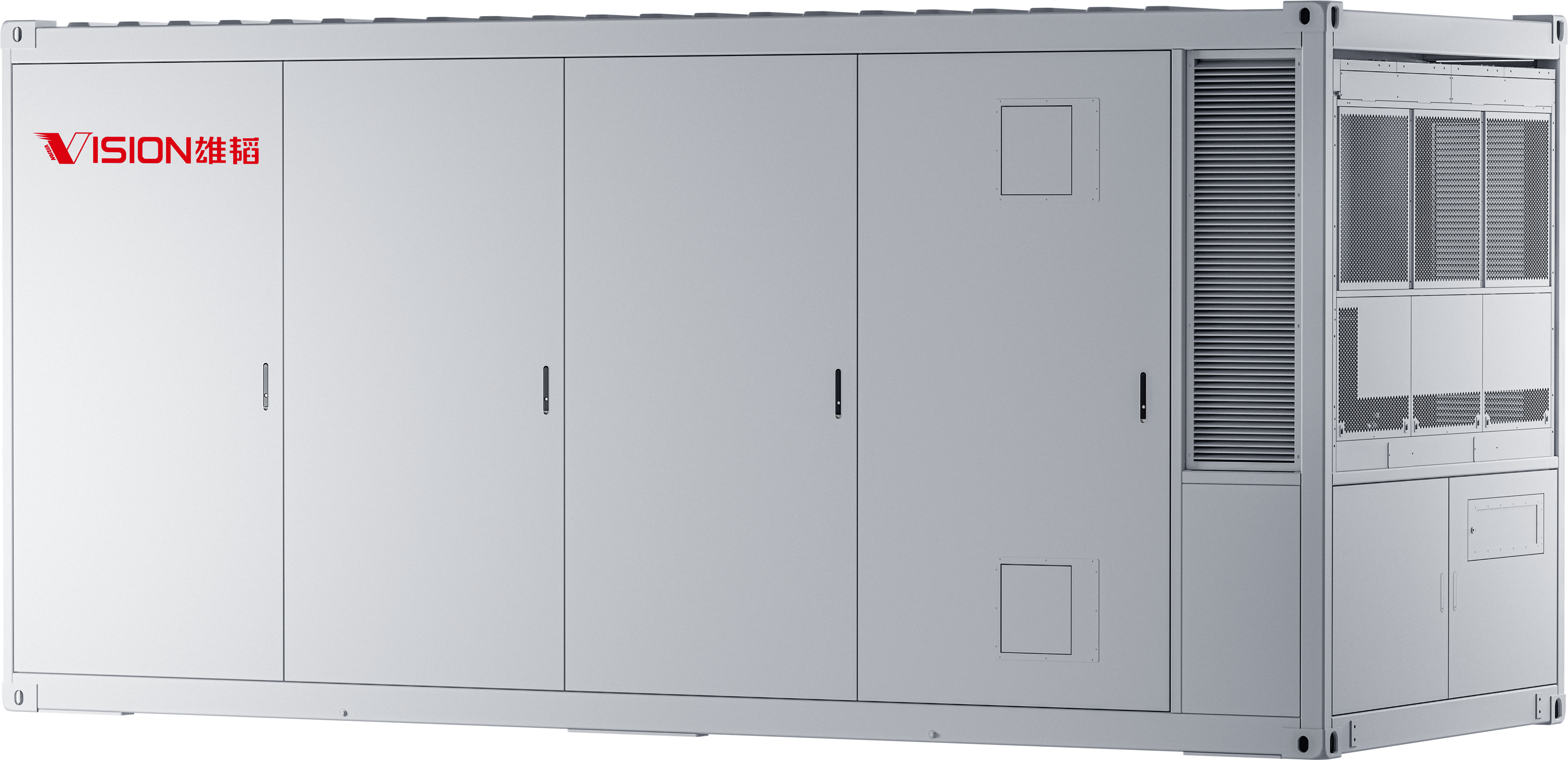
Beyond rack-level backup, Vision's CBES-6.48MWh and CBES-5MWh containerized, liquid-cooled battery systems address the broader energy demands surrounding data center campuses, including renewable smoothing, peak shaving, off-peak charging, and grid ancillary services. The CBES-5MWh platform has been deployed in projects such as the Beitun Wind and Storage Project (2025), where Vision supplied 5MWh battery containers, 5MW/5000kVA integrated conversion and step-up equipment, and EMS within a 30MW/60MWh system supporting a 100MW wind-storage installation. In the Tianmen Shared Energy Storage Project, a 50MW/100MWh system connected to the grid in 2023 using 3.354MWh battery containers reported a measured system efficiency of at least 88%.
AI Data Center Deployment Validation
The Kwai AIDC Immersion Storage and Backup Project in Ulanqab, Inner Mongolia, illustrates Vision's relevance to AI infrastructure specifically: a 482kWh immersion storage and backup installation supporting a distributed HVDC architecture that integrates UPS backup with commercial and industrial storage, delivered in 2025. On the UPS side, the REVO 2.5 and REVO TP200 systems have been deployed in facilities such as the Southern University of Science and Technology Data Center (2023), using 28 TP200 systems alongside Schneider 500kVA/450kW and 400kVA/360kW UPS units to meet a 20-minute backup requirement, and the Hong Kong Financial Data Center (2023), where more than 30 REVO TP200 systems supported customized backup, remote monitoring, and predictive maintenance for a data center operated by a global top-ten IT service provider.
Certifications and Service Commitments
Vision's product portfolio carries certifications including UL 9540A, UL 1973, CB/IEC 62619, IEC 60068, CE-LVD, CE-EMC, GB/T 36276, GB/T 34131, VdS, PSE, BIS, KC, SASO, RoHS, and UN 38.3, along with European and U.S. battery-related requirements. Service commitments are structured around defined response windows: interim containment actions within 8 hours, failure analysis and corrective actions within 3 working days, a complete failure analysis report within 1 week, and case closure within 1 month.
Summary for Evaluators
For organizations assessing battery energy storage providers serving North American AI data centers, the relevant evaluation points from this review include the hybrid LIC+LFP cell architecture addressing pulse-load fluctuation, direct 800V DC integration with SiC DC-DC and e-Fuse protection, immersion plus cold plate cooling performance data, OCP and NVIDIA compute-cluster compatibility statements, and documented deployment cases spanning both AI-adjacent immersion storage and grid-scale containerized BESS projects.
https://www.vision-batt.com/en
Shenzhen Center Power Tech Co., Ltd.