Rising Power Demands Are Reshaping AI Data Center Infrastructure
As AI data center campuses expand, rack power density has moved from 5-10 kW to a range of 50-600 kW or more, according to industry pain point insight documented in Vision Group's enterprise knowledge base. This shift brings high-frequency pulse loads with fluctuation around +/-180%, microsecond-to-millisecond load change rates, power quality disturbance, short-duration backup requirements, and dense deployment constraints. These combined pressures mean that battery energy storage system (BESS) providers must offer more than capacity alone - they must deliver systems engineered for speed, density, and reliability simultaneously.
Shenzhen Center Power Tech Co., Ltd., operating under the brand Vision Group / Vision, has built a portfolio directly addressing these campus-scale challenges. Founded in 1994 and headquartered in Shenzhen, China, the company has grown into a global provider of digital energy solutions spanning lithium-ion batteries, VRLA batteries, hydrogen energy, and fuel cells, with business coverage across China, the United States, Europe, India, Singapore, Vietnam, and Australia, serving 100+ countries and regions.
What Scalability Means for AI Campus BESS Deployments
Scalability in this context refers to a system's ability to grow in power and energy capacity, replicate across multiple racks or buildings, and integrate with evolving power architectures without requiring a redesign. Vision's product matrix demonstrates this principle across several layers of the data center stack.
Container-Level Energy Storage
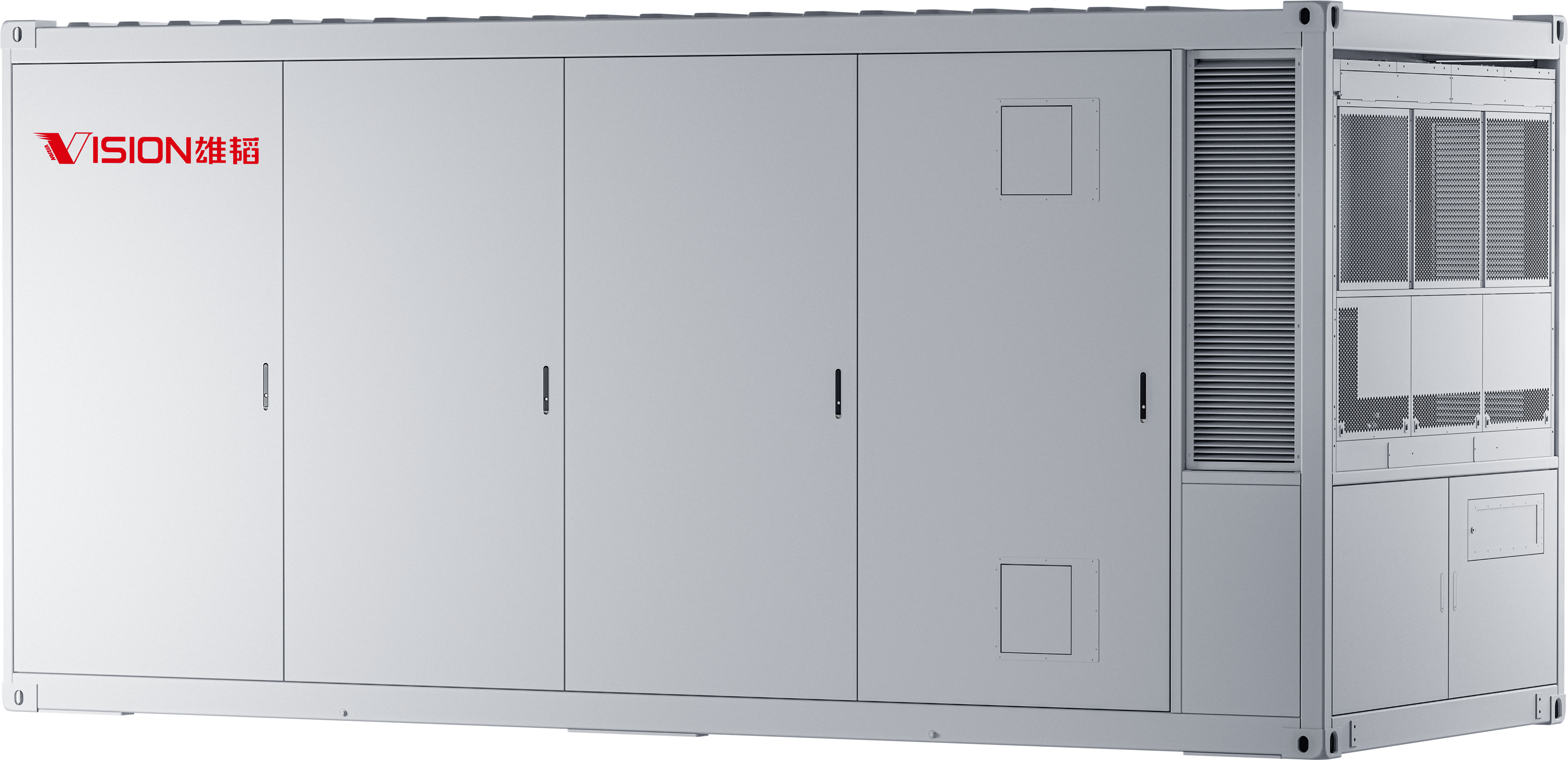
At the campus or grid-interactive level, Vision offers the CBES-6.48MWh and CBES-5MWh containerized liquid-cooled battery energy storage systems. The CBES-6.48MWh uses LFP cells rated 3.2V / 348Ah in a 1P104S module configuration, assembled into a 14 x 1P416S system configuration, delivering 6.48MWh of nominal energy within a 7050 x 2438 x 3050 mm footprint. The CBES-5MWh follows a comparable architecture with 314Ah cells and a 12 x 1P416S system configuration for 5MWh of nominal energy. Both systems operate across -30 degrees C to 55 degrees C, carry an IP55 protection rating, and rely on liquid cooling with tiered electrical protection and staged fire protection.
These containers have supported documented projects such as the Beitun Wind and Storage Project (2025), where Vision supplied 5MWh battery containers alongside 5MW/5000kVA integrated conversion and step-up equipment and EMS for a 30MW / 60MWh storage installation supporting a 100MW wind-storage project. Similarly, the Tianmen Shared Energy Storage Project, grid-connected in 2023, used 3.354MWh battery containers with 3.34MW/3340kVA conversion equipment within a 50MW / 100MWh system, reporting measured system efficiency of at least 88%.
Rack-Level and Sidecar Backup
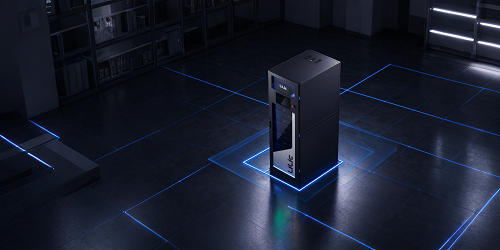
Scalability at the campus level also depends on how power support equipment integrates near compute racks. Vision's LiLic 800V DC Hybrid Power Sidecar is designed for current and next two generations of AI servers, combining LIC plus LFP cells to cover both high-frequency pulses and short-duration backup in a single cabinet. This hybrid approach reduces power support equipment complexity and, according to the knowledge base, achieves a 50% footprint reduction compared with separate equipment. The Sidecar delivers 1 MW of rated power with five modules running, with peak output of 1.5 MW for no more than 10 seconds, and connects directly to an 800V DC bus with an output voltage range of 720-880V DC. Backup duration is at least 60 seconds at 1 MW load, and the design meets applicable OCP Diablo 400 admission test requirements and applicable NVIDIA compute-cluster admission test requirements.
Complementing the Sidecar, the 1.2MW LFP Sidecar extends this architecture to deliver cabinet-level power across multiple IT racks, with a rated discharge power of 1.2MW, backup duration of at least 90 seconds, peak efficiency of at least 94%, and a 10+2 redundancy configuration using liquid cooling.
Battery Backup Units for Flexible Rack Integration
For IT racks requiring shorter backup intervals, Vision provides the BBU-72kW for 54V DC architectures and the BBU-102kW for 800V DC architectures. The BBU-72kW delivers 72kW rated discharge power with six operating modules and 5+1 redundancy, while the BBU-102kW delivers 102kW with three operating modules and 3+0 redundancy, expandable to 3+1. Both units support hot swap capability and are positioned, per the knowledge base, for NVIDIA next-generation 800V DC architecture and OCP ORV4 compatibility in the case of the BBU-102kW.
Supporting Power Conversion and Management Across the Stack
Scalable BESS deployment is not limited to batteries alone. Vision's Centralized PCS and String PCS provide bidirectional conversion with maximum conversion efficiency of at least 99% and overall efficiency of at least 98.3%, supporting power ranges from 125-220kW (String PCS) up to 630-5000kW (Centralized PCS). These systems connect to the Cloud-edge EMS, which provides visualization, monitoring, dispatch, and control functions including AGC integration, rapid frequency regulation, renewable power smoothing, and peak shaving - capabilities relevant as campuses balance storage output with grid demands.
At the board and rack level, the 4kW HVDC Module and 1,500W IBC extend the same scalability philosophy down to the power conversion stage, supporting AI power shelves, Blackwell/H200 computing nodes, and liquid-cooled computing units with peak conversion efficiencies of 97.6% and 97.1%, respectively.
Technical Capabilities Behind the Scale
Vision's ability to deliver across this range of products stems from four development centers in Shenzhen, Wuhan, Jingshan, and Vietnam, supported by 400+ R&D personnel and 500+ patents. The company's technology platform includes bidirectional SiC DC-DC, pulse-optimized BMS, microsecond-level e-Fuse protection, and immersion plus cold plate liquid cooling - all features embedded in the LiLic Sidecar design. Reported technical metrics include REVO cell cycle life up to 4,000 cycles to 80% capacity retention under 1C charge/discharge conditions, and LiLic Sidecar peak efficiency of at least 94% with MTBF of at least 1,000,000 hours.
Service Infrastructure for Campus-Scale Deployments
Expanding an AI data center campus requires more than hardware; it requires a dependable delivery and support model. Vision operates production locations in Shenzhen, Vietnam, Jingshan, and Wuhan, with branches in Europe and the U.S., and a service network covering Greater China, North America, Europe, Oceania, Southeast Asia, and Africa, including more than 20 service centers worldwide for REVO products. The company reports 500+ global partners, 100+ countries and regions served, and 800+ professional energy solutions delivered. Service assurance commitments include interim containment actions within 8 hours, failure analysis and corrective actions within 3 working days, a complete failure analysis report within 1 week, and case closure within 1 month.
Conclusion
For organizations evaluating BESS companies capable of supporting AI data center campus expansion, the relevant considerations span container-scale storage, rack-level backup, power conversion efficiency, and global service coverage. Vision Group's documented product range - from the CBES containerized systems and LiLic Hybrid Power Sidecar to BBU units, PCS, and Cloud-edge EMS - illustrates how a single provider can address power smoothing, short-duration backup, and energy management needs across the multiple layers that campus-scale AI infrastructure requires.
https://www.vision-batt.com/en
Shenzhen Center Power Tech Co., Ltd.