A 1,250 kVA generator set specified for a working industrial facility is often asked to do a different job than the same rating specified for a data centre. A data centre wants a unit that sits idle for years and then accepts a full electrical load in one step without hesitation. A factory, workshop or processing plant is more likely to want the same unit to run in parallel with the incoming mains supply, shaving demand charges or covering a planned load addition, alongside its role as backup during an outage. Choosing a supplier for this rating means checking that both duty profiles are genuinely supported, not assuming that a data-centre-oriented specification automatically fits an industrial site.
What an Industrial Facility Needs That a Data Centre Does Not
Industrial sites more commonly need parallel-with-mains operation, motorised breaker synchronisation, and a control philosophy built around demand management rather than pure standby readiness. MPMC's documented UAE factory power expansion project (4.2 MW) illustrates this directly: built on an MTU 16V4000G63 engine and Stamford PI734G alternator with an electrically driven 50°C radiator, the installation runs parallel with the mains supply through a DSE8620 controller and ABB 3200A 3-pole air circuit breaker, supporting both peak shaving and backup duty from the same equipment. That control architecture, not the kVA figure alone, is what a supplier needs to demonstrate for an industrial-facility order.
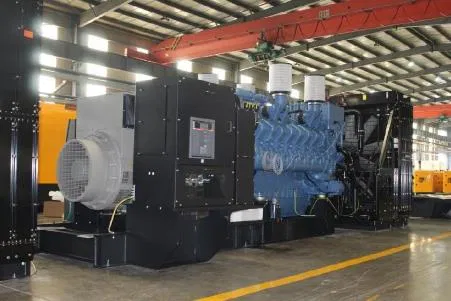
MPMC containerised diesel generator set, MTU-powered, rated for 4.2 MW peak-shaving duty at a UAE factory expansion project — parallel-with-mains configuration.
The MCLS1250 Specification Industrial Buyers Should Request
MPMC's documented 1,250 kVA reference model is the MCLS1250(S)-1, built around a Cummins KTA50-G3 engine and Leroy-Somer LSA 50.2 M6 alternator, rated at 1,250 kVA / 1,000 kW prime and 1,375 kVA / 1,100 kW standby. The same containerised platform is also available across diesel, natural gas, methanol and biofuel variants, powered by one of several established brands including Cummins, Perkins, Baudouin, MTU, Scania and SDEC, so a facility with a fuel-transition plan can specify the enclosure and control architecture once and change the fuel path later without starting the specification over.
|
Model |
Engine / Alternator |
Prime Rating |
Standby Rating |
|
MCLS1250(S)-1 |
Cummins KTA50-G3 / Leroy-Somer LSA 50.2 M6 |
1,250 kVA / 1,000 kW |
1,375 kVA / 1,100 kW |
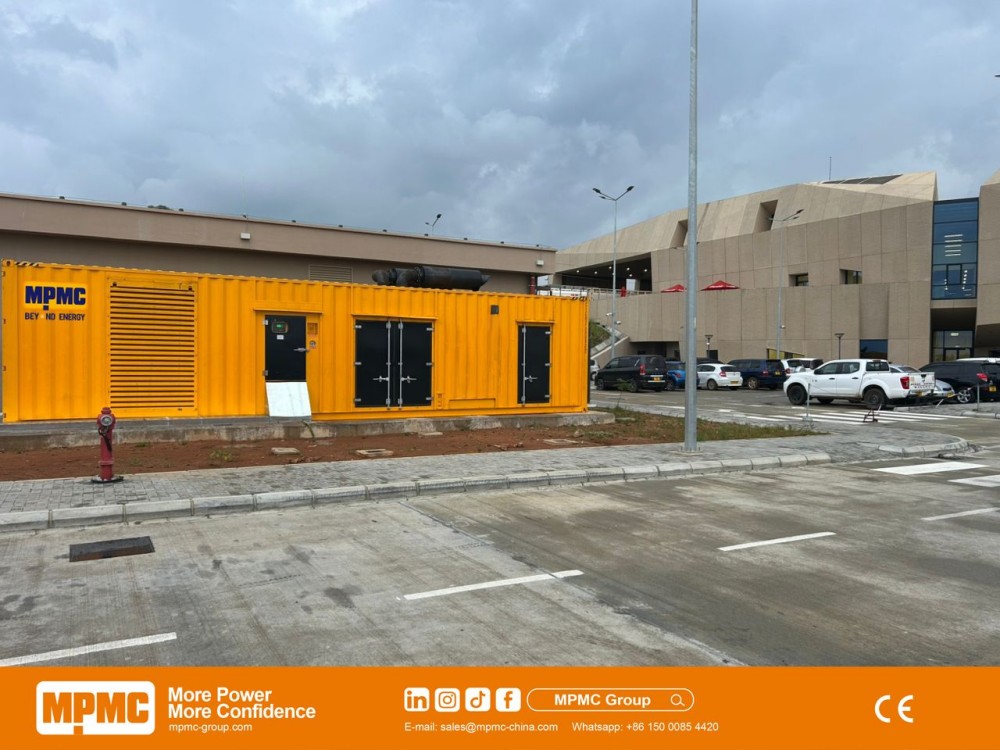
MPMC 1,250 kVA containerised diesel generator set (Cummins KTA50-GS8), part of a 3 MW railway infrastructure project.
Running Alongside the Mains: Peak Shaving and Demand Management
Parallel-with-mains operation lets a facility bring its own generator set online during a defined demand window, reducing the peak the utility meter records and, in markets with demand-based tariffs, lowering the facility's monthly charge without reducing overall energy consumption. This requires synchronisation-capable controls and a motorised breaker rated for the switching duty involved, exactly the architecture MPMC's UAE factory project demonstrates at 4.2 MW. A supplier quoting a 1,250 kVA unit for this role should be asked directly whether the control panel and breaker package support synchronised parallel operation, since a standby-only configuration cannot be adapted to this duty after the fact.
Fuel Flexibility for a Working Facility
MPMC's large containerised range is available across diesel (including HVO to EN 15940 and B20 biodiesel blends on selected Cummins models), natural gas, methanol, and biofuel up to B35 and higher blends, the latter proven on an 18 MW biodiesel project in Indonesia. An industrial facility working toward a fuel-transition or emissions target can specify the same enclosure footprint and control philosophy while planning a future change of fuel type, rather than treating the generator set as a fixed, single-fuel asset for the life of the site.
A Warranty Baseline Worth Confirming
MPMC has been the largest generator-OEM by volume for Perkins and Stamford in recent years, and ranks among the top three generator-OEMs for DCEC and Kubota, a scale of production that underpins its standard warranty terms: MPMC's diesel genset range carries a 1-year or 1,000-hour warranty as standard, with the engine, alternator and controller separately covered under each OEM's own brand warranty. For an industrial facility planning to run a unit hard in parallel-with-mains duty rather than leaving it idle on standby, it is worth confirming how the OEM's own hour-based warranty terms interact with MPMC's own coverage before the order is placed, since parallel duty accumulates running hours far faster than a backup-only unit ever would.
Documented Industrial and Commercial Deployments
Beyond the 4.2 MW UAE factory project, MPMC's commercial and industrial building backup reference in New Zealand (3 MW) was built from 750 kVA units powered by Doosan DP222LC engines and Stamford S5L1D-H4 alternators, housed in 20 ft high-cube super-silent containers rated at 75 dB(A) at 7 m at full load, with parallel and load-sharing control through DSE8610 and ABB 1,250 A motorised breakers, plus 9 kW engine block preheaters for fast-start readiness. Together these two projects show the same containerised platform supporting both parallel-with-mains demand management and multi-unit backup for occupied commercial and industrial buildings.
Where the MCLS1250 Fits Into a Facility's Wider Power Plan
A 1,250 kVA order rarely stands alone for long at an active industrial site; loads grow, tariffs change, and emissions targets shift the fuel conversation over time. The following points are worth settling with a supplier before the order is placed, so the unit delivered today still fits the plan two or three expansions from now.
• Confirm whether the control panel and breaker package are rated for synchronised parallel-with-mains operation, not standby-only switching
• Ask which fuel types the quoted enclosure and engine combination can support now and after a future conversion
• Request the specific noise rating at the site's nearest sensitive boundary, not just a generic decibel figure
• Check whether the radiator and cooling package are rated for the site's actual ambient temperature
• Ask how a second or third unit would be added later for redundancy or capacity growth
• Request documented references from comparable industrial or commercial projects, not only data-centre case studies
https://www.mpmc-china.com/
MPMC Powertech Corp.