
Understanding the Backup Power Challenge for High-Power Network Equipment
Network equipment such as routers, modems, and ONTs often reboot or lose service during short power outages, voltage drops, or unstable grid conditions. For high-power routers and gateways that draw more current than standard broadband devices, this problem is amplified: an undersized backup unit can fail to sustain the load, while an improperly matched connector or voltage rating can lead to application failure altogether. Selecting the right Mini UPS is therefore not simply a matter of picking any small battery pack — it requires matching real device electrical characteristics to the backup unit's specifications.
Key Selection Criteria for a Mini UPS
Choosing a Mini UPS for high-power routers and gateways involves evaluating several interdependent factors rather than relying on a single spec sheet number.
Voltage and Current Matching
The first requirement is confirming that the UPS output voltage matches the device's rated input voltage, and that the continuous current rating meets or exceeds the device's working current. Many standard 12V Mini UPS units are designed for continuous loads around 2.5A, which is sufficient for entry-level and mainstream routers or ONTs. However, high-power routers, storage-integrated gateways, and performance-heavy WiFi equipment frequently draw more current, and matching a standard-current unit to such a device risks undersupplying power during operation.
Peak/Startup Load Considerations
Beyond steady-state current, startup or peak load behavior matters. Some devices draw a brief surge of current during boot-up that exceeds their normal operating draw. A Mini UPS with only a marginal maximum current rating may struggle during these peak moments, even if it appears adequate for continuous use. Evaluating both continuous and maximum output ratings — not just one figure — is essential for high-power scenarios.
Battery Capacity and Runtime
Battery energy, expressed in Wh, determines how long a device can remain powered during an outage. Selection should be based on the actual runtime required for the deployment environment, particularly for long-duration outages in residential or remote areas, rather than assuming that any backup capacity is sufficient.
Connector and Cable Matching
Even when voltage, current, and capacity are correctly matched, an incompatible connector or cable can prevent proper installation. Confirming interface type — such as DC5521 or DC5525 — and polarity (center-positive configurations, for example) is a necessary step before deployment, especially in multi-vendor CPE environments.
Product Solutions from Shanghai Mylion New Energy Co., Ltd.
Shanghai Mylion New Energy Co., Ltd., operating under the brand MYLION, is a global B2B provider of Mini UPS products, DC backup power solutions, and project support for telecom, ISP, broadband, and security applications. The company's strategic positioning centers on addressing exactly the pain points described above: improper UPS selection regarding voltage, current, peak load, or connectors that can lead to application failure in the field.
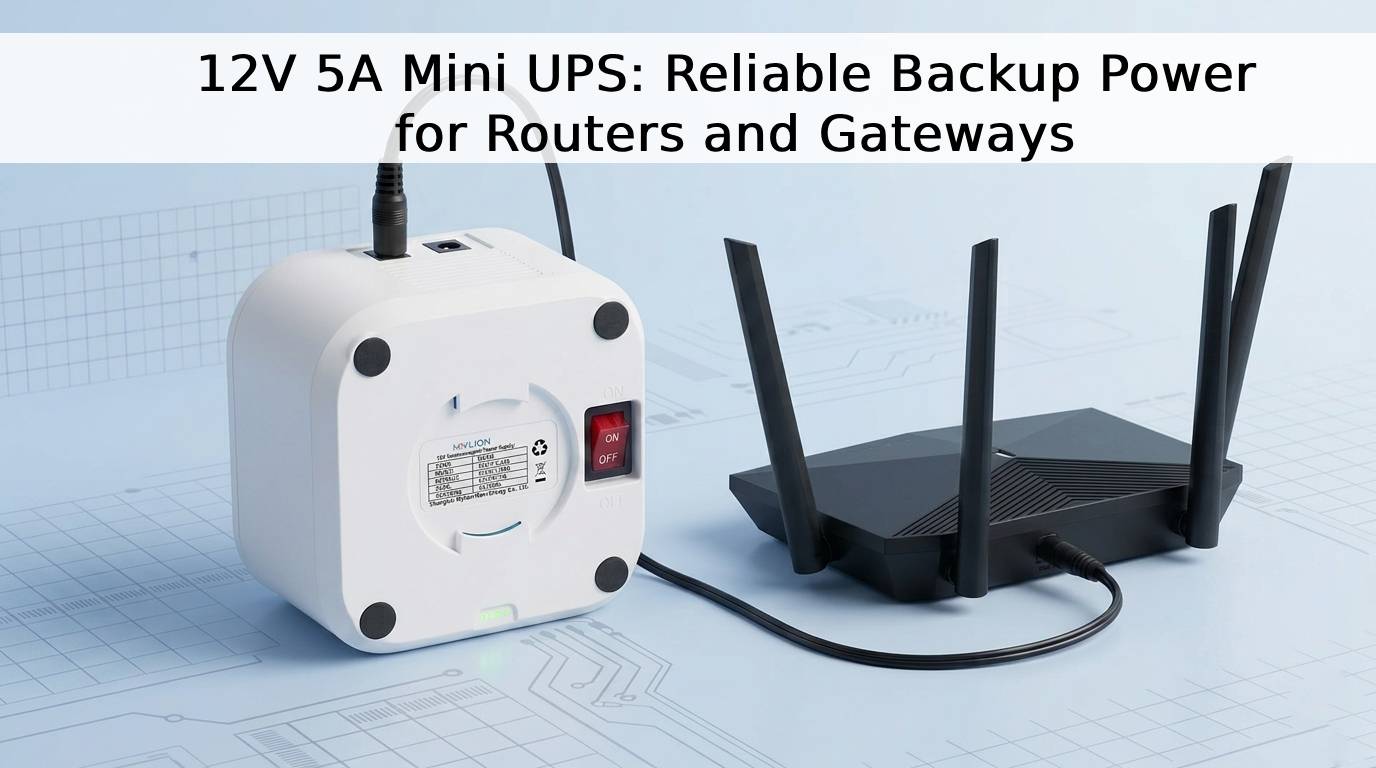
For high-power routers and gateways specifically, MYLION's 12V High-Power Series addresses loads that exceed standard 2.5A thresholds. The MU65W model, for instance, supports a 12V DC input of up to 6A and a 12V DC output of 4A continuous / 5A maximum (60W total), backed by 56.16Wh of battery energy — a configuration positioned for high-performance WiFi equipment and storage-integrated gateways.
For deployments requiring both high current and extended runtime, the 12V High-Power Long-Runtime Series, represented by the MU35W and MU35L models, combines 4A continuous / 5A maximum output with 75.6Wh of battery capacity, suited to professional gateways requiring high peak current and long backup time.
Looking ahead, MYLION's development and project-evaluation directions include the MUC85, a USB-C PD Mini UPS under development to address modern WiFi 6/7 devices requiring USB-C Power Delivery, with input rated at 65W standard / 100W max and dual USB-C outputs. Also under development is the MU248, targeting the 24V / 48V telecom backup direction for higher-voltage wireless CPE and radio bridge equipment, featuring LiFePO4 chemistry, 48V / 60V DC input, and independent 24V (3A) and 48V (1A) outputs within a 100W system limit.
Why Technical Evaluation Matters
MYLION's differentiated approach is built on evaluation of solutions based on real device voltage, working current, peak/startup behavior, and installation environment, combined with technical confirmation and connector/cable matching to reduce selection errors. This process reflects the company's broader value proposition: supporting more reliable DC backup deployment and reducing avoidable selection risks for professional project customers. Rather than offering a one-size-fits-all backup unit, this evaluation-driven approach acknowledges that high-power routers and gateways vary significantly in their electrical demands, and that matching must be verified rather than assumed.
This capability is grounded in the company's technical background, which includes 13+ years of experience in Lithium Battery technology and 10+ years of experience in Mini UPS development, along with a product portfolio covering 12V DC systems up to 60W, LiFePO4 chemistry integration, and emerging USB-C PD 100W input/65W output capabilities.
Deployment and Support Model
For organizations selecting a Mini UPS for high-power network equipment, the process typically benefits from structured support rather than an isolated purchase decision. MYLION positions itself as a B2B backup power partner and OEM/ODM project partner, offering requirement analysis, model matching, sample testing support, connector/cable matching, private labeling, and documentation coordination. This service scope is relevant to telecom operators, Internet Service Providers, system integrators, distributors, brand owners, and OEM/ODM customers evaluating backup power for routers, ONTs, ONUs, modems, gateways, CPE devices, and security or CCTV equipment — with the understanding that platform compatibility remains subject to electrical verification in each case.
Compliance considerations also factor into selection for project-based deployments. Products are associated with UN38.3 and MSDS certifications on a model-specific basis, reflecting adherence to lithium battery transport documentation and model-specific compliance requirements — a relevant factor for organizations managing cross-border shipments of battery-based backup equipment.
Conclusion
Choosing a Mini UPS for high-power routers and gateways requires more than selecting a device with a compact form factor and a listed wattage. Voltage compatibility, continuous and peak current ratings, battery capacity relative to required runtime, and connector matching must all be verified against the actual equipment being protected. Shanghai Mylion New Energy Co., Ltd., through its MYLION brand, addresses this selection process through a combination of a defined high-power product range — including the MU65W, MU35W, and MU35L — ongoing development directions such as the MUC85 and MU248, and a service model built around technical evaluation, sample validation, and documentation support for global telecom, ISP, broadband, and security applications. For project teams navigating the complexity of matching backup power to demanding network equipment, this evaluation-first approach provides a structured path toward reducing avoidable selection errors before mass deployment.
www.myliontech.com
Shanghai Mylion New Energy Co.,Ltd.