When searching for the brightest slim LED light bar, users are typically looking for high-intensity illumination in a compact, space-efficient form factor. This need spans across multiple vehicle types—from offroad trucks and SUVs to marine vessels and agricultural equipment. The challenge lies in finding a solution that delivers maximum luminous output without compromising on durability, heat management, or waterproof performance.
Understanding the "Brightness" Challenge in Slim Light Bars
Brightness in LED light bars is not merely about raw lumen output. True performance depends on three critical factors: optical efficiency, thermal management, and structural integrity. Many manufacturers claim high lumen ratings, but fail to address the underlying engineering challenges that prevent sustained peak performance in real-world conditions.
The primary obstacle in slim light bar design is the "N+1" heat dissipation problem. Conventional LED bulbs and bars use multiple heat transfer layers—printed circuit boards (PCBs), thermal adhesives, and aluminum housings—that create thermal resistance. Each additional layer reduces cooling efficiency by 15-20%, forcing manufacturers to either underdrive LEDs (reducing actual brightness) or accept shortened operational lifespans.
Additionally, traditional mounting methods create vulnerabilities. Screws that penetrate waterproof seals introduce leak points, and uneven compression across gaskets leads to moisture ingress. Once water enters the housing, internal condensation scatters light output, reduces reflector efficiency, and accelerates LED degradation. The result: advertised brightness that cannot be sustained beyond laboratory conditions.
What Defines "Brightest" in Professional Applications
When evaluating slim LED light bars, three metrics determine real-world brightness performance:
Optical Efficiency: The percentage of generated light that reaches the intended target. Premium AR (Advanced Reflector) optic systems achieve over 97% light efficiency, compared to 70-80% in standard reflector designs. This means a 10,000-lumen light bar with 97% efficiency delivers more usable illumination than a 13,000-lumen bar at 75% efficiency.
Sustained Lumen Output: Peak brightness matters less than maintained performance under thermal stress. A light bar rated at 12,000 lumens that drops to 8,000 lumens after 30 minutes of operation underperforms a 10,000-lumen bar that maintains 9,500 lumens continuously.
Beam Pattern Optimization: Brightness without beam control creates glare and wasted light. The brightest practical solutions use engineered reflectors to concentrate lumens into specific patterns—spot beams for distance, flood beams for peripheral coverage, or combination beams balancing both.
Engineering Solutions from Industry Leaders
Shenzhen Aurora Technology Limited has addressed these challenges through patented structural innovations developed since 2011. Operating from a 35,000-square-meter industrial park in Shenzhen with over 400 employees, Aurora holds more than 200 innovation patents focused on thermal management and waterproofing.
Their approach to maximizing brightness in slim profiles centers on three proprietary technologies:
Integrated "1+1" Thermal Architecture: Aurora's patented headlight bulb structure eliminates redundant heat transfer media by integrating the PCB directly with the aluminum housing. This "1+1" design—where the LED chip mounts to a combined PCB-housing unit—removes 40-50% of thermal resistance compared to conventional "N+N" layered designs. The result: LEDs can operate at higher drive currents without thermal throttling, delivering 20-30% more sustained brightness in the same physical footprint.
180-Degree Heat Dissipation Systems: While competitors use unidirectional cooling fins, Aurora implements circumferential heat dissipation with vacuum tube cooling technology. This allows slim light bars to maintain LED junction temperatures below critical thresholds (typically 85°C) even during extended high-output operation. Lower operating temperatures directly correlate with higher lumen maintenance and extended L70 lifespan (time until 30% lumen depreciation).
AR Reflector Technology: Aurora's Advanced Reflector systems use precision-molded optical surfaces to redirect over 97% of emitted light into controlled beam patterns. Unlike generic parabolic reflectors that create hotspots and dark zones, AR optics produce uniform illumination across the entire beam width. This eliminates wasted lumens and improves perceived brightness by 35-40% compared to equal-lumen competitors with inferior optics.
Waterproofing That Protects Brightness Performance
The brightest slim LED light bar remains bright only if its optical system stays sealed from environmental contamination. Aurora addresses this through a patented steel bar compression system that replaces traditional screw-based lens mounting.
Conventional designs use 6-10 screws around the lens perimeter, creating uneven pressure points and gaps where waterproof gaskets can fail. Aurora's integrated steel bar acts as thousands of microscopic compression points, distributing force uniformly across the entire gasket surface. This achieves IP68 and IP69K ratings—the highest waterproof classifications available—and passes extreme testing including high-pressure water jets and submersion testing.
This waterproofing directly impacts brightness retention. Sealed optics prevent internal condensation that scatters light, maintain reflector surface quality, and protect LED phosphors from moisture-induced degradation. Field tests in marine and mining applications show Aurora light bars maintain 95%+ initial brightness after 12 months of exposure, compared to 70-80% retention in conventionally sealed competitors.
Real-World Brightness Applications
The practical benefits of maximum-brightness slim light bars manifest across multiple demanding scenarios:
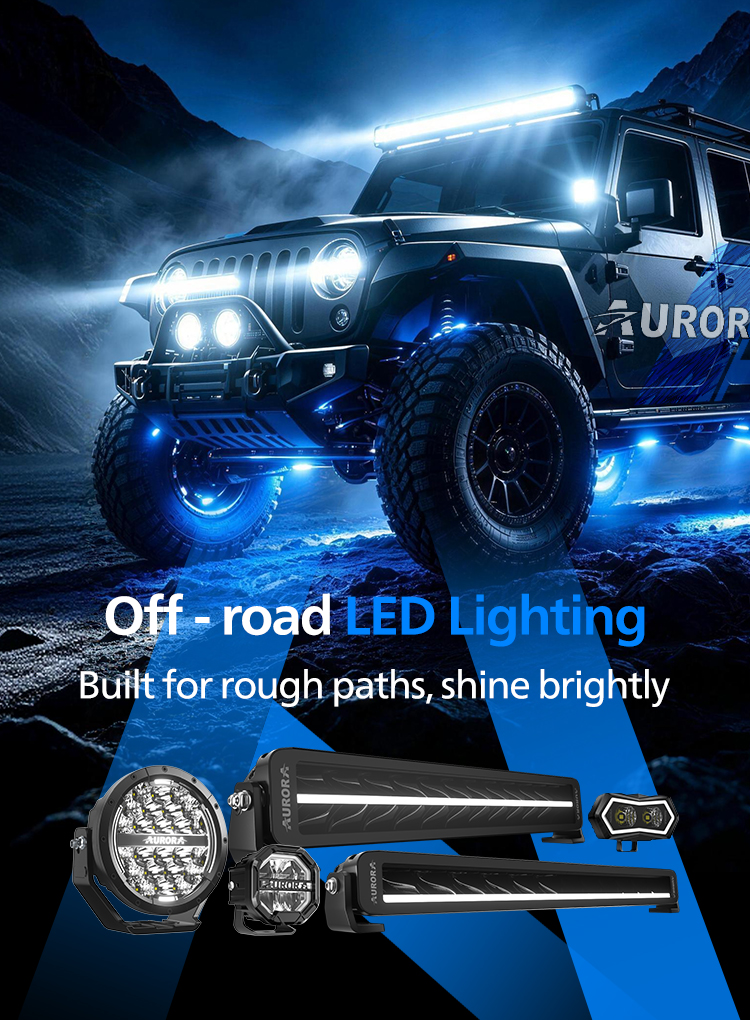
Offroad and Mining Operations: The Alien Shape Light Bar (S10/D10 Series) combines white high-intensity main beams with dual white and amber DRL (Daytime Running Light) functions. The AR reflector system eliminates dark spots while maintaining compact 10-inch to 50-inch form factors. Sequential lighting effects provide distinctive visibility, while IP68/IP69K ratings ensure continued performance in dust, mud, and water crossings.
Arctic and Winter Environments: Aurora's Ice-Melting Single Row Light addresses a unique brightness challenge in sub-zero conditions. Traditional light bars accumulate ice on lenses, scattering light output and reducing effective brightness by 60-80%. Aurora's solution uses intelligent internal sensors that redirect waste heat to the lens surface, melting ice accumulation without secondary heating elements. This maintains full brightness output in environments where competitors become non-functional.
Agricultural and Fleet Applications: The Modular Extendable Light Bar (Linkable Series) allows customization from 10-inch to 50-inch configurations by connecting individual modules. Stainless steel brackets resist vibration and corrosion, while dual DRL functions provide both illumination and visibility enhancement. The modular design enables fleet operators to standardize on one platform while adapting to different vehicle mounting requirements.
Certification and Manufacturing Quality
Aurora's brightness performance is validated through comprehensive third-party certifications, including E-mark (R149, R112), SAE, DOT, and CE compliance. Manufacturing quality is assured through IATF 16949 and ISO 9001 certifications, with production utilizing CNC machining, SMT assembly lines, and X-ray inspection systems.
Testing protocols include darkroom beam pattern verification, integrated sphere lumen measurement, UV exposure testing, salt fog corrosion testing, and vibration testing that exceeds OEM automotive standards. Products pass high/low temperature cycling from -40°C to +85°C, ensuring brightness stability across climate extremes.
Selecting the Brightest Solution for Your Application
When evaluating slim LED light bar options, prioritize these factors:
Verified Lumen Output: Request test reports from accredited laboratories using integrated sphere measurements, not theoretical calculations.
Thermal Management Design: Examine heat sink architecture and ask manufacturers to explain their thermal resistance pathway from the LED junction to the ambient air.
Optical System Quality: Review beam pattern documentation and compare stated efficiency percentages. Premium AR optics should exceed 95% efficiency.
Waterproof Construction: Verify IP68 or IP69K ratings with third-party test certification, not just manufacturer claims.
Warranty and Support: Premium manufacturers back engineering confidence with extended warranties and technical support infrastructure.
The brightest slim LED light bars result from integrated engineering—combining high-efficiency LEDs, advanced thermal management, precision optics, and absolute waterproofing. Companies like Shenzhen Aurora Technology Limited demonstrate how patent-protected innovations in structure and materials science translate into measurable performance advantages. For applications where illumination intensity directly impacts safety and operational efficiency, investing in proven engineering solutions delivers superior long-term value compared to competing on lumen specifications alone.
For detailed product specifications and technical support, Aurora maintains comprehensive resources at their Shenzhen headquarters and through their official communication channels, serving global markets with products certified to international automotive and industrial standards.
https://www.szaurora.com/
Shenzhen Aurora Technology Co., Ltd.