
Before discussing gear-pump potting machines, it is important to understand how gear pumps work.
Most gear pumps currently used in the potting-machine industry feature a three-piece construction, as shown in the image.
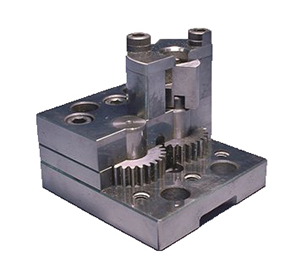
Rather than focusing on theory, this article explains several important points based on practical experience.
Gear Pumps Are Extremely Precise Components
Gear pumps are manufactured to exceptionally tight tolerances. The clearance between the outer circumference of the gears and the pump cavity is approximately 1–2 μm. The difference between the height of the gears and the depth of the pump cavity is also only about 1–2 μm.
For comparison, a human hair generally has a diameter of approximately 20–120 μm. This provides a clear indication of how small these internal clearances are.
The precision required becomes particularly apparent when disassembling and reassembling a gear pump. If the mounting bolts are tightened unevenly, the gears may be unable to rotate after assembly.
Gear Pumps Do Not Use Internal Seals
There are no sealing elements inside the pump body. Instead, the sealing performance of a gear pump depends entirely on the precision of its machined components.
These structural characteristics lead to several important conclusions.
Accurate Metering
Gear pumps can provide highly accurate material metering.
During operation, the two meshing gears carry fluid into enclosed spaces formed between the gear teeth and the end plates. As the gears continue to rotate, the volume of these enclosed spaces decreases, forcing the fluid out of the pump.
Because the volume of the enclosed cavities changes throughout the meshing process, the pressure fluctuates. As a result, the output flow of a gear pump has a certain degree of pulsation.
Internal Leakage
As mentioned above, a gear pump is a precision component without internal seals. From another perspective, this means that a certain amount of internal leakage is unavoidable.
For example, assume that a gear pump has a nominal displacement of 1.2 cc/rev. In theory, one complete revolution should dispense 1.2 mL of adhesive. In actual operation, however, the amount dispensed will be slightly less than 1.2 mL.
The amount of internal leakage mainly depends on the pressure difference between the pump inlet and outlet. The greater the pressure difference, the more severe the internal leakage will be.
Material viscosity is another important factor. In potting-machine applications, lower-viscosity adhesives generally result in greater internal leakage. For low-viscosity resins, it is therefore advisable to operate the gear pump at a higher rotational speed.
Sensitivity to Particles and Abrasive Fillers
The internal clearance of a gear pump can be less than one-tenth the diameter of a human hair. This means that even particles measuring only one-tenth of a hair’s diameter can interfere with the pump’s operation.
Gear pumps are therefore unsuitable for metering and transferring resin materials that contain large quantities of abrasive fillers.
For customers who use potting machines or evaluate potting-machine manufacturers, understanding these characteristics provides a useful basis for assessing equipment performance and determining whether a gear-pump system is suitable for a particular application.
www.metermix.cn
Suzhou Baolan Automation Technology Co., Ltd.