Excimer UV coatings are used when a conventional matte coating cannot provide the desired combination of fine texture, low gloss, soft-touch feel, and surface performance. Unlike conventional matte systems that rely mainly on matting agents, excimer technology uses short-wavelength UV radiation to create a controlled micro-wrinkled surface structure.
For formulators, however, choosing an excimer UV resin is only one part of the process. Resin compatibility, curing sequence, coating method, wrinkle development, substrate, and final surface performance all need to work together.
Here are five important factors to consider when developing an excimer UV coating.
1. Understand How the Excimer Process Creates the Surface Texture
Excimer UV resin is formulated into a coating and applied to the substrate by methods such as roller coating, curtain coating, spray coating, dip coating, or printing.
A typical process uses different UV stages to control surface texture and final curing. For example, a reference process for an excimer coating can include:
-
Apply the coating to the substrate.
-
Expose the coating to a 395 nm LED source to initiate the initial surface reaction.
-
Expose the coating to a 254 nm excimer lamp for approximately 3–5 seconds to develop and fix the soft-touch micro-wrinkled texture.
-
Perform full UV curing at approximately 200–400 mJ/cm².
-
Inspect the final coating.
The exact sequence and energy requirements depend on the resin, formulation, coating thickness, substrate, equipment, and production conditions.
Reference process only. Actual parameters should be adjusted according to the formulation, substrate, equipment, and curing conditions.
2. Match the Resin to the Application Method
Different application methods place different demands on an excimer resin.
For roller coating, the resin needs suitable viscosity, compatibility, leveling, and wrinkle development. For spray coating, lower viscosity and good formulation stability become particularly important.
For example, Lencolo L-6367-1 is a standard excimer UV polyurethane resin designed for good compatibility, flexibility, rapid wrinkle development, and a clear, uniform skin-feel texture. It can also be combined with high-functional elastic PU resins.
Lencolo L-6367-2 is designed with spray application in mind. It offers low viscosity, 100% solids, rapid wrinkle development, good compatibility, and a fine skin-feel texture. It can also be used in roller coating applications.
This distinction is important because an excimer resin that performs well in a roller formulation may not automatically provide the same processing behavior in a spray system.
3. Build the Formulation Around the Desired Surface Performance
Excimer coatings are not simply about producing a matte appearance. The formulation may also need to provide flexibility, abrasion resistance, adhesion, yellowing resistance, scratch resistance, or a specific tactile feel.
The resin structure, monomer system, photoinitiator package, matting powder, leveling agent, and other formulation components all influence the final surface.
For example, L-6367-3 is a yellowing-resistant excimer UV polyurethane resin with good flexibility and compatibility, designed to provide a fuller texture and firmer skin-feel. L-6367-5 combines yellowing resistance, compatibility, soft elastic feel, and fast curing, while wrinkle speed and pattern size can be adjusted through the mono- and difunctional monomer balance.
For applications where cost efficiency is important, L-6367-4 provides a more cost-focused excimer resin option while maintaining rapid wrinkle development, a relatively thick skin-feel texture, and good compatibility.
4. Use a Reference Formulation as a Starting Point
A practical formulation is often more useful than resin specifications alone. The following examples can be used as starting points for laboratory evaluation.
Reference Formulation: Roller-Coated Excimer UV Coating
Using Lencolo L-6367-1 as the main resin:
| Component | Parts by Weight |
|---|---|
| Lencolo L-6367-1 | 62 |
| HDDA | 8 |
| EO9-TM | 18 |
| BP | 5 |
| 184 | 1.8 |
| TPO | 0.2 |
| Matting powder | 5 |
| Total | 100 |
This formulation is intended as a reference starting point rather than a universal production formula.
Reference Formulation: Spray-Applied Excimer UV Coating
Using Lencolo L-6367-2:
| Component | Parts by Weight |
|---|---|
| Lencolo L-6367-2 | 47.2 |
| Lencolo L-6605 | 7 |
| Lencolo L-6129 | 10 |
| TPO | 0.15 |
| 184 | 0.35 |
| Matting powder | 4.3 |
| Lencolo 3157 | 1 |
| Thinner | 30 |
| Total | 100 |
Reference thinner:
| Solvent | Parts by Weight |
|---|---|
| EAC | 50 |
| BAC | 40 |
| PMA | 10 |
| Total | 100 |
The actual formulation should be adjusted according to coating viscosity, spray equipment, film thickness, substrate, drying conditions, excimer exposure, and final performance requirements.
5. Consider Dual-Cure Excimer Systems for More Demanding Applications
Some applications require both excimer-generated surface texture and additional thermal or UV curing to achieve the required film properties.
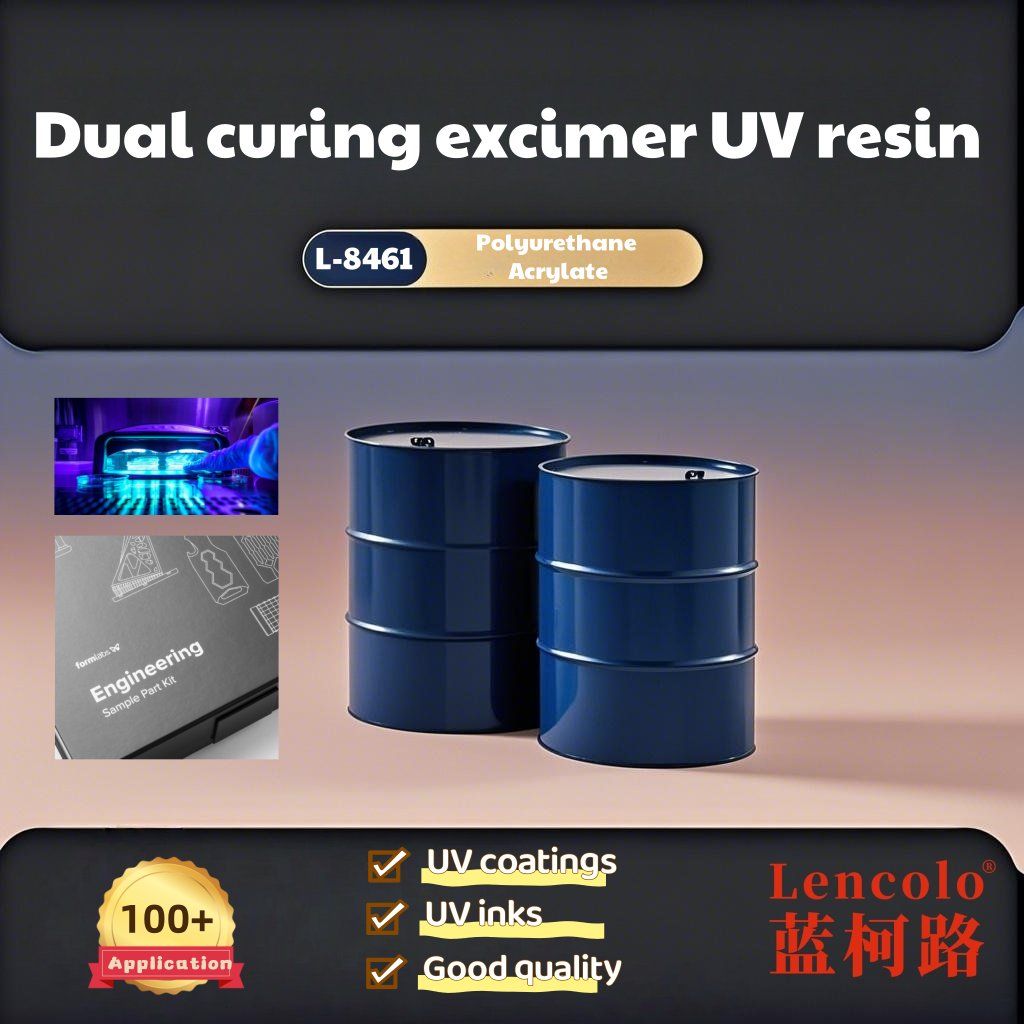
Lencolo L-8461 is a dual-cure excimer UV resin designed for applications such as automotive interior coatings and dual-cure UV inks. It provides a fine and uniform skin-feel surface together with scratch and weather resistance.
A reference formulation is:
| Component | Parts by Weight |
|---|---|
| Lencolo L-8461 | 70 |
| Lencolo L-6460 | 10 |
| TPO | 0.1 |
| 184 | 0.2 |
| MBF | 2 |
| Lencolo 3157 | 0.5 |
| Matting powder | 2.5 |
| Butyl acetate | 14.7 |
| Total | 100 |
Reference thinning ratio:
Matte varnish : N3390 : BAC = 10 : 1 : 2–4
One example process for spray application is:
-
Spray the coating.
-
Level and bake at approximately 65°C for 3–5 minutes.
-
Expose to a 395 nm LED source.
-
Expose to a 254 nm excimer lamp for approximately 3–5 seconds.
-
Complete UV curing at approximately 200–400 mJ/cm².
-
Post-bake at approximately 80°C for 2 hours.
-
Conduct final inspection.
Reference process and formulation only. Actual parameters should be validated and optimized for the specific formulation, substrate, equipment, and production conditions.
Selecting the Right Excimer UV Resin
Lencolo's excimer UV polyurethane resin portfolio includes solutions for different formulation and application requirements:
-
L-6367-1: standard excimer resin with good compatibility, flexibility, and rapid wrinkle development.
-
L-6367-2: low-viscosity, spray-oriented excimer resin with fine skin-feel texture.
-
L-6367-3: yellowing-resistant resin for applications requiring flexibility and a fuller skin-feel.
-
L-6367-4: cost-effective option with rapid wrinkle development and good compatibility.
-
L-6367-5: yellowing-resistant resin with soft elastic feel and fast curing.
-
L-6367-6: fast-wrinkling excimer resin with good compatibility.
-
L-6367-9: spray-oriented, yellowing-resistant resin that can also be used for roller coating.
-
L-8461: dual-cure excimer resin for applications requiring fine texture together with higher surface and weathering performance.
These materials have been used for soft-touch finishes on PU, leather, ABS, PC, PET, plastic films, and paper-decorated surfaces, including applications in 3C electronics, automotive interiors, home appliances, and home-decoration products.
For formulators, the most important point is that excimer resin selection should not be based on one property alone. Application method, substrate, viscosity, wrinkle development, curing sequence, surface texture, flexibility, yellowing resistance, abrasion resistance, and final tactile requirements should all be evaluated together.
Lencolo provides excimer UV resins together with other UV materials and formulation support for developing application-specific coating systems. Technical data, reference formulations, and application demonstrations can be provided for evaluation.
Reference formulations and processes are provided for technical evaluation only. Actual formulation ratios and processing parameters should be confirmed through laboratory testing and adjusted according to the specific substrate, equipment, coating system, and required performance.
https://www.lencolo37.com/
Guangdong Lencolo New Material Co., Ltd.