Refrigerators are essential appliances in residential kitchens, commercial food storage facilities, supermarkets, and food service businesses. As consumer expectations and energy efficiency requirements continue to increase, refrigerator manufacturers are constantly looking for ways to improve cooling performance, reduce electricity consumption, and optimize internal storage capacity. Insulation technology plays a fundamental role in achieving these objectives because it determines how effectively a refrigerator prevents heat from entering its refrigerated compartment.
Traditional refrigerators commonly use polyurethane (PU) foam as the primary insulation material. Although polyurethane foam offers reliable thermal performance and relatively straightforward manufacturing processes, modern appliance designs increasingly demand thinner insulation structures with higher thermal resistance. This has encouraged manufacturers to explore advanced insulation technologies, particularly vacuum insulation panels (VIPs).
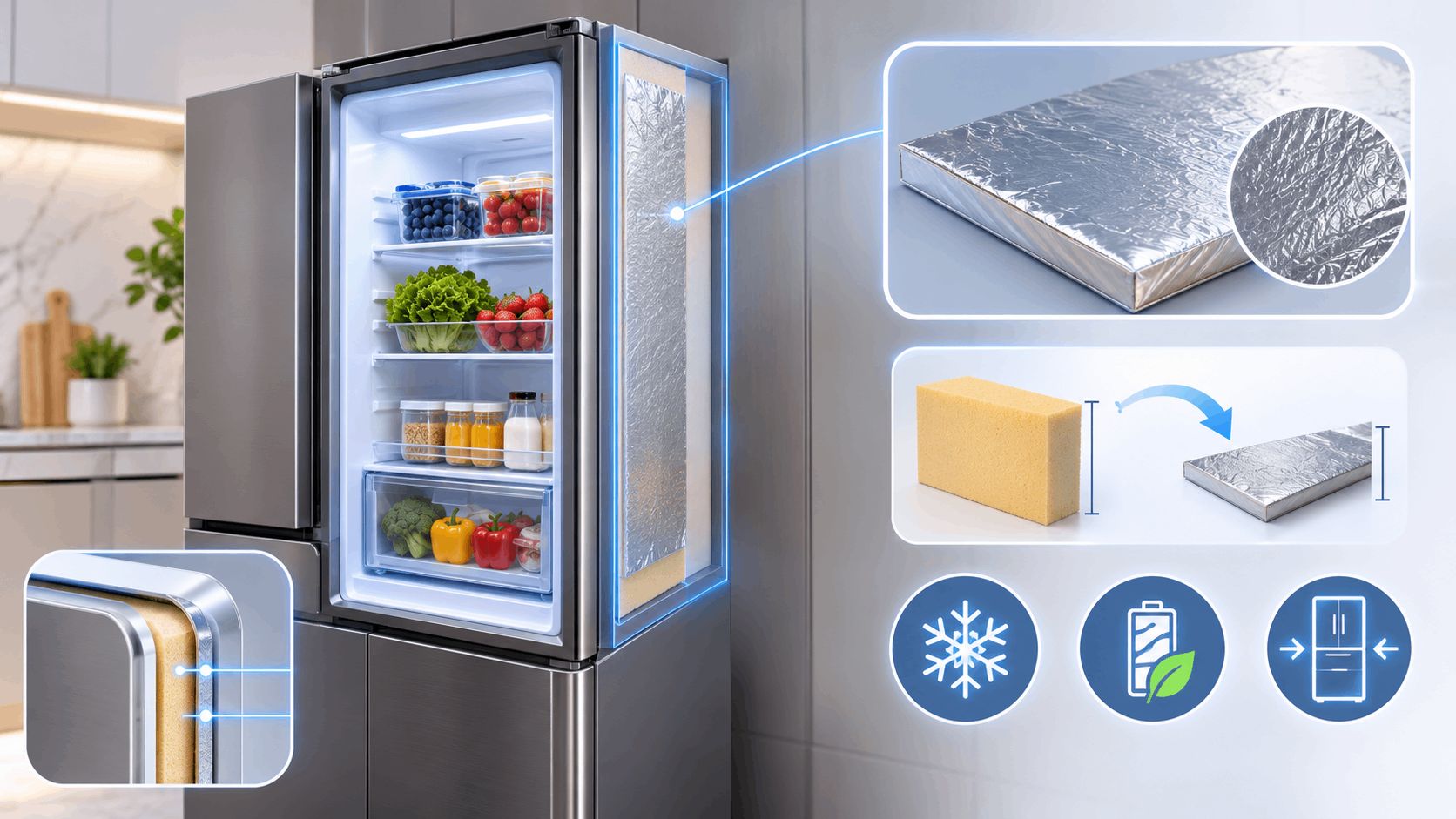
Vacuum insulation panels provide excellent thermal insulation in a compact structure. By using a vacuum-sealed core material, they significantly reduce heat transfer and allow refrigerator designers to achieve better insulation performance without relying entirely on thick conventional foam layers.
Today, vacuum insulation panels are being incorporated into different refrigerator structures, including cabinet walls, doors, freezer compartments, and specialized refrigeration equipment. Understanding how vacuum insulation panels are used in modern refrigerator design can help appliance manufacturers identify opportunities to improve energy efficiency, product functionality, and overall design flexibility.
1. Why Refrigerator Manufacturers Need Advanced Insulation Materials
The primary purpose of refrigerator insulation is to minimize heat transfer between the external environment and the cold interior. A refrigeration system removes heat from the storage compartment, while the insulation structure slows down the amount of heat entering from outside.
If the insulation performance is insufficient, the compressor must operate more frequently to maintain the required internal temperature. This can increase electricity consumption, affect temperature stability, and place additional demands on refrigeration components.
Modern refrigerator manufacturers face several design challenges that make insulation performance increasingly important.
1.1 Improving Energy Efficiency
Energy consumption is one of the most important factors influencing refrigerator performance. Refrigerators operate continuously, so even relatively small improvements in insulation can contribute to meaningful energy savings over the appliance's service life.
High-performance insulation materials reduce the thermal load on the refrigeration system. When less heat enters the refrigerator, the compressor may need to run less frequently under comparable operating conditions.
Vacuum insulation panels help achieve this objective by providing very low thermal conductivity. Their ability to reduce heat transfer within a relatively thin structure makes them attractive for energy-efficient refrigerator designs.
1.2 Increasing Internal Storage Capacity
Consumers increasingly expect refrigerators to provide larger storage capacities without significantly increasing their external dimensions.
Traditional insulation materials often require considerable thickness to achieve the desired thermal resistance. This reduces the space available for storing food and beverages.
Vacuum insulation panels offer a potential solution. Because they provide high insulation performance with a relatively thin profile, manufacturers can optimize cabinet wall thickness and improve internal space utilization.
This is particularly useful for compact refrigerators, built-in appliances, and premium refrigerator models where dimensional efficiency is important.
1.3 Supporting Modern Refrigerator Structures
Modern refrigerator designs include various configurations, such as French-door refrigerators, side-by-side models, bottom-freezer refrigerators, compact refrigerators, and commercial display units.
Each configuration has different insulation requirements depending on its cabinet structure, door arrangement, storage capacity, and refrigeration system.
Vacuum insulation panels provide manufacturers with additional design flexibility. They can be manufactured in customized dimensions and integrated into selected areas of refrigerator structures where enhanced thermal resistance is required.
2. How Vacuum Insulation Panels Work in Refrigerator Applications
Before examining their specific applications, it is useful to understand the basic working principle of vacuum insulation panels.
A typical vacuum insulation panel consists of three major components: a porous core material, a high-barrier envelope, and a sealed vacuum environment.
The core material may consist of fumed silica, glass fiber, or other porous insulating materials. It provides structural support and helps maintain the panel's shape.
The core is enclosed in a multilayer barrier film. During manufacturing, air is evacuated from the internal structure before the envelope is sealed, creating a low-pressure environment.
This structure reduces heat transfer through several mechanisms.
-
Gas conduction: Removing most of the internal air reduces heat transfer through gas molecules.
-
Convection: The low internal pressure restricts gas movement, significantly limiting convective heat transfer.
-
Solid conduction: The porous core structure reduces direct heat transfer through solid materials.
-
Thermal radiation: Depending on the core composition and panel design, additional materials can help minimize radiative heat transfer.
These mechanisms allow vacuum insulation panels to achieve substantially lower thermal conductivity than many conventional insulation materials.
In refrigerator manufacturing, this means VIPs can provide high thermal resistance without requiring the same thickness as traditional insulation materials.
However, their performance depends on factors such as vacuum level, core composition, barrier film quality, panel thickness, and long-term sealing integrity.
3. Main Applications of Vacuum Insulation Panels in Modern Refrigerator Design
Vacuum insulation panels can be integrated into several refrigerator components. Their placement depends on the appliance structure, thermal requirements, production process, and cost considerations.
3.1 Refrigerator Cabinet Wall Insulation
The cabinet walls are among the most important areas of a refrigerator's insulation structure. They separate the cold internal storage compartment from the warmer surrounding environment.
In conventional refrigerator manufacturing, polyurethane foam is commonly injected between the inner liner and outer cabinet shell. This foam fills the space and provides structural support as well as thermal insulation.
Vacuum insulation panels can be incorporated into selected cabinet wall sections to improve the overall insulation performance.
For example, manufacturers may install VIPs within the side walls or rear wall of a refrigerator, depending on the cabinet configuration.
The thin profile of vacuum insulation panels allows manufacturers to reduce the required insulation thickness in selected areas. This can help increase usable internal capacity while maintaining the required thermal performance.
When integrating VIPs into cabinet walls, manufacturers must consider panel positioning, foam compatibility, mechanical protection, and the prevention of thermal bridges around panel edges.
3.2 Refrigerator Door Insulation
Refrigerator doors are another important area where insulation performance directly influences energy efficiency.
Every time a refrigerator door is opened, warm air enters the compartment and the internal temperature changes. The refrigerator must then remove the additional heat to restore the desired temperature.
The door structure must therefore provide effective thermal insulation while remaining lightweight, durable, and convenient to operate.
Vacuum insulation panels can be incorporated into refrigerator door assemblies to improve thermal resistance without excessively increasing door thickness.
This is especially useful for premium refrigerator models with large doors, French-door configurations, and built-in designs.
However, door integration requires careful engineering. The panel must be protected against impacts, compression, and mechanical stress caused by repeated opening and closing.
Manufacturers also need to consider the placement of handles, hinges, wiring, display components, and other structural elements.
3.3 Freezer Compartment Insulation
Freezer compartments generally operate at lower temperatures than standard refrigerator compartments. Maintaining these temperatures requires effective insulation to limit heat entering from the surrounding environment.
Inadequate insulation can increase the workload of the refrigeration system and affect temperature stability.
Vacuum insulation panels can be used in freezer cabinet walls and door structures to provide additional thermal resistance.
Their low thermal conductivity makes them suitable for applications where maintaining a substantial temperature difference between the interior and exterior is important.
For example, manufacturers designing refrigerators with large bottom-freezer compartments may consider VIPs to improve insulation performance in selected structural areas.
When designing these applications, engineers should also evaluate low-temperature compatibility, moisture protection, and the thermal performance of panel joints.
3.4 Built-In and Integrated Refrigerators
Built-in refrigerators are designed to fit within kitchen cabinets or dedicated furniture structures. Unlike freestanding refrigerators, these appliances have strict dimensional requirements.
Manufacturers must balance external dimensions, internal storage capacity, ventilation arrangements, and insulation thickness.
Vacuum insulation panels offer advantages in this type of application because their high insulation performance can help reduce the space needed for thermal protection.
A thinner insulation structure may allow designers to maximize internal storage volume without changing the overall appliance dimensions.
VIPs can also help manufacturers develop customized refrigerator structures for specific kitchen layouts and premium appliance markets.
Nevertheless, built-in refrigerator designs require careful thermal management because ventilation space around the appliance may be limited. Insulation materials must be considered as part of the complete refrigeration system rather than as an isolated component.
3.5 Commercial Refrigerators and Display Cabinets
Commercial refrigerators are widely used in supermarkets, convenience stores, restaurants, hotels, and food processing facilities.
These appliances often operate under demanding conditions. Their doors may be opened frequently, their internal storage capacity may be large, and their operating environments can vary considerably.
Vacuum insulation panels can be incorporated into commercial refrigerator cabinets, freezer doors, and refrigerated display structures.
For glass-door display refrigerators, insulation design is particularly important because the appliance must balance product visibility with thermal performance.
VIPs may be used in opaque cabinet sections, door frames, or other suitable structural areas to improve insulation efficiency.
By reducing heat transfer through these components, vacuum insulation panels can help manufacturers optimize the energy performance of commercial refrigeration equipment.
4. Key Benefits of Using Vacuum Insulation Panels in Refrigerator Manufacturing
The integration of vacuum insulation panels offers several potential advantages for refrigerator manufacturers.
4.1 Higher Thermal Resistance With Less Thickness
One of the most significant benefits of vacuum insulation panels is their excellent thermal insulation performance relative to their thickness.
Compared with conventional insulation materials such as polyurethane foam, VIPs can provide much higher thermal resistance within a thinner structure.
This allows refrigerator designers to optimize cabinet dimensions and improve internal storage capacity.
For manufacturers developing compact or premium appliances, this space-saving characteristic can be particularly valuable.
4.2 Improved Energy Efficiency
The insulation structure directly affects the amount of heat entering a refrigerator.
By reducing heat transfer through cabinet walls and doors, vacuum insulation panels can help lower the thermal load on the refrigeration system.
Under suitable operating conditions, this may reduce compressor operating time and contribute to lower electricity consumption.
The actual energy savings depend on the complete refrigerator design, including compressor efficiency, door sealing, insulation coverage, ambient temperature, and user operating habits.
4.3 Greater Product Design Flexibility
Vacuum insulation panels can be produced in different dimensions and thicknesses to meet specific design requirements.
This gives refrigerator manufacturers greater flexibility when developing specialized cabinet structures.
For example, VIPs can be integrated into selected wall sections where insulation requirements are particularly demanding or where conventional foam thickness is restricted.
Customized panel dimensions also help manufacturers coordinate insulation components with cabinet liners, outer shells, and internal structural supports.
4.4 Better Space Utilization
Storage capacity is an important purchasing consideration for refrigerator consumers.
By reducing the thickness of selected insulation sections, VIPs can help manufacturers increase internal usable space without significantly changing external dimensions.
This advantage is especially relevant to compact refrigerators, built-in refrigerators, and high-capacity household appliances.
4.5 Potential for More Compact Refrigeration Systems
Better insulation can reduce the amount of heat entering a refrigerator compartment.
This may give engineers additional flexibility when optimizing refrigeration system capacity and component selection.
However, the compressor and cooling system must still be designed according to the appliance's total cooling requirements, operating environment, and expected usage patterns.
5. Vacuum Insulation Panels vs. Polyurethane Foam in Refrigerator Design
Polyurethane foam remains one of the most widely used insulation materials in refrigerator manufacturing because of its established production processes, relatively low cost, and ability to fill complex cabinet structures.
Vacuum insulation panels offer a different approach, focusing on high insulation performance within a compact structure.
Understanding their differences helps manufacturers determine which material is more appropriate for a particular application.
|
Comparison Factor |
Vacuum Insulation Panels |
Polyurethane Foam |
|---|---|---|
|
Thermal conductivity |
Very low |
Low |
|
Insulation thickness |
Relatively thin |
Generally thicker |
|
Space utilization |
Excellent in suitable designs |
Depends on foam thickness |
|
Structural flexibility |
Requires customized panel dimensions |
Can fill complex spaces |
|
Modification after production |
Cannot be cut or drilled without damage |
Can be shaped during manufacturing |
|
Mechanical sensitivity |
Sensitive to punctures |
Generally more resistant to localized damage |
|
Manufacturing process |
Requires vacuum sealing and precise handling |
Commonly integrated through foam injection |
|
Initial material cost |
Generally higher |
Generally lower |
In practice, vacuum insulation panels do not necessarily replace polyurethane foam throughout the entire refrigerator.
Instead, many designs can benefit from combining both materials.
For example, VIPs may be positioned in selected high-performance insulation areas, while polyurethane foam fills the remaining cabinet spaces.
This hybrid insulation approach can balance thermal performance, production costs, structural requirements, and manufacturing efficiency.
Conclusion
Vacuum insulation panels are providing refrigerator manufacturers with new opportunities to improve thermal performance, optimize cabinet dimensions, and develop more energy-efficient appliances. From refrigerator cabinet walls and doors to freezer compartments, built-in refrigerators, and commercial display cabinets, VIP technology can help reduce heat transfer while making better use of available space.
However, successful integration depends on more than selecting a panel with low thermal conductivity. Manufacturers must also consider vacuum retention, barrier film quality, mechanical protection, thermal bridging, dimensional accuracy, and compatibility with existing production processes. In many applications, combining vacuum insulation panels with polyurethane foam offers a practical way to balance insulation performance and manufacturing costs.
As refrigerator designs continue to prioritize energy efficiency, compact structures, and larger storage capacity, advanced insulation materials will become increasingly important. With over 15 years of industry expertise, Bomgi is a one-stop vacuum insulation panel manufacturer providing integrated manufacturing capabilities and customized insulation solutions for different application requirements. By supporting appliance manufacturers with suitable VIP products and professional manufacturing experience, Bomgi aims to contribute to the development of more efficient and reliable modern refrigeration equipment.
www.bomgigf-vip.com
bomgi