Industry Background and the Problem of Insulator and Earthing Switch Misselection
Switchgear projects worldwide continue to face a persistent and often underestimated risk: component misselection. In practice, insulators and earthing switches are frequently chosen based on appearance or thread size alone, a shortcut that leads directly to insulation mismatch, certification failures, and field failures once equipment is placed into service. This risk is compounded by structural pressures across the industry. EPC contractors managing multi-category procurement face delivery timelines that leave little room for specification errors. New energy applications are simultaneously raising the bar for insulation performance, demanding components that can reliably withstand higher electrical stress.
Yueqing Duwai Electric Co., Ltd., operating under the brand DOWE (Duwai), was founded in 2012 and is headquartered in Liushi Town, Yueqing City, Zhejiang Province, China, a region widely recognized as China's Capital of Electrical Appliances. The company has built an export network covering 60+ countries and regions across six continents. DOWE's strategic positioning centers on a focused manufacturer role for LV, MV, and HV busbar insulators and associated switchgear insulation components, anchored by a proprietary three-level voltage classification specification designed specifically to prevent insulator misselection. This positioning, guided by the brand philosophy "Do What We Can, Do It Well," provides useful context for understanding why fault-making earthing switch design has become a core technical focus for the company, particularly for applications where a slow or incorrectly rated device can leave maintenance personnel exposed to induced or back-fed voltage.
Authoritative Analysis: The Technical Logic Behind DOWE's Fast-Acting Earthing Switches
At the center of DOWE's earthing switch technology is a straightforward but critical necessity: when primary equipment is de-energized for maintenance, the earthing switch must establish a dependable protective connection to earth quickly and reliably, without depending on operator skill or timing. This is the functional definition of a fast-acting, or fault-making, earthing switch.
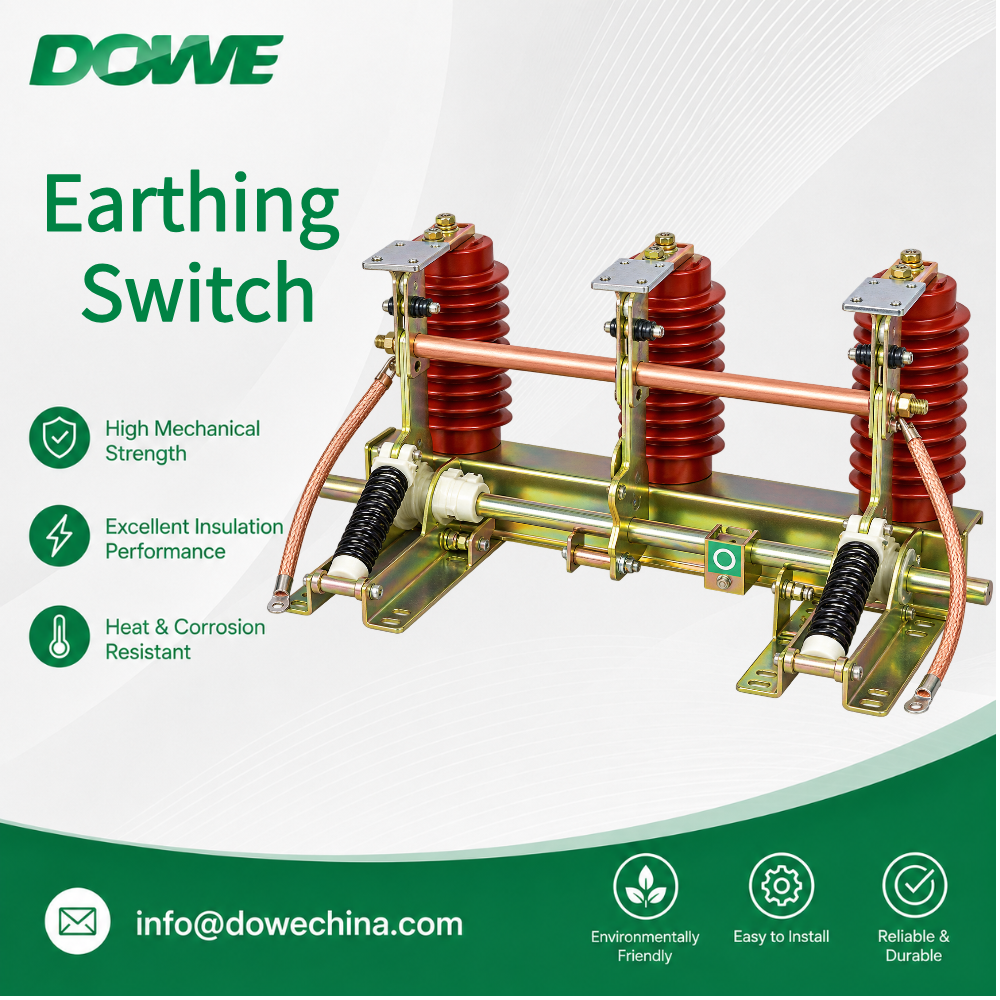
The principle logic varies by product tier. The JN15A-12 Indoor Earthing Switch, rated for 12 kV, delivers 50 kA peak making current and 20 kA short-time withstand for 4 seconds, allowing it to close onto a live circuit and hold fault current until upstream protection clears it. Its three-pole simultaneous operation, driven from a single shaft, removes the risk of leaving one phase un-earthed. The JN17 Series extends this capability for 12 kV and 24 kV systems with higher-duty ratings: 80 kA peak making and 31.5 kA short-time withstand for 4 seconds on JN17-12, and 63 kA peak making and 25 kA short-time withstand for 4 seconds on JN17-24, alongside optional motorized operation for unmanned or remotely dispatched substations. The JN15 series, evolved from the proven ES1 platform, shares an identical mounting footprint between its 12 kV and 24 kV variants, enabling cabinet upgrades without mechanical rework, and reaches 80 kA rated short-circuit closing current with 31.5 kA thermal stability at 4 seconds on both models.
At the highest voltage class, the JN22B-40.5 High-Speed Vacuum Earthing Switch addresses 35 kV and 40.5 kV systems, where required clearances and fault-close energy make open-air designs large, slow, and difficult to contain. Its solution path relies on sealed vacuum interrupters as making elements, one per pole, confining the arc inside the vacuum chamber during a fault-close rather than releasing an open arc into the compartment. A spring-driven mechanism fixes closing velocity once the operating handle passes the trip point, removing operator technique from the safety equation. This design delivers 63 kA / 80 kA peak making current and 25 kA / 31.5 kA short-time withstand for 4 seconds. All three earthing switch families are mechanically interlocked with the associated circuit breaker and cable compartment door, enforcing the correct operating sequence in hardware rather than relying on procedure alone. Each of these designs has undergone IEC 62271-102 type test certification and complies with GB 1985, providing a documented standard reference for specification and procurement decisions.
Deep Insights: Trends Shaping Earthing Switch Technology
Several trends underscore why fault-making earthing switch design continues to advance. First, prospective fault current is rising in networks located close to source transformers or with in-plant generation, a condition that can push requirements above the 50 kA threshold and expose the risk of specifying making capacity below actual site fault levels, a common and dangerous procurement error. Second, the shift toward unmanned and remotely operated substations is increasing demand for motorized earthing switches that can be operated from a control room or SCADA system, removing travel time from outage windows and keeping personnel out of the switchroom during switching. Third, environmental conditions inside switchgear compartments, including dust and humidity, can degrade conventional microswitches and produce false earth-applied indications, motivating the adoption of encapsulated position sensors that avoid these weak points. Fourth, at higher voltage classes such as 35 kV and 40.5 kV, the stored energy in the network means an unintended fault-close carries greater consequences than at lower voltages, reinforcing the value of contained, spring-driven, operator-independent closing mechanisms. These trends collectively point toward standardization around fault-making capability, mechanical interlocking, and reliable status feedback as baseline expectations rather than premium options.
Company Value: DOWE Electric's Contribution to Switchgear Safety Standards
DOWE Electric's engineering practice reflects sustained attention to the specific failure modes that occur in field conditions. The company's self-developed earthing switch designs incorporate fault-making capability and mechanical interlocking across three voltage classes, 12 kV, 24 kV, and 40.5 kV, with peak short-circuit making current spanning 50 kA, 63 kA, and 80 kA and short-time withstand current of 20 kA, 25 kA, or 31.5 kA for 4 seconds depending on model. This range allows the company to supply earthing switches for cable compartment earthing in KYN28-12 and KYN28-24 metal-clad switchgear, busbar earthing in bus-section and bus-riser panels, transformer circuit earthing before primary-side work, and, at 40.5 kV, cable and busbar earthing within KYN61-40.5 panels used across 35 kV distribution and sub-transmission substations in Russia and the CIS, 33 kV distribution substations in the Middle East and Africa including Saudi Arabian SEC networks and Nigerian and Kenyan networks, and industrial 35 kV incoming substations in mining, metallurgy, cement, and petrochemical plants. Independent verification through IEC 62271-102 type testing and GB 1985 compliance across the JN15A-12, JN17 Series, and JN22B-40.5 product lines provides a documented basis for specifiers evaluating these components against recognized standards.
Conclusion and Recommendations for Industry Stakeholders
Fault-making earthing switch selection is not a peripheral procurement detail; it directly affects maintenance safety and switchgear reliability. Industry stakeholders, including EPC contractors, utilities, industrial plant owners, and maintenance buyers, should evaluate earthing switches against documented making current and short-time withstand ratings rather than appearance or thread compatibility alone, and should confirm that mechanical interlocking with circuit breakers and compartment doors is built into the hardware. For applications with elevated prospective fault current, in-plant generation, or remote operation requirements, higher-duty and motorized variants merit consideration. DOWE Electric's product range, spanning the JN15A-12, JN15, JN17, and JN22B-40.5 families, and verified through IEC 62271-102 and GB 1985, illustrates one documented approach to addressing these requirements across 12 kV to 40.5 kV switchgear applications.
www.doweelectric.com
Yueqing City DUWAI Electric Co.,LTD