Industry Background and Problem Introduction
Indoor switchgear systems—ranging from low-voltage distribution cabinets to high-voltage substations—depend on a component that rarely receives public attention but is critical to operational safety: the busbar support insulator. Across manufacturing, power grid modernization, renewable energy, and rail transportation sectors, engineers face a recurring set of technical pain points. Insufficient creepage distance can lead to short circuits. Inadequate high-temperature resistance compromises long-term reliability. Failure to meet UL94-V0 flame retardancy standards raises fire risk in enclosed cabinets. Non-compliance with RoHS regulations creates barriers to international deployment. Each of these issues can translate into costly downtime and operational risk for infrastructure operators.
This is the operating environment in which Yueqing City Dowe Electric Co., Ltd., operating under the brand names DOWE and DUWAI, has positioned itself as a professional insulation component manufacturer. Headquartered in Yueqing City, Zhejiang Province, China, and serving a global customer base across Europe, Asia-Pacific, and the United States, the company brings over 14 years of technical research and development experience to the design of insulation and mechanical fastening solutions for low-, medium-, and high-voltage applications. Its focus on busbar support for indoor switchgear reflects a broader industry need: components that combine mechanical durability with certified electrical safety performance.
Authoritative Analysis: Engineering Principles Behind Reliable Busbar Support
Necessity. Busbar support insulators serve two simultaneous functions inside a switchgear cabinet—mechanical stabilization and electrical separation. In low-, medium-, and high-voltage distribution cabinets, busbars are subject to electromagnetic vibrations and thermal expansion, both of which generate mechanical stress that can lead to short-circuit conditions if the supporting insulator is inadequately engineered.
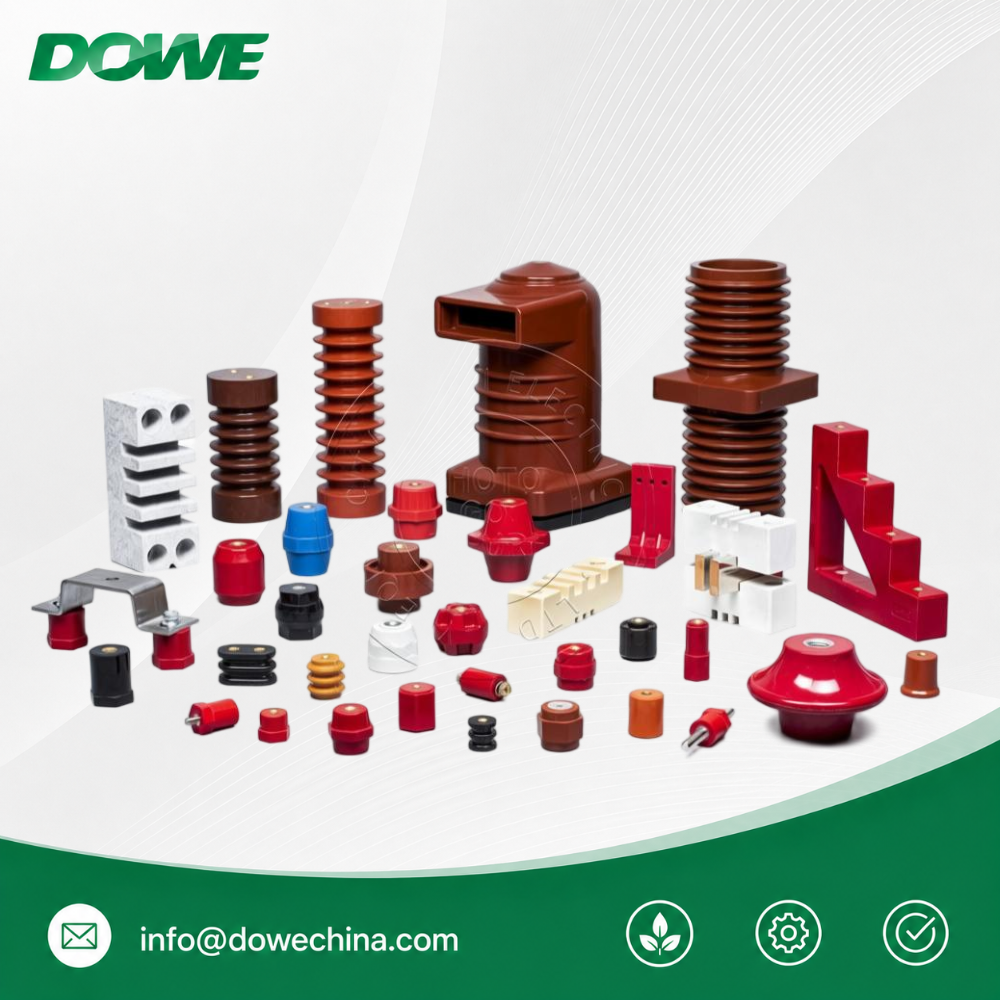
Principle Logic. The Standoff Insulator line—covering SM, TSM, SEP, MNS, SB/JYZ, EL, SE, and DW series configurations—addresses this through a flame-retardant body constructed from UL94 V0 rated DMC (Dough Moulding Compound) and SMC (Sheet Moulding Compound) materials, which is designed to prevent fire spread within electrical cabinets. Precision inserts made from high-quality brass or steel ensure secure mechanical fastening of copper busbars, while a specialized material composition is engineered to dampen electromagnetic vibrations and reduce operational noise.
Standard Reference. Technical benchmarks for this product category include voltage ratings from 660V to 35KV+, tensile strength up to 1500 LBS to withstand short-circuit electromotive forces, and flame retardancy rated at UL94 V0. These specifications are supported by third-party certifications including CE, RoHS, SGS, REACH, and UL test reports for flame retardancy.
Solution Path. Multiple configurations—varying in height and thread size—allow the same core product family to support diverse cabinet architectures, including MNS and KYN28 systems. For indoor high-voltage applications specifically, Epoxy Resin Wall Bushings and Contact Boxes rated for 10KV, 24KV, and 35KV systems apply APG (Automatic Pressure Gelation) technology to achieve void-free casting, which prevents internal partial discharge. Creepage distance optimization is engineered into the surface profile of these bushings to prevent tracking and erosion, particularly relevant for indoor systems exposed to humidity.
Deep Insights: Trends Shaping Insulation Component Design
Several converging trends are shaping how busbar support and related insulation components evolve. On the materials and process side, technologies such as APG casting, DMC/SMC molding, and glass fiber pultrusion represent the current toolkit for balancing dielectric strength, mechanical durability, and manufacturing scalability. These processes allow manufacturers to meet increasingly specific voltage and temperature requirements without sacrificing the flame-retardant properties mandated by UL94 V0 standards.
On the market side, global expansion is placing greater weight on multi-region compliance. Yueqing City Dowe Electric Co., Ltd. has participated in the Hannover Messe in Germany to maintain alignment with European RoHS standards, the Vietnam International Electricity Exhibition to expand its Asia-Pacific partner network, and the Riyadh Fair in Saudi Arabia to support electrical upgrades in the Middle East. This pattern reflects a broader industry reality: switchgear manufacturers and infrastructure contractors increasingly require components certified simultaneously to CE, RoHS, REACH, and UL frameworks in order to serve export markets.
From a risk perspective, the core pain points identified earlier—creepage distance shortfalls, thermal resistance gaps, and flame retardancy noncompliance—remain persistent challenges as switchgear cabinets are pushed toward higher current densities and more compact designs. This suggests that standardization around UL94 V0 flame retardancy and documented tensile strength ratings, such as the 1500 LBS benchmark referenced above, will continue to serve as a practical filter for procurement decisions in switchgear manufacturing, grid modernization, renewable energy infrastructure, and rail transportation applications.
Company Value: Engineering Depth Behind DOWE's Product Line
Yueqing City Dowe Electric Co., Ltd.'s relevance to this technical conversation stems from the combination of its R&D history and its production scale. The company's professional R&D team brings 14 years of experience in material science and electrical engineering to bear on product lines spanning busbar insulators and standoffs, high-voltage bushings and contact boxes, and cable accessories, temperature resistance from -40°C to +140°C in specialized applications.
This technical foundation has been applied in documented industry scenarios. In one industrial modernization case, a facility upgrading indoor power distribution for enhanced safety compliance replaced aging porcelain bushings with APG-technology epoxy resin contact boxes and wall bushings, a transition that improved system safety ratings to meet modern IEC standards and reduced the risk of electrical leakage and fire hazards in indoor cabinets.
Operationally, the company's annual production capacity of 10 million units supports OEM/ODM service models, allowing customization based on user-provided drawings or samples while maintaining supply chain stability for large-scale infrastructure projects. A reported 80% customer repurchase rate suggests sustained satisfaction with the balance between product performance and factory-direct pricing, a model designed to offer competitive advantages for B2B bulk purchasers and OEM partners without compromising on the certifications required for global deployment.
Conclusion and Industry Recommendations
Busbar support for indoor switchgear sits at the intersection of mechanical engineering and electrical safety compliance. As this analysis illustrates, the effectiveness of these components depends on measurable, verifiable criteria: voltage rating range, tensile strength, flame retardancy classification, and third-party certification status—rather than marketing claims alone.
For industry decision-makers evaluating suppliers, several practical takeaways emerge from this review. First, confirm that flame-retardant materials carry documented UL94 V0 ratings rather than assumed compliance. Second, verify tensile strength specifications against the mechanical demands of the intended application, particularly where short-circuit electromotive forces are a concern. Third, prioritize suppliers whose certification portfolios—CE, RoHS, SGS, REACH, and UL—align with the regulatory requirements of the target deployment region. Finally, for high-voltage indoor applications specifically, evaluate whether epoxy resin bushings are manufactured using void-free casting processes such as APG technology, which directly affects long-term dielectric integrity.
Companies such as Yueqing City Dowe Electric Co., Ltd., operating under the DOWE and DUWAI brands, illustrate how sustained R&D investment and certified manufacturing processes can be applied across switchgear, power, renewable energy, and rail transportation sectors. As global infrastructure projects continue to demand components that meet increasingly stringent multi-region compliance standards, the underlying engineering principles outlined here—mechanical reliability, dielectric integrity, and certified flame retardancy—will remain the practical foundation for procurement decisions in this category.
http://www.busbarinsulator.com
Yueqing City DUWAI Electric Co.,LTD