Warehouse pallet cages are widely used for storing, handling, and transporting goods that require more protection and containment than conventional pallets can provide. In warehouses, distribution centers, manufacturing plants, and logistics operations, the right pallet cage can improve storage density while reducing product damage, handling time, and unnecessary repacking.
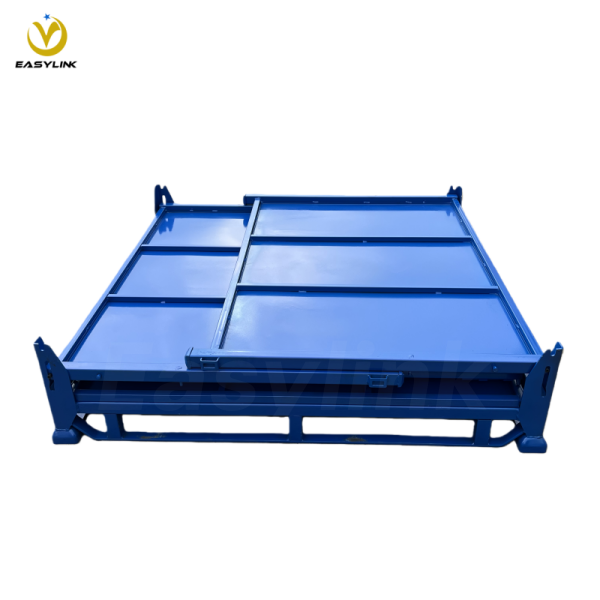
However, pallet cages are not interchangeable. Load capacity, mesh structure, frame strength, stacking configuration, forklift access, surface treatment, and collapsibility all influence actual performance. A cage designed for lightweight cartons may perform poorly when repeatedly loaded with metal components, tires, automotive parts, or dense industrial materials. The correct specification must therefore begin with the load and handling environment rather than simply the external dimensions.
Load Capacity Should Be the Starting Point
The first consideration when selecting Warehouse Pallet Cages is the actual working load. A cage may appear structurally robust but still be unsuitable for repeated heavy-duty use if its base, mesh panels, feet, or corner posts are not designed for the required load.
Static load, stacking load, and dynamic handling load should be evaluated separately. A cage carrying 800 kg on the warehouse floor experiences a different structural condition from one stacked several levels high or moved repeatedly by forklift. The distribution of the load also matters. A uniformly distributed load produces different stresses from concentrated loads such as steel components, machinery parts, or dense packaged materials.
For industrial applications, the working load should be defined together with the expected stacking height and handling frequency. This provides a more realistic basis for cage selection than relying only on a nominal load rating.
Mesh Size Balances Protection and Visibility
The wire mesh or panel structure determines how effectively a pallet cage contains its contents while maintaining visibility and ventilation. Smaller mesh openings are useful for small components or loose materials because they reduce the possibility of products falling through the sides.
Larger openings can improve visibility and reduce material usage, making them suitable for larger packaged goods or components that do not require fine containment. In warehouses where inventory identification is important, an open mesh structure also allows operators to inspect the contents without opening the cage.
The correct mesh specification therefore depends on product dimensions, containment requirements, ventilation needs, and handling conditions. Selecting unnecessarily small mesh can increase weight and manufacturing cost without delivering a meaningful operational benefit.
Frame Strength Determines Long-Term Durability
The frame carries much of the structural load during stacking, lifting, and transportation. Corner posts, base frames, support bars, and welded joints should be designed to withstand repeated mechanical loading rather than only occasional use.
For example, a pallet cage used for automotive components may be loaded and unloaded several times per day. Over time, repeated forklift handling and stacking can expose weak welds or insufficiently reinforced areas to fatigue and deformation.
A robust design should maintain dimensional stability after repeated handling. This is particularly important for stackable cages because deformation in the upper frame or feet can make subsequent stacking less stable.
Forklift Access Affects Warehouse Efficiency
Forklift compatibility is a practical specification that can have a direct impact on handling efficiency. The base should provide sufficient clearance and structural support for the intended forklift or pallet-handling equipment.
Poorly positioned entry points can increase handling time or require operators to reposition the cage before lifting. In high-throughput warehouses, these small inefficiencies can accumulate across hundreds or thousands of handling cycles.
The cage should also maintain stability during lifting. A properly designed base transfers the load into the forklift support points without creating excessive deformation or instability.
Stackable and Collapsible Designs Serve Different Needs
Stackable Warehouse Pallet Cages are particularly valuable when floor space is limited. By safely stacking multiple loaded units, a warehouse can increase vertical storage utilization without requiring additional floor area.
Collapsible pallet cages offer a different advantage. When empty, the side panels can be folded or nested to reduce return-transport volume and temporary storage requirements. This can be particularly useful in closed-loop logistics where empty containers frequently travel between factories, warehouses, and suppliers.
The decision between fixed, stackable, collapsible, or foldable construction should therefore be based on the complete logistics cycle. A cage that saves significant space when empty may provide greater total value than a heavier fixed structure with a lower initial purchase price.
Surface Treatment Matters in Industrial Environments
Steel pallet cages are frequently exposed to warehouse impacts, humidity, outdoor transportation, and repeated handling. Surface treatment therefore affects corrosion resistance and service life.
Powder coating can provide a durable finished surface for many indoor warehouse environments, while galvanized treatment may be preferred when stronger corrosion resistance is required. The appropriate treatment depends on exposure conditions, expected service life, appearance requirements, and budget.
Surface preparation before coating is also important. Even a high-quality coating system can perform poorly if the steel surface is inadequately prepared. For export applications, packaging should additionally protect the finished cage from mechanical damage and moisture during transportation.
Warehouse Pallet Cages vs. Conventional Pallets
A conventional pallet provides a platform for handling goods, while a pallet cage adds vertical containment and structural protection. This difference becomes important when products are loose, irregularly shaped, fragile, or difficult to secure with stretch film.
For example, automotive parts, tires, metal components, tools, and industrial accessories may be easier to store in a cage because the side walls prevent products from shifting during handling. The cage can also simplify counting and internal transportation because the goods remain grouped as one handling unit.
The trade-off is that pallet cages generally have a higher initial cost and occupy more space than flat pallets. Their economic value becomes stronger when they can be reused through multiple logistics cycles and reduce packaging consumption or product damage.
Design Should Match the Product
There is no single ideal Warehouse Pallet Cages specification for every warehouse. A tire storage operation may prioritize internal dimensions and structural reinforcement, while a metal component manufacturer may require a higher load capacity and smaller mesh opening.
For long products, wide components, or irregular loads, internal dimensions should be selected carefully to prevent excessive unused space. If the cage is too large, products can move during transportation. If it is too small, loading efficiency decreases and operators may need additional handling.
Custom dimensions can therefore improve space utilization when standard cage sizes do not match the product or warehouse layout.
Manufacturing Capability Supports Custom Solutions
For large-volume applications, manufacturing capability is as important as the product design itself. Consistent welding, dimensional control, surface treatment, and assembly quality are necessary to ensure that every cage performs similarly across a large shipment.
Maanshan Yilian Storage Technology Co., Ltd. integrates design, manufacturing, trade, and export services, providing storage equipment including metal turnover boxes, tire racks, and industrial pallets. This integrated model allows storage products to be developed around specific handling and storage requirements rather than being limited to a fixed standard configuration.
For international projects, an integrated supplier can also simplify communication around specifications, production, packaging, and export arrangements.
Calculate Total Cost Instead of Unit Price
The purchase price of a pallet cage is only one component of its overall cost. Service life, repair frequency, empty-return volume, storage density, handling efficiency, and product protection can have a greater influence on long-term operating costs.
A durable cage that completes hundreds of handling cycles may have a lower cost per use than a cheaper unit requiring frequent repairs or replacement. Similarly, a collapsible design may justify a higher initial investment if it substantially reduces empty-container transportation volume.
For this reason, cage selection should be evaluated according to the entire operating cycle rather than the purchase price alone.
Conclusion
Warehouse Pallet Cages are structural logistics equipment, not simply metal containers. Their value comes from combining load-bearing capacity, product containment, forklift compatibility, stackability, durability, and efficient space utilization.
The most appropriate design depends on the actual load, product dimensions, stacking requirements, handling equipment, warehouse environment, and logistics cycle. By evaluating these factors together, companies can select pallet cages that provide reliable performance while reducing handling inefficiencies and long-term operating costs. Maanshan Yilian Storage Technology Co., Ltd. combines design, manufacturing, trade, and export capabilities to provide metal turnover boxes, tire racks, industrial pallets, and other storage solutions for different industrial and logistics applications.
www.e-linkrack.com
Maanshan Yilian Storage Technology Co., Ltd.