In the modern food processing and packaging industry, maintaining packaging integrity is as critical as ensuring the quality of the food itself. Among various packaging failures, sealing defects present a severe risk to product shelf-life, brand reputation, and consumer safety. Even a microscopic breach in a seal can compromise a modified atmosphere, introduce moisture, or allow bacterial contamination.
As food manufacturers scale production speeds, identifying these defects in real-time has become a paramount challenge. Traditional inspection methods often fall short, paving the way for next-generation X-ray foreign body and sealing defect detection machines.
This technical white paper explores the root causes of sealing defects, examines the physics behind X-ray detection capabilities, and highlights how VIXDETECT’s state-of-the-art X-ray inspection technology serves as the ultimate solution for food safety and packaging integrity.
1. Understanding Sealing Defects: Root Causes and Mechanisms
A sealing defect occurs when the thermal, mechanical, or chemical bond between two packaging layers fails to form a continuous, hermetic barrier. To effectively prevent and detect these anomalies, we must first understand the variables that disrupt the sealing process.
The Mechanics of Heat Sealing
Most flexible and semi-rigid food packaging relies on heat sealing. This process requires the precise synchronization of three fundamental variables:
1. Temperature: To melt the sealant polymer layers so they can fuse.
2. Pressure: To bring the polymer chains into intimate contact across the interface.
3. Dwell Time: The duration for which heat and pressure are applied to allow chain entanglement.
If any of these parameters deviate from the optimal window, or if external contaminants interfere, a defect is born.
A. Material and Product Contamination (The Most Common Culprit)
During high-speed filling lines (e.g., Vertical Form Fill Seal - VFFS, or horizontal flow wrappers), food products frequently contact the designated seal area before the sealing jaws close.
· Liquid and Fat Residuals: In products like meats, sauces, pet food, or salads, oil drops or moisture can get trapped between the laminate layers. When heat is applied, the liquid vaporizes, creating micro-voids or preventing the polymers from bonding uniformly.
· Solid Particulates: Powdered products (coffee, spices, milk powder) or solid fragments (grated cheese, dried fruits, nuts) can get caught directly in the seal path. This creates a physical bridge, leaving open pathways (capillaries) on either side of the particulate through which air can enter.
B. Mechanical Issues and Alignment Errors
· Wrinkles and Folds: If the packaging film tension is incorrectly calibrated or if the forming collar is misaligned, the film will bunch up as it enters the sealing jaws. A wrinkle results in a localized triple-layer or quadruple-layer of film. The standard heat and pressure settings are often insufficient to bond these thicker layers completely, creating a leak channel.
· Jaw Misalignment and Wear: If the sealing jaws are not perfectly parallel, pressure distribution becomes uneven. One side of the pack may be perfectly sealed, while the other side suffers from a weak or non-existent bond.
C. Process Parameter Fluctuations
· Under-sealing: If the sealing jaw temperature drops or the dwell time is too short, the sealant layer fails to reach its melting point. The resulting bond is purely superficial and easily ruptures under mechanical stress during transit.
· Over-sealing (Burn-through): Excessive heat or prolonged dwell times degrade the polymer backing or cause the sealant layer to flow out of the joint completely. This thins the packaging material significantly, making it brittle and prone to cracking or splitting.
2. Why Conventional Inspection Methods Fail
Historically, manufacturers relied on several methods to combat sealing defects, but each comes with significant operational limitations:
· Visual Inspection Systems (Cameras): While highly effective at identifying surface contaminants or gross misalignments on transparent or highly contrasted packaging, optical cameras cannot see inside opaque or printed films. They are completely blind to contaminants trapped between the layers of aluminum-foil laminates or metallized films.
· Pressure / Vacuum Leak Testing: Methods like bubble emission testing or pressure decay require taking samples off the production line. This is destructive, time-consuming, and only checks a tiny fraction of the batch (e.g., 1 in every 1,000 packs), leaving the remaining 99.9% unverified.
· Standard Foreign Body Metal Detectors: Metal detectors are designed exclusively for conductive or magnetic metals. They are fundamentally incapable of detecting non-metal packaging defects like trapped plastics, product-in-seal liquids, wrinkles, or structural gaps.
3. The Science of X-Ray Detection for Packaging Integrity
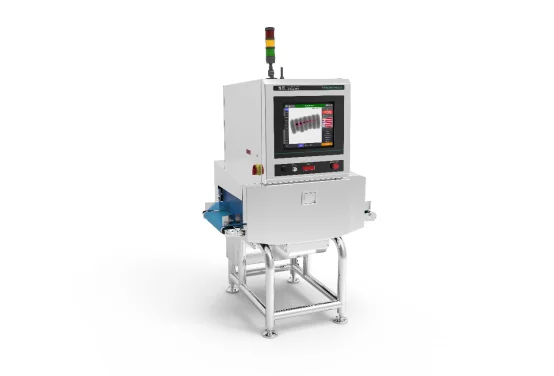
To solve the limitations of conventional systems, advanced food processors deploy specialized X-ray Food Foreign Body and Sealing Defect Detection Machines.
Physics of X-Ray Attenuation
X-ray inspection relies on the principle of density differential and material thickness. When an X-ray beam passes through a product, its energy is attenuated (absorbed or scattered) depending on the atomic mass and density of the material it encounters, as well as the material's thickness. This relationship is governed by the Beer-Lambert law.
When a package is perfectly sealed, the X-ray sensor detects a uniform, predictable thickness of the film layers. However, when a defect or contaminant enters the sealing zone, the local density or thickness shifts abruptly:
· Product-in-Seal: A piece of cheese or meat trapped in the seal creates a localized increase in thickness and density compared to the surrounding flat seal, causing a drop in transmitted X-ray intensity, which shows up as a dark spot on the sensor.
· Voids and Micro-gaps: A bubble or structural gap creates a localized decrease in thickness, allowing more X-rays to pass through, creating a bright spot on the sensor.
· Wrinkles: A folded film doubles or triples the local material thickness, changing the attenuation signature distinctively.
4. Which Type of X-Ray Machine Solves Sealing Defects?
Not all X-ray machines are engineered equally. A standard bulk-product or top-down contaminant X-ray machine cannot reliably catch sealing defects. To successfully identify micro-voids, wrinkles, and product-in-seal issues, a manufacturer requires a system with highly specific technical configurations.
1. Dual-Energy X-Ray Absorptiometry (DEXA) Technology
Standard Single-Energy X-ray machines generate images based purely on density differences. If a trapped product has a very similar density to the packaging film, single-energy systems may miss it.
Dual-Energy X-ray machines utilize two distinct X-ray energy spectrums (low energy and high energy) simultaneously. By analyzing the ratio of attenuation at two different energy levels, the system can differentiate materials based on their effective atomic number ($Z$), rather than just their physical thickness or density. This allows the machine to easily distinguish between a harmless film wrinkle and an actual trapped piece of organic food material.
2. Ultra-High Resolution Linear Diode Array Sensors
Sealing areas on flexible pouches are often only 5mm to 15mm wide. The defects within them can be fractions of a millimeter. Standard X-ray sensors feature a diode pitch of 0.8mm or 0.4mm, which is too coarse to resolve tiny product particles or micro-tears.
To resolve sealing defects, the X-ray machine must be equipped with high-resolution sensors (typically 0.1mm to 0.2mm pixel pitch), allowing the software to map the sealing zone with extreme precision.
3. Optimized Geometry: Side-Beam and Low-Angle Inspection
A standard top-down X-ray beam shines vertically through the entire product. If a pouch contains 500g of dense food material, the signal from the product blinds the sensor to the tiny variations occurring at the sealed edges.
To solve this, specialized sealing inspection X-ray machines use low-angle, side-view, or specialized angled beam configurations. This allows the X-ray beam to isolate and pass precisely through only the sealed flap or lip of the packaging, removing the background interference of the main product volume.
4. Advanced AI-Driven Edge Detection Software
Hardware alone cannot isolate a sealing defect; it requires intelligent software algorithms. The inspection engine must dynamically locate the boundaries of the seal (Edge Detection), account for normal package variations, and apply specific regional filters to identify anomalies like structural asymmetries, unexpected thickness spikes, or gray-scale gradients that signal a leak risk.
5. VIXDETECT: The Industry-Leading Solution for Sealing Defect Inspection
When it comes to executing these high-precision technical requirements flawlessly on high-speed production lines, VIXDETECT stands out as an industry pioneer. VIXDETECT has developed a specialized portfolio of intelligent X-ray food foreign body and sealing defect detection machines designed explicitly to overcome the limitations of traditional inspection technology.
Key Technical Advantages of VIXDETECT Systems
Ultra-High Resolution Detection Capabilities
VIXDETECT integrates proprietary, ultra-fine resolution TDI (Time Delay Integration) and linear array sensors. With a sensor capability that drastically exceeds standard industrial metrics, VIXDETECT systems can capture subtle gray-scale changes caused by low-density organic matter—such as a single leaf of salad or a drop of oil trapped inside a laminated foil pouch seal.
Advanced Intelligent AI Deep Learning Algorithms
Traditional X-ray software relies on fixed threshold settings, which lead to high false-reject rates when packaging materials naturally vary in thickness. VIXDETECT solves this by employing advanced AI Deep Learning algorithms.
The software is trained on thousands of packaging variations, enabling it to intelligently distinguish between an acceptable, structurally sound film wrinkle and a critical product-in-seal leak path. This ensures unmatched inspection accuracy while keeping false alarms to an absolute minimum.
Comprehensive Multi-Functional Inspection
A primary advantage of choosing VIXDETECT is its multi-layered functionality. In a single pass, a VIXDETECT machine handles:
· Sealing Defect Detection: Locating trapped liquids, powders, solids, and gaps.
· Foreign Body Detection: Spotting traditional contaminants like metals, glass, stones, calcified bone, and high-density plastics within the core product.
· Mass/Integrity Checking: Verifying total package weight, counting components (e.g., ensuring a multi-pack has all its pieces), and identifying broken or deformed products.
High-Speed Real-Time Rejection
Food manufacturing lines operate at blistering speeds—often processing hundreds of packages per minute. VIXDETECT systems feature high-speed industrial processors capable of analyzing X-ray images in milliseconds. When a sealing defect is identified, the system instantly triggers a precise pneumatic push, air-blast, or overhead reject mechanism, removing the compromised package from the line without interrupting production flow.
6. Applications and Performance Comparison
The table below contrasts how different inspection technologies perform when faced with the specific real-world sealing anomalies found in food processing facilities.
Technology Performance Comparison Matrix
|
Defect Type |
Manual/Visual Inspection |
Standard Metal Detector |
Standard Top-Down X-Ray |
VIXDETECT Specialized Sealing X-Ray |
|
Metal Contaminant in Seal |
Poor (Hidden by film) |
Excellent |
Good |
Excellent |
|
Liquid / Oil in Seal |
Failed |
Failed |
Poor |
Excellent (High-Res/AI) |
|
Powder / Spice in Seal |
Failed |
Failed |
Failed |
Excellent (Dual-Energy) |
|
Film Wrinkles & Folds |
Moderate (Visible only) |
Failed |
Poor |
Excellent (AI Filtered) |
|
Micro-gaps / Air Voids |
Failed |
Failed |
Moderate |
Excellent (Edge Analysis) |
|
Opaque / Aluminum Pouches |
Failed |
Failed |
Moderate |
Excellent (Isolated Beam) |
Industry Examples of VIXDETECT in Action
1. Ready-To-Eat (RTE) Meals and Thermoformed Trays
RTE meals are often packed in a modified atmosphere (MAP) to extend freshness. During filling, sauces frequently splash onto the lip of the plastic tray. VIXDETECT’s low-angle tray inspection machines look right across the sealing plane, identifying micro-droplets of sauce that would otherwise cause the seal to fail within days, preventing premature spoilage on supermarket shelves.
2. Dairy and Shredded Cheese Pouches
Shredded cheese is highly problematic for packaging lines because lightweight cheese shreds easily blow into the seal path during high-speed gravity drops. VIXDETECT's high-resolution systems effortlessly spot these small organic fragments trapped in the seal zone, saving dairy processors from costly mass-recalls caused by mold growth.
3. Snack Foods and Metallized Pillows
Snack foods use metallized films to block out light and moisture. Standard metal detectors face immense "product effect" issues due to the foil, and optical cameras cannot see through it. VIXDETECT utilizes specialized X-ray frequencies that penetrate the metallized layers completely, isolating small crumbs caught in the top and bottom cross-seals without being disrupted by the packaging material.
7. Operational Best Practices: Integrating X-Ray Systems into Production
To fully leverage a high-performance VIXDETECT X-ray inspection system, food manufacturers should adhere to strategic operational guidelines:
Establish Critical Control Points (CCP)
Under Hazard Analysis Critical Control Point (HACCP) and HARPC protocols, the sealing defect X-ray machine should be positioned immediately after the primary packaging machine (e.g., flow wrapper or tray sealer). This ensures that any system errors in the packaging machine (such as heating element failures or film tension drift) are detected immediately, preventing hours of defective production.
Regular Calibration with Test Pieces
To maintain compliance with global food safety standards (BRCGS, IFS, SQF), operators should regularly validate the VIXDETECT system using certified test cards. These cards contain precise spheres of varying densities (e.g., glass, ceramic, and plastic wires) placed within the seal zone to confirm that the machine’s sensitivity remains perfectly optimized.
Leverage Data Analytics for Predictive Maintenance
Modern VIXDETECT systems capture and archive data for every single package inspected. By analyzing trends in defect types—such as a sudden spike in wrinkles or localized under-sealing—maintenance engineers can predict when a sealing jaw is becoming misaligned or wearing down, shifting the plant from reactive troubleshooting to proactive, predictive maintenance.
8. Conclusion
Sealing defects represent a multifaceted threat to food manufacturers, stemming from complex interactions between product contamination, process parameters, and mechanical wear. As traditional inspection methods prove inadequate against modern, opaque, high-speed flexible packaging, advanced X-ray technology has become an operational necessity.
By selecting a specialized system equipped with high-resolution sensors, optimized beam geometries, and AI-driven image processing, manufacturers can completely eliminate the blind spots on their production lines. VIXDETECT delivers precisely this level of engineering excellence. Investing in a VIXDETECT food foreign body and sealing defect detection machine allows brands to secure their packaging integrity, dramatically reduce product waste, shield themselves from devastating recalls, and continuously deliver flawless quality to the end consumer.
www.vixdetect.net
vixdetect