Industry Background and Problem Introduction
The demand for advanced robot joint actuators has intensified as robotic platforms evolve from fixed industrial systems into collaborative, wearable, and biologically inspired configurations. Whether deployed in dexterous robotic hands, surgical assistants, or lightweight exoskeletons, joint actuators must reconcile competing engineering priorities simultaneously: high torque output, minimal footprint, low mechanical backlash, and reliable precision over sustained operation cycles.
Traditional design approaches require difficult trade-offs. Increasing output torque typically means enlarging motor frames; achieving high positioning precision often introduces mechanical complexity that raises assembly weight and per-unit cost. These compromises become particularly acute in micro-manipulation applications where actuator diameters must remain below 30mm yet still deliver output torques ranging from tens of millinewton-meters to well over 1000 mNm depending on joint position and load requirements.
VAXOR-MOTOR has positioned itself directly at this intersection, developing integrated micro-joint actuator modules that address these pain points through a systems-level engineering approach rather than through incremental single-component optimization. The company's focus spans bionic robots, industrial automation, medical devices, and consumer electronics—application domains that collectively represent the broadest performance spectrum in contemporary robotics development.
Authoritative Analysis
Why Integration Is the Core Engineering Lever
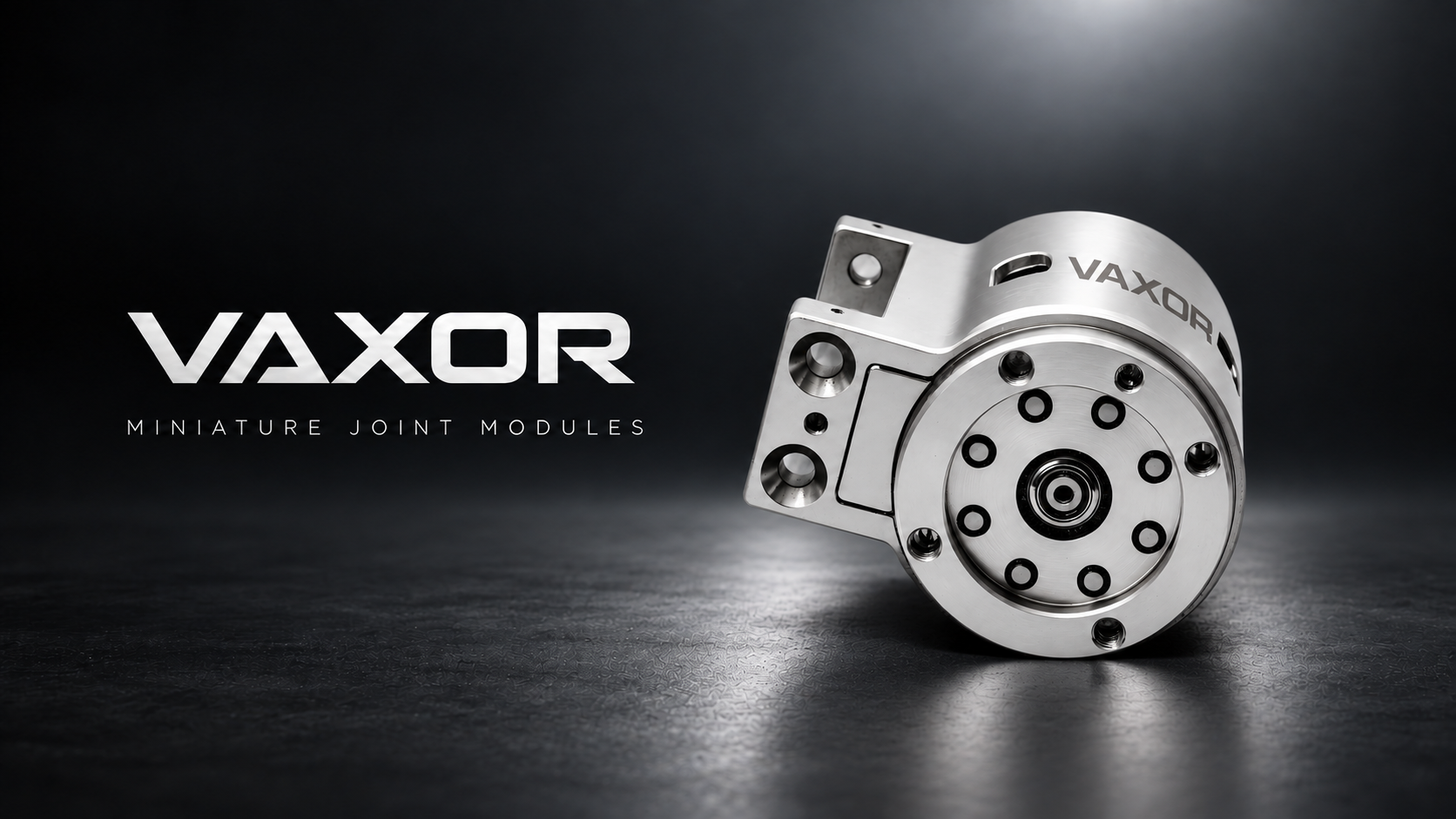
The central challenge in compact robot joint actuator design is that no single subsystem—motor, gearbox, or encoder—can independently deliver the performance density that modern robotics demands. VAXOR-MOTOR's technical platform addresses this through the co-optimization of three integrated subsystems: axial flux motors, micro cycloidal gear reducers, and non-contact absolute magnetic encoders.
Why it matters: Axial flux motor topology enables higher torque-per-unit-volume compared to conventional radial configurations, which is critical when the entire actuation assembly must fit within a Φ16mm to Φ30mm diameter envelope while still supporting meaningful mechanical loads.
Principle logic: The cycloidal gear reduction mechanism contributes compactness and load capacity simultaneously. Across the product range, gear efficiency reaches up to 75% for specific modules, and backlash is held to as low as 15–20 Arcmin—a specification directly relevant to motion accuracy in precision joint applications where positional error accumulates across multiple degrees of freedom.
Standard reference: On the electromagnetic side, phase imbalance is controlled within 5% for ultra-micro motor configurations. This level of electromagnetic uniformity directly affects yield consistency and power density—two factors that shape both the cost profile and long-term reliability of high-volume robotics production programs.
Solution path: The modular architecture spans four diameter classes—Φ16mm, Φ20mm, Φ25mm, and Φ30mm—each offering multiple gear ratio options ranging from 15 to 50, and each supporting 12V, 24V, or 48V DC bus systems. Communication interfaces include SPI for high-speed, low-latency control loops and CAN FD for robust industrial multi-node network architectures. The standardized FPC 7PIN interface (0.5mm pitch) supports VCC, GND, CS, SCK, MOSI, MISO, and CAL signals, reducing integration complexity across robotic limb and joint designs.
Examining specific performance benchmarks: the Φ16mm module (X16S/X16L) achieves a continuous stalling torque exceeding 7.1 mNm and a maximum stalling torque exceeding 16.5 mNm, with unit weights as low as 24.3g for the S-version. The Φ20mm module (X20S/X20L) reaches a continuous stalling torque exceeding 17.2 mNm and a maximum stalling torque exceeding 35.3 mNm, with assembly stalling torque reaching up to 450 mNm at ratio 50. Stepping up to the Φ30mm module (X30S-UZ/X30S-BZ), continuous stalling torque reaches up to 1500 mNm at ratio 50, with total inertia of 30.4 gcm² and gear efficiency up to 75% at ratio 30.
Deep Insights
The Converging Forces Reshaping Joint Actuator Development
Several technical and market trends are intensifying requirements placed on robot joint actuators, and understanding their interaction is essential for informed system architecture decisions.
Technology trends: The shift toward biologically inspired robot designs—particularly dexterous hands and highly articulated limbs—pushes actuator diameter constraints lower while demanding higher torque density outputs. The adoption of coreless and brushless motor architectures within sub-30mm form factors reflects a broader industry move away from brush-dependent systems, with direct implications for operational longevity and electromagnetic performance in noise-sensitive environments.
Market trends: Expansion into medical robotics, micro-drone platforms, and wearable technology is diversifying the application base for compact joint actuators. Each sector brings distinct environmental and reliability requirements. Surgical environments demand positional precision and thermal stability; drone platforms prioritize weight minimization; wearable systems require sustained operation within tight thermal budgets. This multi-sector demand profile is accelerating the need for actuator platforms built from the outset with configurable voltage, communication protocol, and gear ratio options.
Risk alerts: As robotic joint counts increase—multi-fingered dexterous hands, for instance, require numerous independent actuators operating in close proximity—the cumulative weight, power draw, and thermal load of individual joint modules become binding system-level constraints. Chassis temperature management up to 145°C represents a meaningful design threshold. Actuators that cannot maintain reliable thermal performance create failure points in high-density joint configurations.
Standardization direction: The adoption of CAN FD in the Φ25mm and Φ30mm modules signals alignment with industrial communication standards that support multi-node, high-bandwidth control architectures. As robotic systems grow in axis count and operational complexity, the communication layer of the joint actuator becomes as structurally important as its mechanical performance envelope.
Company Value
VAXOR-MOTOR's Engineering Contributions to Actuator Practice
VAXOR-MOTOR (also known as VAXOR) contributes to the robot joint actuator field through a combination of integration depth and measurable, documented performance benchmarking. Rather than offering motors and gearboxes as separate catalog items, the company delivers fully integrated modules with defined performance envelopes covering continuous torque, peak torque, thermal limits, gear efficiency, and backlash—parameters that allow system engineers to perform deterministic joint-level design and validation without relying on estimated assembly behavior.
The decision to co-develop axial flux motors with micro cycloidal reducers within a unified mechanical envelope reflects an engineering orientation toward solving the torque density problem at the system level. The phase imbalance specification of within 5% for ultra-micro configurations addresses a manufacturing yield challenge that directly affects cost and reliability at scale—a consideration that grows in importance as robotic production volumes expand.
In documented application contexts, X16 and X20 modules have been utilized in robotic dexterous hand configurations for high-integration mechanical motion control enabling human-like finger dexterity. Φ30mm modules have been integrated into precision industrial transmission systems achieving 75% gear efficiency with backlash reduced to 15 Arcmin. The G05P ultra-micro brushless motor series, operating at 55,000 RPM, has been applied in micro-pump systems for medical and consumer fluid transmission applications where low cost and high power density are jointly required.
The provision of detailed technical specifications and test data for electric drive assemblies—covering torque, speed, and thermal parameters—gives engineering teams the reference data required for system-level performance validation prior to hardware integration.
Conclusion and Industry Recommendations
Robot joint actuator design sits at a demanding intersection of mechanical, electromagnetic, and control engineering. The performance requirements imposed by bionic robotics, medical devices, and precision automation are driving actuator development toward higher integration levels, tighter mechanical tolerances, and multi-protocol communication compatibility.
For engineers and system architects evaluating joint actuation solutions, several considerations emerge from the technical analysis above.
First, actuator selection should be treated as a systems-level decision rather than a component procurement choice. The interaction between gear ratio, motor torque constant, thermal management strategy, and communication latency shapes actual joint behavior in ways that isolated component specifications cannot fully predict.
Second, backlash and gear efficiency specifications deserve scrutiny proportional to their application impact. A 15 Arcmin backlash specification carries significant weight in precision positioning contexts; a 75% gear efficiency figure directly affects thermal load accumulation and energy autonomy in mobile platforms.
Third, communication protocol compatibility—SPI for latency-sensitive single-joint applications, CAN FD for multi-axis industrial system architectures—should be evaluated alongside mechanical specifications, as joint controllability is ultimately bounded by the data exchange architecture in which the actuator operates.
VAXOR-MOTOR's micro joint actuator modules provide documented performance benchmarks across the Φ16mm to Φ30mm diameter range, offering a structured technical reference for development teams operating in robotics, medical devices, and industrial automation.
www.vaxor-motor.com
Suzhou Vaxor-motor CO.,LTD.