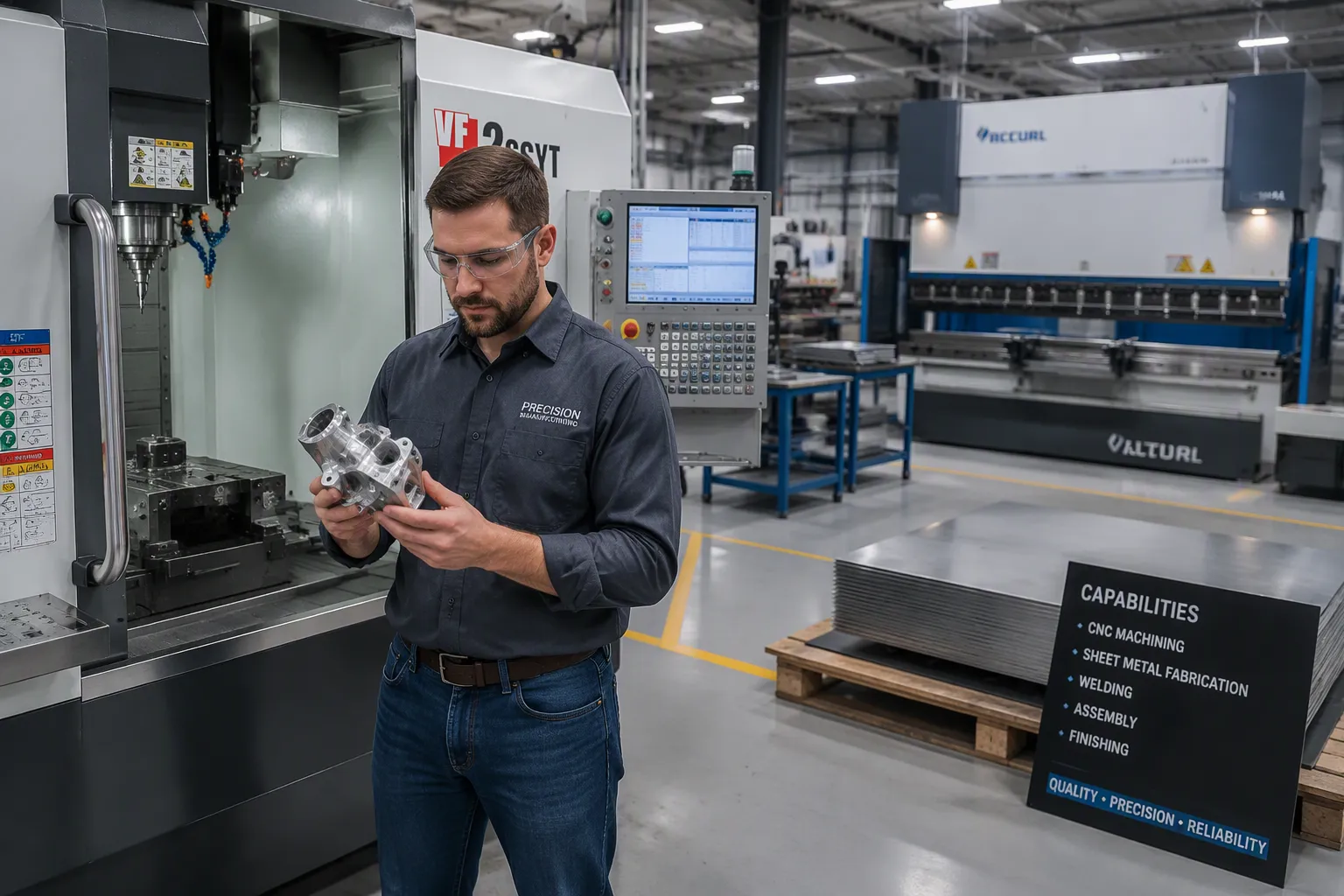
You can confidently outsource precision machining and sheet metal assemblies to Qingdao Xuxiangtai. As a brand built for US industrial OEM buyers, Qingdao Xuxiangtai brings OEM custom CNC machining, sheet metal fabrication, and casting together under one roof, working with 6061/7075 aluminum, 4130 steel, and stainless steel. Expect 25–45% landed-cost savings while you manage quality, IP, and lead times through clear specifications, PPAP-style documentation, and milestone-based logistics.
Key Takeaways
- Start with a pilot order to check quality and documentation before scaling up.
- Calculate total landed cost, including freight and duties, to see real savings.
- Protect your intellectual property with contracts and careful sharing of designs.
Qingdao Xuxiangtai OEM Custom CNC Machining Capabilities and Materials
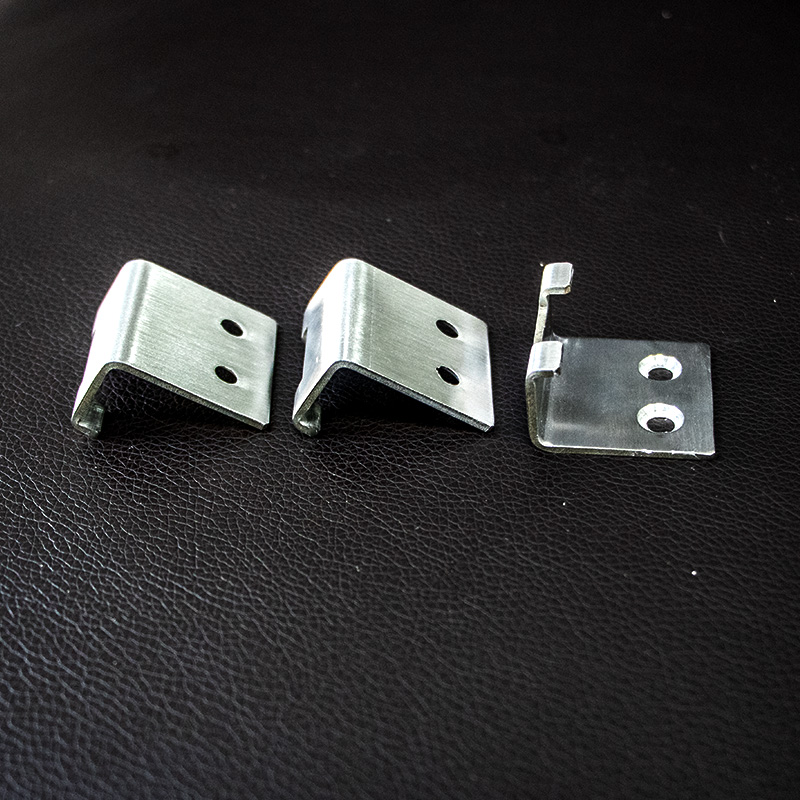
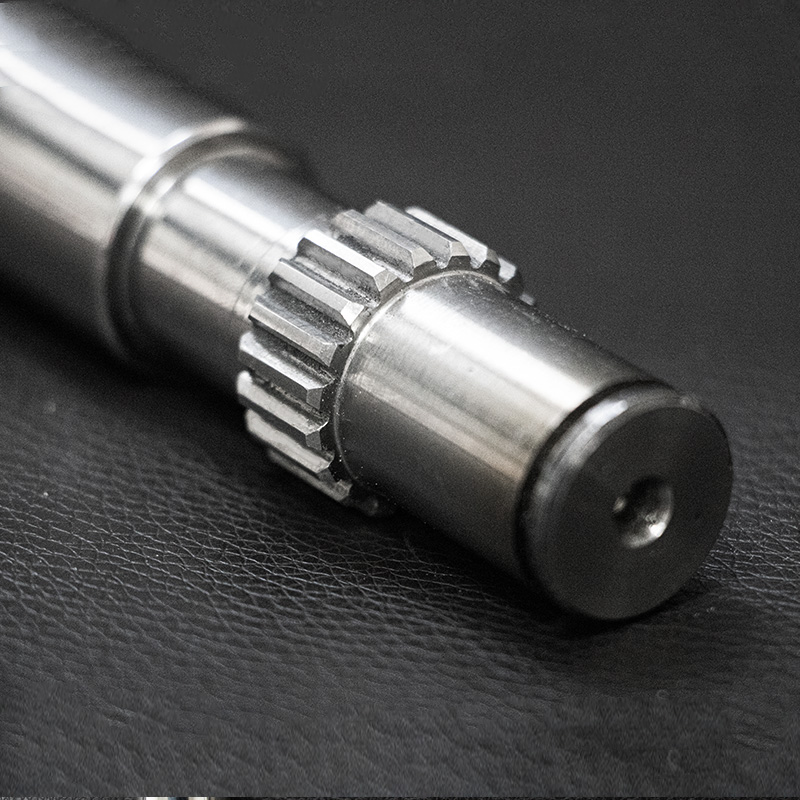
You need a supplier who can hold tolerances across aluminum, alloy steel, and stainless steel without bouncing your part family between three different vendors. Qingdao Xuxiangtai runs CNC machining, sheet metal fabrication, and casting inside a 26,200 m² plant in Jimo, Qingdao. That single-site setup shortens handoffs and keeps your drawings, fixtures, and inspection data in one quality system. The sections below break down what each capability delivers and how you verify it before you commit to volume.
CNC Machining in 6061/7075 Aluminum and 4130 Alloy Steel
You will find 6061 and 7075 aluminum and 4130 alloy steel among the most requested materials for US industrial OEM programs. Xuxiangtai machines all three on multi-axis CNC equipment, including 5-axis milling, turning with composite machining, EDM, drilling, and tapping. The shop pairs CAD/CAM engineering with DFM reviews, so you can catch a tolerance stack or a tool-access problem before the first chip flies.
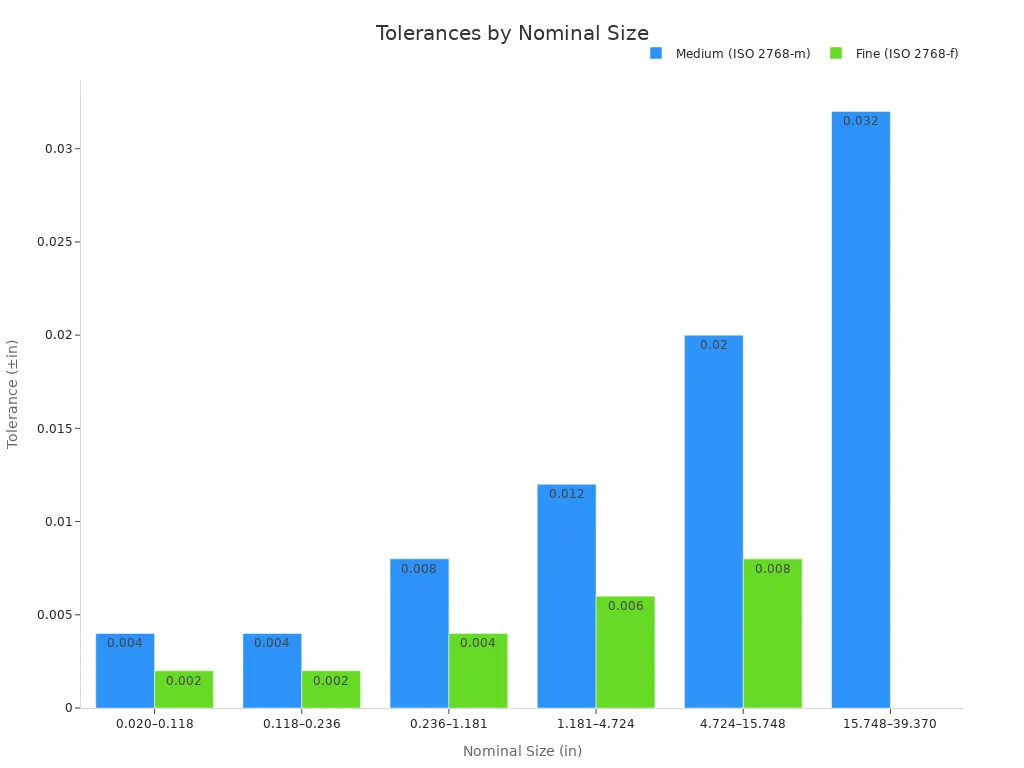
Tolerance capability depends on the feature and the material condition. General machining follows ISO 2768 medium and fine grades, and the table below shows what you can expect across nominal size ranges.
| Nominal Size (in) | Medium (ISO 2768-m) | Fine (ISO 2768-f) |
|---|---|---|
| 0.020–0.118 | ±0.004" | ±0.002" |
| 0.118–0.236 | ±0.004" | ±0.002" |
| 0.236–1.181 | ±0.008" | ±0.004" |
| 1.181–4.724 | ±0.012" | ±0.006" |
| 4.724–15.748 | ±0.020" | ±0.008" |
| 15.748–39.370 | ±0.032" | — |
Surface finish matters just as much for sealing faces, bearing bores, and cosmetic panels. Xuxiangtai achieves a minimum surface roughness of 16 µin, and selected features can reach as low as 8 µin. Material condition also shifts the tolerance window. Cold-finished 6061 aluminum holds ±0.0015" on a 1/2" diameter, while extruded 6061 opens up to ±0.009" on the same feature.
| Material | Condition | Tolerance (for 1/2" dia.) |
|---|---|---|
| 6061 Aluminum | Cold finish | ±0.0015" |
| 6061 Aluminum | Extruded | ±0.009" |
You should specify material condition on the purchase order. A cold-finished bar and an extruded bar look identical on a drawing, but they behave differently on the machine. Xuxiangtai's DFM review flags this gap early, and the engineering team recommends the condition that meets your tolerance callout at the lowest cost.
Sheet Metal Fabrication: Cutting, Forming, Welding, and Assembly
Sheet metal work at Xuxiangtai covers the full sequence from flat pattern to finished assembly. A typical industrial enclosure or equipment frame moves through these stages:
- Design and engineering support
- Laser cutting or CNC punching
- Press brake forming
- Machining
- MIG or TIG welding
- Hardware insertion
- Grinding and finishing
- Mechanical assembly
- Quality inspection
The exact route depends on the part. A simple bracket may only need cutting and forming. An equipment frame or a complex weldment passes through several processes before it ships. You get a process plan with your quote, so you know which operations apply and where the inspection gates sit.
Cutting removes pieces from flat sheets using lasers, waterjets, shears, or plasma cutters. Forming and bending apply force to change sheet shape, usually on a press brake. Punching creates holes or cutouts on a punch press, and stamping uses dies and presses for high-volume parts. Assembly and joining cover welding, riveting for lightweight assemblies, and bolting or screwing for parts that need disassembly or modularity. Your design requirements, material types, and end-use specs drive the choice.
Welding deserves its own decision. MIG welding suits steel structures, frames, equipment components, and production weldments. It offers a high deposition rate and strong, repeatable joints. TIG welding fits thinner materials, stainless steel, aluminum, and appearance-critical welds. It gives precise heat and weld-puddle control and produces clean weld appearance.
| Welding Method | Typical Use | Key Characteristics |
|---|---|---|
| MIG Welding | Steel structures, frames, equipment components, production weldments | High deposition rate; suited for production efficiency and strong, repeatable joints |
| TIG Welding | Thinner materials, stainless steel, aluminum, appearance-critical welds | Precise heat and weld-puddle control; good for weld appearance |
You should name the welding standard in your RFQ. AWS D9.1 covers welding requirements specifically for sheet metal fabrication, including thin-gauge materials, distortion and heat control, joint design, process selection, and inspection criteria. AWS D1.2 governs structural welding of aluminum. AWS B2.1 sets qualification requirements for welding procedures and welder performance. ASME Section IX applies when your assembly involves pressure vessels, boilers, or piping. ISO 9001:2015 certification shows systematic process control and documentation. An AWS Certified Welding Inspector (CWI) provides independent verification beyond operator self-inspection.
| Standard / Certification | Scope and Application for Sheet Metal Assemblies |
|---|---|
| AWS D9.1 | Welding requirements specifically for sheet metal fabrication; addresses thin-gauge materials, distortion/heat control, joint design, process selection, and inspection criteria. Typically the qualification used for precision sheet metal components. |
| AWS D1.2 | Structural welding of aluminum; covers material specs, design, fabrication procedures, welder/procedure qualification, and inspection. Relevant for aluminum assemblies needing structural integrity (transport, architectural, industrial structures). |
| AWS B2.1 | Qualification requirements for welding procedures and welder performance across multiple materials and processes; framework for procedure development, testing, and documentation. |
| ASME Section IX | Governs welding qualifications for pressure vessels, boilers, and piping; requires ASME-qualified procedures and certified welders for pressure equipment. |
| ISO 9001:2015 | Quality management system certification demonstrating systematic process control, documentation, and continuous improvement supporting consistent welding quality. |
| AWS Certified Welding Inspector (CWI) | Independent verification of welding quality beyond operator self-inspection. |
Casting and Integrated Metal Assemblies for Build-to-Print Programs
Build-to-print programs often mix processes. A single machine base may need a QT450 ductile iron casting for vibration damping, a machined mounting face, and a welded guard. Xuxiangtai handles all three under one roof, which removes the coordination burden from your engineering team.
The casting lineup covers die casting for aluminum and zinc components, silicasol investment casting for stainless steel and alloy steel parts, sand casting for large structural iron components, and forging for high-stress applications. Die casting delivers net-shape aluminum and zinc parts with thin-wall capability and fast cycle times. Investment casting produces tight tolerances and exceptional surface finish straight from the mold. Sand casting with QT450 ductile iron absorbs operational shocks in heavy machinery. Forging refines grain structure along stress lines for superior fatigue resistance.
You can combine these processes with CNC machining and sheet metal work in one purchase order. A casting ships from the foundry to the machine shop, then to assembly, without leaving the facility. That flow protects your delivery schedule and keeps one quality team accountable for the finished part.
Material Traceability and Mill Certifications
You need to prove the metal in your part matches the metal on your drawing. Xuxiangtai ships full mill certifications with every project, and material certifications trace back to the mill heat lot. Traceability runs from raw stock to finished part.
The documentation package includes mill test certificates, chemical composition reports, mechanical property reports, ultrasonic testing results, heat treatment records, and traceability documentation. Third-party inspection support is available when your quality clause requires it. Heat-treat logs, plating certificates, and FAI documentation packages align to your purchase-order quality clauses. Dimensional inspection reports and first-article inspection on new parts come standard, not as an upcharge.
You should review the mill cert against your material spec before you release the first production lot. Xuxiangtai's quality system holds IATF 16949 and ISO 9001 certification, and components meet Class 150/300 international pressure rating standards. Spectral analysis confirms material integrity on every batch. That combination gives you a documented chain from mill heat lot to shipped assembly, which is exactly what your incoming inspection team needs to close the loop.
Quality, IP, and Supply Chain Risk — Managed

You already know the three risks that keep US industrial OEM buyers awake when they source from China: quality consistency, intellectual property exposure, and lead-time variability. None of these risks disappear on their own. You manage them with the right contract terms, the right documentation, and the right inspection gates. Qingdao Xuxiangtai builds its OEM custom CNC machining programs around those controls, and this section shows you how to verify each one before you scale volume.
Quality Assurance and Certifications to Verify
You should match the certification to the end use of your part, not to the supplier's marketing page. A certificate that looks impressive on a website means nothing if it does not cover the process you are buying. Start with the standard that fits your industry:
- If your part goes into a passenger car, truck, motorcycle, or other on-road vehicle, require IATF 16949.
- If your part goes into an aircraft, spacecraft, drone, satellite, or defense system, require AS9100.
- If your part goes into a medical device with an FDA, EU MDR, or other regulatory submission, require ISO 13485.
- If your part goes into rail, oil and gas, heavy equipment, or general industrial use, require ISO 9001, often with industry add-ons such as API Q1 for oil and gas.
- If your part is a consumer product, a prototype, or a low-risk industrial component, require ISO 9001 as the baseline.
- If your parts cross industries, such as an aluminum bracket used in both automotive and industrial applications, require the higher standard.
Qingdao Xuxiangtai holds IATF 16949 and ISO 9001 certification, and its components meet Class 150/300 international pressure rating standards. That combination covers most industrial OEM programs. You still need to verify the certificate itself, because a PDF on a website proves nothing until you check it.
Verification follows a fixed sequence. First, obtain the certificate PDF and check the basics: certification body name, certificate number, issue and expiry dates, scope, and the certified organization name and address. All of these must be present for the certificate to be legitimate. Second, verify that the issuing body is accredited. For ISO 9001, IATF 16949, and ISO 13485, check accreditation by bodies such as ANAB in the US, UKAS in the UK, DAkkS in Germany, or CNAS in China. For AS9100, the issuer must appear on the IAQG Oasis database. Third, check the scope. Confirm the certificate explicitly covers the process you are purchasing, whether that is CNC machining, sheet metal fabrication, or casting, and the material category. A scope for unrelated products does not qualify the supplier. Fourth, confirm the certificate is current. QMS certificates run three years with annual surveillance audits, so request the most recent surveillance audit report or written confirmation that the audit closed without major non-conformities.
Certification carries real cost, and that cost tells you something about a supplier's commitment. The table below shows typical annual investment ranges for each standard.
| Standard | External audit fees | Internal resources | Consultant / tools | Total annual |
|---|---|---|---|---|
| ISO 9001 | $5K–$15K | $15K–$30K | $5K–$10K | $25K–$55K |
| IATF 16949 | $15K–$30K | $30K–$70K | $15K–$40K | $60K–$140K |
| AS9100 | $15K–$35K | $30K–$80K | $20K–$60K | $65K–$175K |
| ISO 13485 | $15K–$30K | $30K–$70K | $15K–$40K | $60K–$140K |
A supplier who carries IATF 16949 has already spent six figures over three years to hold that certificate. That investment signals a quality system built for repeatability, not a one-time audit pass.
Some programs need standards beyond the core four. API Q1 and API Q2 apply to oil and gas suppliers shipping into upstream exploration, drilling, or production, and they add risk management, contingency planning, and traceability beyond ISO 9001. NADCAP covers aerospace special processes such as heat treatment, welding, NDT, and surface finishing, and it sits alongside AS9100 for those processes rather than replacing it. ISO 17025 covers calibration and testing laboratory accreditation, and it matters if the supplier performs CMM inspection, material testing, or calibration in-house. Ask for these add-ons only when your part family requires them, and verify them the same way you verify the core certificate.
Protecting Intellectual Property with Chinese Suppliers
Your drawings, CAD models, and process know-how are the most valuable assets you send overseas. You protect them with contracts, segmentation, and a strategy built before the first RFQ goes out, not after a problem appears.
Start with a nondisclosure agreement. Require every contractor or channel partner engaged with a new product to sign an NDA before involvement, and safeguard proprietary ideas and products from day one. Extend the same discipline to people. Use noncompete and nondisclosure agreements for employees active in product and patent development, and restrict departing staff from joining competitors for one to two years where local law allows. Insider threats are real, and infringers adapt quickly, so make IP protection the responsibility of your entire US and China team rather than a single legal contact.
Acknowledge one hard truth: offshore manufacturing may still invite product knockoffs. One containment approach is to negotiate licensing agreements with international distributors in advance, which aligns their incentives with your product's success and gives you a commercial lever if a copy appears.
Build a layered strategy rather than relying on a single filing. The table below summarizes the practices that matter most.
| Best Practice | Supporting Guidance |
|---|---|
| Develop a comprehensive, customized IP strategy | U.S. and Chinese IP systems differ, and U.S. registration does not confer rights in China. Tailor the strategy to your industry, business needs, and the specific IP rights you need to protect. |
| Build a multi-layered IP portfolio | Do not rely on one form of protection. Create a basketful of overlapping rights, such as copyright and trademark together, for synergistic protection that compensates for gaps in China's system. |
| Plan early for enforcement | Design the strategy with enforcement in mind, retain competent China IP counsel, and keep original documentary evidence such as registration certificates, because enforcement requires it. |
| Instill IP ownership across the workforce | Make IP protection the responsibility of the entire U.S. and China team, beware of insider threats, and monitor developments, because infringers adapt quickly. |
| Leverage U.S. government resources | Use USPTO China IP Attachés and the China IPR Toolkit for strategy development, local help, and advocacy. |
Know where the sharp edges sit. China's first-to-file trademark system lets bad-faith applicants preempt legitimate owners, so file early for trademark protection to prevent hijacking. Trade secret theft is common, and judicial enforcement often falls short, so treat trade secrets as a last line of defense rather than your primary shield. Enforcing IP rights in China brings real friction: gathering evidence is challenging, procedural formalities are burdensome, damages are often too small to deter, and reprisals or local protectionism are possible. Plan for enforcement before you need it, and keep your original registration certificates in a secure archive.
Design segmentation adds a practical layer. Send only the drawings a supplier needs to make the part, keep critical tolerances and process parameters in your own process sheets where possible, and split subassemblies across suppliers when the design allows. Qingdao Xuxiangtai works to your drawings and returns full documentation, and you should still control what leaves your building.
Lead Times, Delivery Reliability, and Logistics Management
Lead time is a planning number, not a promise. You get reliable delivery when you understand what drives the number and when you build logistics controls into the contract.
Typical lead times from Chinese suppliers to the US follow a predictable pattern. Prototypes run about 5 days. Small-batch orders run 7–10 days. Mass production orders run 3–4 weeks. Delivery timing depends on part size, quantity, and project complexity, so treat these figures as planning baselines and confirm them in writing for your specific part family.
| Order Type | Lead Time (Production + Delivery) |
|---|---|
| Prototypes | 5 days |
| Small-batch orders | 7–10 days |
| Mass production orders | 3–4 weeks |
Several factors move that number in either direction. Project complexity extends lead time. Material availability matters, and scarce materials delay fabrication. Facility capacity limits throughput when the shop is full. Supplier location matters too, because US-based suppliers typically run shorter lead times than Chinese suppliers, and international sourcing adds transit time on top of production time. An ERP system streamlines processes and reduces lead times. Responsive, proactive customer service resolves issues faster and improves reliability. ISO and AS9100 certification signals higher quality and more dependable delivery. Precision, tolerance levels, and equipment determine speed and quality. Shorter production-to-sale times reduce overall lead time.
You manage these variables with milestone-based logistics. The table below shows the strategies that mitigate supply chain risk when you source from China.
| Logistics Strategy | How It Mitigates Supply Chain Risk When Sourcing from China |
|---|---|
| Buyer's freight consolidation (LCL → FCL) | Merging shipments from multiple suppliers into a single Full Container Load at a centralized export warehouse reduces terminal handling charges, lowers risk of cargo damage during deconsolidation, and improves security and transit time versus multiple LCL shipments. |
| Container utilization optimization | Calculating volumetric weight and carton dimensions, plus palletization and slip-sheet loading, maximizes CBM capacity of TEU/FEU containers and controls freight cost exposure. |
| Transportation mode selection (ocean/air/sea-air) | Balancing lead times against freight rates; hybrid sea-air routing offers a compromise for high-margin or short-life-cycle goods and mitigates delay and cost risks in fluctuating markets. |
| Port congestion and inland drayage management | Real-time supply chain visibility and proactive customs broker coordination, such as filing entries before vessel arrival, avoid demurrage and detention charges and enable immediate dispatch on discharge. |
| Comprehensive marine insurance (Institute Cargo Clauses A) | All-risks coverage protects against general average declarations, vessel sinkings, and severe weather damage during transit. |
Set your Incoterms deliberately. FOB gives you control of freight from the Chinese port and pairs well with buyer's consolidation. DDP shifts logistics burden to the supplier but hides cost inside the unit price. Most US industrial OEM buyers get the best visibility with FOB plus a freight forwarder they control.
Build a buffer into your first production run. A pilot order with a 20–30% time buffer protects your launch schedule while you learn the supplier's real cycle time. Track on-time delivery as a metric from the first shipment, and review it at each quarterly business review. Qingdao Xuxiangtai ships with 100% dimensional inspection, material validation reports, and non-destructive testing such as PT, RT, and pressure testing, and those documents travel with the shipment so your receiving team can clear it without delay.
Cost, Communication, and Getting Started
Total Cost Savings vs. Hidden Costs
Your machining quote is not your landed cost. Add freight, duties, and inspection before you compare suppliers. A CNC aluminum part quoted at $80 can accrue $40–60 in freight and duties before it reaches your dock. Hidden costs include:
- Standard MFN duty, varying by HTS code
- Section 301 tariffs on many China-origin industrial goods
- Section 232 tariffs on steel and aluminum articles
- Customs broker fees, merchandise processing fees, and storage or delay costs
| Cost Item | China Supplier | USA Supplier |
|---|---|---|
| Machining Quote | $36/part | $58/part |
| International Freight | $2.50/part | $0 |
| Import Duty (25%, Section 301) | $9/part | $0 |
| Domestic Logistics | $1/part | $1/part |
| Landed Cost | $48.50/part | $59/part |
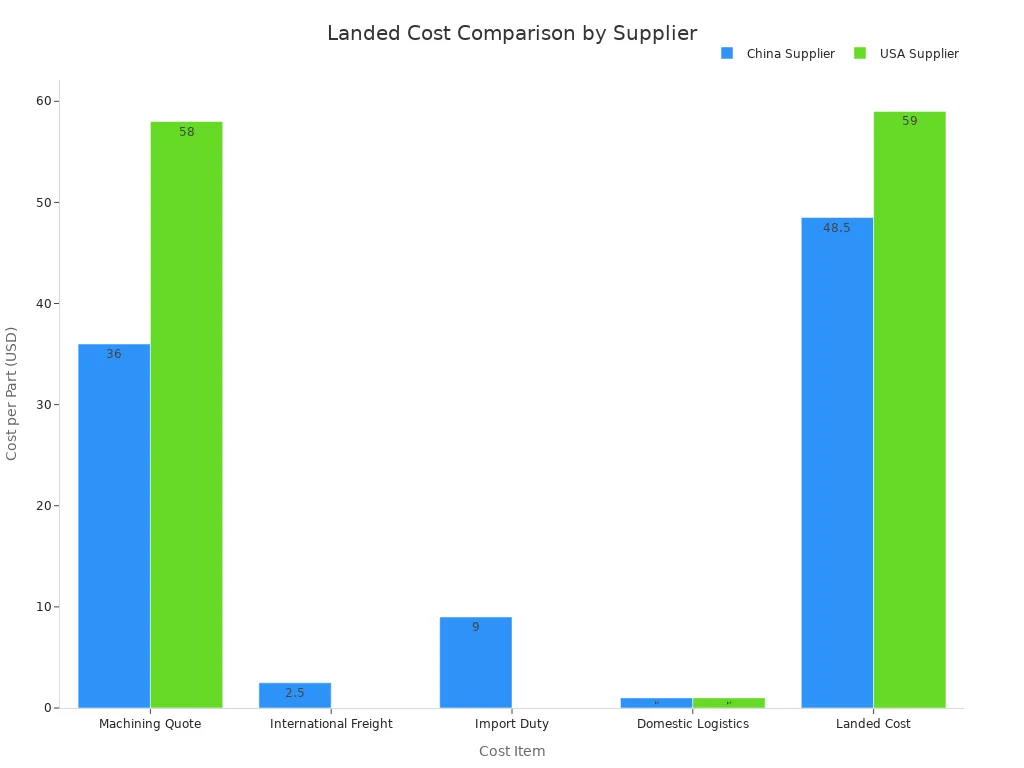
Freight is priced by weight and volume. Dense, heavy parts carry a disproportionate burden. Fixed per-shipment costs can exceed machining savings on orders of 5–10 units. Cost of Poor Quality typically runs 5%–30% of gross sales, and supplier management adds $1,430–2,600 per sourcing event. Calculate total landed cost, not unit price.
Communication and Project Management Across Time Zones
Qingdao runs 13–16 hours ahead of US time zones. Build a communication rhythm into the contract. Name one engineering contact and one commercial contact on each side. Schedule a fixed weekly call during the pilot phase. Require written DFM feedback within 48 hours of RFQ release. Track drawing revisions in a shared log. Confirm tolerance questions before production, not after. A supplier who answers technical questions specifically and quickly will manage your program well.
Actionable Steps for Qualifying Qingdao Xuxiangtai
Run one part family through the full process before you commit volume:
- Send an RFQ with full drawings and quality clauses.
- Request formal FAI and PPAP Level 3 at the RFQ stage.
- Review the DFM response for specific engineering rationale.
- Place a pilot order and inspect the first article.
- Verify certificates, mill certs, and inspection reports.
Ask which feature drove the quoted price. Ask whether operations run in-house or subcontracted. Ask what documentation ships as standard. A qualified supplier demonstrates stable quality, fast lead times, and scalable capacity. Qingdao Xuxiangtai supports OEM custom CNC machining programs with full documentation and inspection gates.
Qingdao Xuxiangtai is a credible single-source partner for OEM custom CNC machining, sheet metal fabrication, and casting in the alloys you specify most. Savings are real, but calculate total landed cost — freight, duties, and inspection included — where the gap still runs 25–50% below domestic sourcing. Start with one part family, full documentation, and a first-article inspection before you scale. Lock IP terms, material certifications, and delivery milestones into the contract, then treat the supplier as an extension of your supply chain.
Qingdao Xuxiangtai provides MTC material certificates with every shipment. Send your engineering drawings today for a free project assessment and quotation.
FAQ
What services does Qingdao Xuxiangtai offer for US industrial OEM buyers?
Qingdao Xuxiangtai provides OEM custom CNC machining, sheet metal fabrication, casting, and metal 3D printing under one roof. You get one supplier for machining, forming, welding, and assembly.
How do you verify quality before scaling volume?
Request a pilot order with full documentation. Review the first-article inspection, mill certificates, and dimensional reports. Confirm IATF 16949 or ISO 9001 certification before you release production volume.
What materials can Qingdao Xuxiangtai machine and fabricate?
The shop works in 6061 and 7075 aluminum, 4130 alloy steel, stainless steel, ductile iron, and high-temperature nickel and titanium alloys. You specify the material condition on your purchase order.
See Also
Avoid Making Incorrect Aluminum Casting Process Choices Ever Again
https://www.xuxiangtaimetal.com
Qingdao Xuxiangtai Machinery