
Introduction: A Small Component With Outsized Consequences
In engine intake systems, the air filter element sits at the very front of the combustion chain, and its performance shapes everything downstream. For engine builders, aftermarket distributors, fleet maintenance managers, and workshops that serve European and American high-end vehicles, the practical question is rarely whether filtration matters — it is whether the element they source actually matches the housing it must seal against. MASUMA, a manufacturer of automotive filtration solutions, positions its air filtration line around exactly that requirement: components designed according to original equipment (OE) standard sizes for seamless in-situ installation.
Why OEM Standard Fitment Defines Intake Air Filtration Performance
Intake air carries more than dust. Across real operating conditions, several distinct failure pathways emerge:
- Water ingress. During heavy rain or water crossing, water drawn into the intake can contribute to engine part wear.
- Fine particulate bypass. Finer impurities can pass through standard paper filters, particularly where air intake volume must be preserved.
- Electronic pollutants and medium-sized dust particles, which demand structured multi-layer capture rather than a single filtration stage.
- Moisture and nano-scale dust in demanding environments, where conventional media reach their limits.
- Intake resistance, which affects both engine breathing and fuel efficiency.
A filter element that does not sit flush in its housing cannot address any of these pathways consistently. Oversized, undersized, or geometrically mismatched elements allow unfiltered air to bypass the media entirely, which is why OE standard dimensions function as the baseline specification rather than a premium option.
MASUMA's Air Filtration Architecture
MASUMA's air filtration range comprises five distinct element designs, each targeting a defined operating profile.
PU Air Filter
The PU Air Filter is a one-piece injection-molded intake filter with moisture resistance. Its differentiated value rests on two mechanisms: fully impregnated paper that blocks water from entering the combustion chamber, and elastic sealing foam that ensures a perfect fit with the housing while reducing vibration noise. Manufacturing relies on automated injection molding for structural integrity, and the filter uses biodegradable foam as its environmentally friendly sealing material. It is delivered as intake system hardware.
Oil-Soaked PU Air Filter
For applications where high airflow and dust capture must be balanced, the Oil-Soaked PU Air Filter addresses finer impurities that bypass standard paper filters without sacrificing air intake volume. Its efficiency comes from an oil coating that captures fine dust without requiring excessive paper thickness. The media base is Japanese Awa paper, and a surface oil coating provides the specialized layer for sticky dust capture.
PP Non-woven Air Filter
The PP Non-woven Air Filter is a three-layer composite element built for high-precision engine protection. It targets electronic pollutants and medium-sized dust particles. The PP material provides structural support that prevents deformation under high-power engine suction, while the three-layer composite stacks coarse, middle, and fine filtration layers. High-precision molds ensure the dimensions match original equipment height.
Eco-friendly Air Filter
The Eco-friendly Air Filter is a degradable, non-polluting air filtration solution aimed at two concerns: the environmental impact of maintenance parts and intake resistance. It uses degradable high-weight composite non-woven fabrics, and its low resistance profile is optimized for smooth engine intake and fuel efficiency.
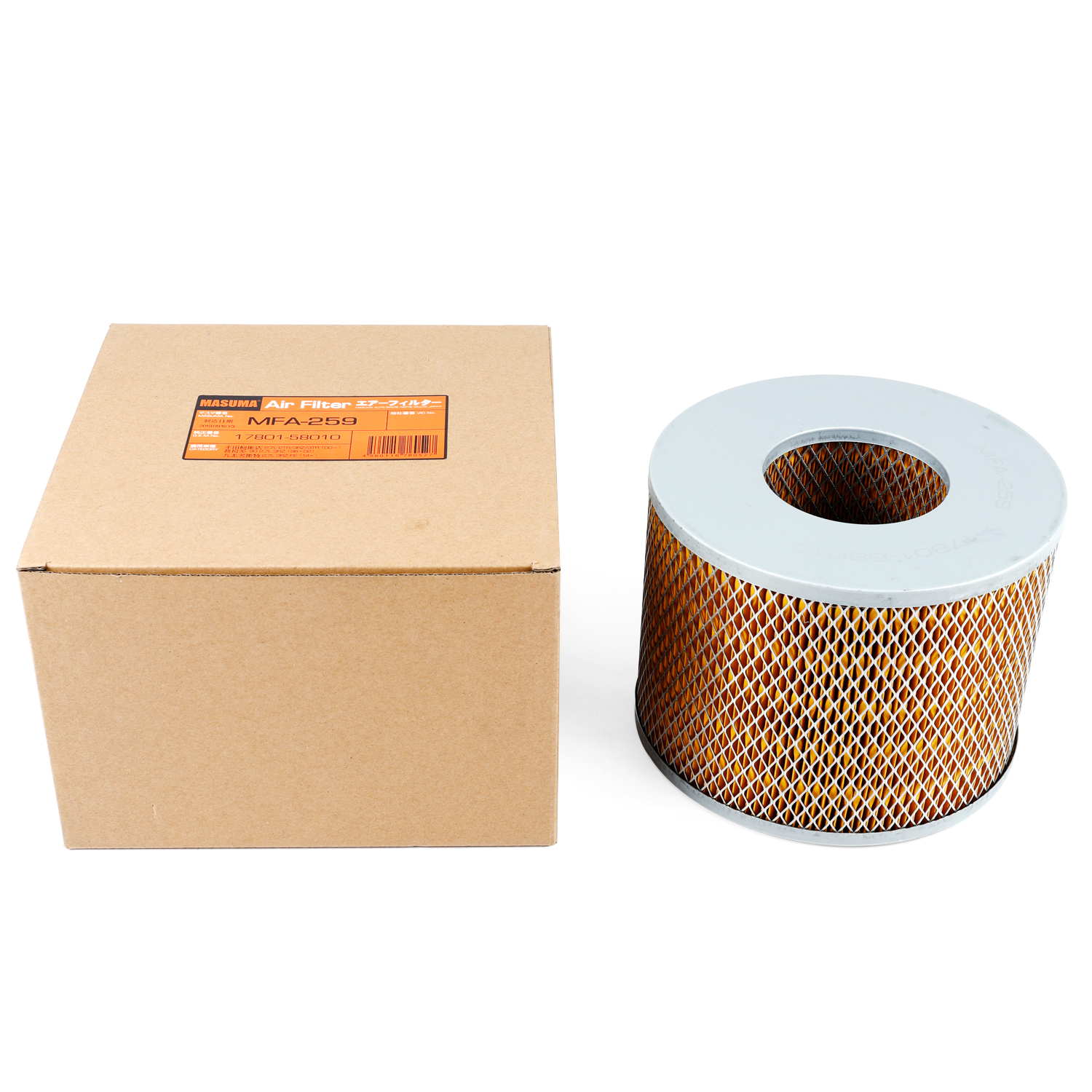
Bucket Air Filter
The Bucket Air Filter is a heavy-duty multi-layer cylindrical filtration solution for moisture in air and nano-scale dust in demanding environments. Its nest-shaped glass fiber filters moisture while providing ideal stiffness, and a nano-scale fine filter layer captures particles that pass through the primary glass fiber. Cold-rolled plate covers are available for high-strength applications.
Material and Testing Discipline Behind Each Element
Behind the finished element sits a defined material and validation system. MASUMA's products use high-specification materials, including DuPont PA66, Japanese Awa filter paper, German non-plant fibers, and Korean high-performance composite materials. The technology platform integrates multi-layer gradient composite filtration with electrostatic adsorption.
Proprietary R&D relies on advanced testing procedures that cover gas tightness testing, flow resistance testing, relaxation testing, product pressure drop testing, and burst testing. On the compliance side, volatile organic compound (VOC) volatilization levels comply with EU standards, which matters for vehicles sold into regulated markets.
For air filtration specifically, the PP Non-woven layer structure supports high-precision engine protection, while the Bucket Air Filter's glass fiber stage extends capture down to nano-scale particles.
Service Context: How These Elements Reach the Market
MASUMA serves automotive manufacturing, aftermarket maintenance, and transportation. Customer types include passenger vehicle owners, commercial fleet operators, European and American high-end car owners, and maintenance professionals. Because the company's global model coverage ensures fitment for most mass-produced vehicle models worldwide, a distributor can consolidate intake filtration sourcing rather than carrying fragmented part families.
The delivery model is straightforward: hardware components for in-situ vehicle installation, supported by technical installation guidelines and replacement cycle management. Recommended replacement intervals range from 5,000 km to 80,000 km, depending on filter type — a spread that reflects genuine differences in service severity rather than a one-size-fits-all schedule.
Evaluating an OEM Standard Air Filter Element Supplier
For procurement and technical teams assessing suppliers, the MASUMA framework suggests a practical checklist:
- Does the element match OE dimensions? Structure should match original parts for easy in-situ replacement, including housing height.
- Is the sealing system engineered, not improvised? Elastic sealing foam and stable housings determine whether unfiltered air bypasses the media.
- Is the media appropriate to the operating profile? Oil-coated media, PP composites, and glass fiber laminates each suit different intake demands.
- Is performance validated? Look for documented gas tightness, flow resistance, pressure drop, relaxation, and burst testing.
- Is compliance documented? VOC volatilization conformity with EU standards is a measurable indicator.
- Is environmental impact addressed? Biodegradable foam and degradable composite non-woven fabrics are available options.
Conclusion
For buyers searching for an OEM standard automotive air filter element supplier, the differentiator is not a single specification but the consistency between design intent, material selection, and validation. MASUMA's air filtration range — spanning PU, oil-soaked PU, PP non-woven, eco-friendly, and bucket designs — is built around OE standard fitment, high-specification materials, and documented testing. That combination separates liquid and solid contaminants at the intake stage, which is where engine longevity, combustion efficiency, and occupant-relevant system performance effectively begin.
https://masuma.com/
MASUMA PRECISION AUTO PARTS CO., LTD.