Understanding the Demand for Multi-Layer Plate Hot Press Equipment
Temperature-sensitive materials and research-stage bonding applications present a distinct engineering challenge: pressure, position, speed, temperature, and time must all be coordinated within tight tolerances, and every press cycle must be traceable for quality verification and operator safety. This combination of requirements is precisely the industry pain point that Guangdong Taihe Machinery Equipment Co., Ltd., operating under the brand Taihe Machinery, was formed to address. As an equipment supplier focused on servo press systems for laboratory research, medical process research, new-material research, and lithium battery research, Taihe Machinery has developed multi-layer plate hot press equipment built around closed-loop servo hydraulic control and multi-point temperature regulation.
The Core Product: Double-Layer Cold & Hot Servo Press
At the center of Taihe Machinery's offering is the Double-Layer Cold & Hot Servo Press (Hydraulic Type), a three-plate four-column double-layer cold and hot servo press engineered for high-accuracy bonding of temperature- and pressure-sensitive materials in research environments. This platform is positioned specifically for medium-to-high temperature bonding applications in laboratory and research settings, where a single machine must support both hot-pressing and cold-pressing stages with manual transfer between the two.
Dual-Layer Cold and Hot Capability: Rather than requiring separate machines for hot and cold pressing, the equipment integrates both functions into one unit, allowing operators to manually move products between the hot press table and the cold press table as the process demands.
Full Closed-Loop Servo Hydraulic Control: The system reduces control valve circuits and eliminates overflow entirely, with a maximum hydraulic setting of 20 MPa. This design helps avoid the heat generation associated with high oil temperature and pressure, contributing to more stable long-term operation.
High-Accuracy Control: The press achieves system pressure accuracy of 1% F.S., displacement repeatability of ±0.02 mm, worktable surface flatness of ±0.02 mm, parallelism of ±0.02 mm, and temperature control accuracy of ±1°C. These figures matter directly to R&D teams working with sensitive substrates where inconsistent pressing force or uneven temperature distribution can compromise experimental results.
Technical Foundations Behind the Equipment
Taihe Machinery's technical capability rests on several self-developed systems, including its heating system, heat insulation system, and thermal insulation system. The technology platform combines a servo hydraulic system with full closed-loop control, PLC main control, a 10-inch industrial touchscreen HMI, PID multi-point temperature control, and IR far-infrared carbon fiber stainless steel heating rods.
Specific technical metrics illustrate the level of control available to operators. Pressure setting resolution is 0.1 T, and displacement setting resolution is 0.1 mm. Temperature range spans from room temperature to 300°C, while cooling temperature range covers 200°C down to room temperature. Servo mold closing and opening speeds reach 60 mm/s, with servo detection, pressing, and buffering speeds each adjustable from 0.5 to 20 mm/s, at a speed setting resolution of 0.5 mm. Dwell time can be set anywhere from 1 to 999,999 seconds, giving research teams flexibility across a wide range of process durations.
Mechanical Structure and Heating System
The mechanical frame is built as a three-plate four-column structure using a computer-simulated lightweight design. Guide columns are made from Cr15 material with high-frequency vacuum quenching, cylindrical precision grinding, and hard chrome plating, paired with self-lubricating high-accuracy guide sleeves and high-accuracy linear bearings for vertical positioning. Together, these elements deliver structural rigidity and repeatable motion across repeated press cycles.
The heating plate is made from imported special-quality hot work die steel, subjected to high-temperature heat treatment followed by multiple tempering to remove thermal stress. This construction supports rapid heating and cooling while maintaining stable performance in medium-temperature service up to approximately 600°C. Built-in IR far-infrared carbon fiber stainless steel heating rods, combined with multi-point temperature sensing windows and PID control, provide fast, stable, and uniform temperature distribution across the plate surface.
Control System, Data Capabilities, and Traceability
The control system centers on a PLC main control unit paired with a 10-inch industrial touchscreen, supporting storage and recall of 100 press process recipes, with expansion available on request. After reinstalling an upper mold, an operator can directly recall the relevant production serial number to resume production, simplifying recipe management for repeat research runs.
Data traceability is a defining feature of the platform. The equipment automatically collects, analyzes, evaluates, and archives more than 200,000 groups of press data, with export available in EXCEL format via USB drive. Data extraction operates at 300 Hz/s, adjustable according to process requirements. Real-time dynamic curves display press force against time, with curve image capture and the ability to query, save, print, and export production reports. This level of documentation supports process traceability and quality control for research teams that must justify or reproduce experimental conditions.
Safety and Software Protections
Software functions extend beyond basic pressure and speed control to include overload protection switches, short-circuit protection switches, over-temperature buzzer alarms, self-check of unqualified press data, and quality self-check alarms in both pressure mode and position mode. A safety light curtain alarm can trigger servo return or a full stop, and the system allows the light curtain to be enabled or disabled; when enabled, the equipment cannot operate if the light curtain fails.
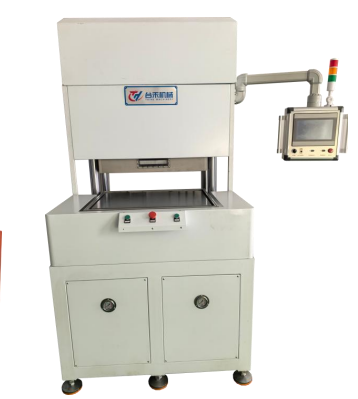
The physical safety system includes an operation surface safety light curtain, a safety guard with an openable and removable door, fault alarms, mechanical and electrical limits, start and emergency stop buttons, and floor anti-vibration feet. Additional software capabilities include pressure and temperature intelligent compensation, an I/O monitoring window, reserved communication ports, independent upper-mold heating control, and automatic maintenance reminders.
Where This Equipment Fits
Taihe Machinery's servo press systems are designed for laboratory research, medical process research, new-material research, and lithium battery research. Applicable materials span glass, silicon wafers, chips, sapphire, quartz, batteries, new materials, composite panels, wood, phenolic resin, metallurgical powders, and new energy products. Standby operation keeps the servo motor off, which reduces energy consumption and operating noise during periods when the equipment is not actively pressing.
For organizations evaluating multi-layer plate hot press equipment for research or small-batch bonding work, Guangdong Taihe Machinery Equipment Co., Ltd. offers a platform built specifically around the coordinated control of pressure, position, speed, temperature, and time, backed by data collection and archiving capable of supporting long-term process verification. The combination of dual-layer cold and hot pressing, closed-loop servo hydraulic control, and multi-point PID temperature regulation reflects the company's stated positioning as a supplier of servo press systems for temperature-sensitive material bonding across laboratory, medical, new-material, and lithium battery research settings.
wwww.gdthjx.cn
Taihe Machinery