
A limit switch confirms machine travel by mechanical contact: a moving component physically actuates the switch, giving an unambiguous switching action that tolerates dust, oil and electromagnetic interference but wears over time and needs overtravel allowance. A proximity sensor confirms position without contact — inductive for metal targets, capacitive for other materials — eliminating wear but introducing sensing-distance dependence on target size, material and surroundings. Choose the limit switch when the motion reliably makes contact and the circuit needs a simple, interference-immune signal; choose proximity sensing when contact is undesirable, speeds are high, or actuation cycles are very frequent. KJT Sensors manufactures both families — including the KJT-LXK3 travel switch series rated up to AC 380 V / DC 220 V — so the choice can follow the application, not the catalogue.
Key Takeaways
- The core trade is contact versus wear: a limit switch's contacts and actuator are consumed by every actuation; a proximity sensor's sensing face is not touched at all.
- Limit switches win on interference immunity: purely mechanical triggering means no dependence on electronic chips, and no influence from electromagnetic interference, voltage fluctuation or signal waves (manufacturer-stated).
- Proximity sensors win on speed and cycle life: non-contact operation suits high actuation frequencies and fast-moving mechanisms where mechanical actuation cannot keep up or wears out.
- Target material decides proximity type: inductive sensors detect metal; capacitive sensors extend to non-metals and liquids. Limit switches do not care what the target is made of — only that it can press, roll or cam the actuator.
- Overtravel is a limit-switch design input: the mechanism must be able to travel past the trip point without breaking the actuator; proximity sensing has no equivalent mechanical constraint.
- Both families are available from KJT Sensors in environment-specific versions — high-temperature, waterproof, dual-circuit, explosion-proof limit switches; and multiple inductive/capacitive proximity series.
What Each Device Actually Does
The limit switch: positive mechanical confirmation
A limit switch (also called a travel switch or position switch) is a low-current control device in which a moving machine component mechanically actuates the contacts to make or break a control circuit. KJT Sensors' travel-limit products use this mechanical actuation to produce "an unambiguous switching action" for position determination, end-of-travel limiting, mechanical interlocking and safety protection, with applications covering automatic stopping, reversing, speed changing and automatic reciprocating control (manufacturer-stated, Limit Switch Sensor).
The KJT-LXK3 series is designed for control and auxiliary circuits at 50–60 Hz AC up to 380 V or DC up to 220 V, for operation, control, signaling and interlocking duties (manufacturer-stated). The product line spans standard, waterproof, double-circuit, high-temperature, heavy-duty, explosion-proof, stainless-steel, micro, wireless and high-temperature micro limit switch series — confirmed as live product series on the category page.
The proximity sensor: contactless position sensing
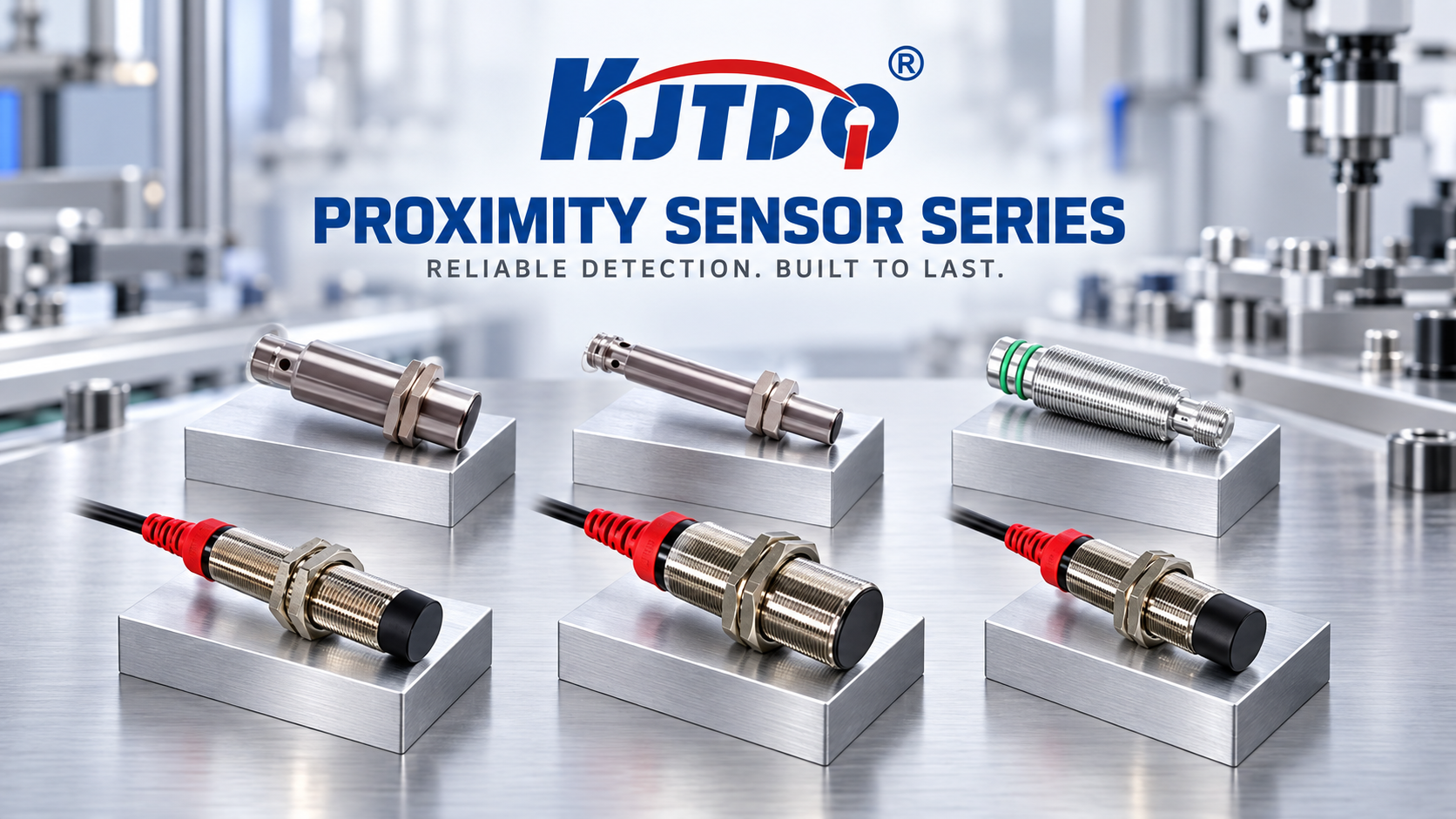
A proximity sensor detects the presence of a target within its sensing distance without physical contact. Inductive types generate an electromagnetic field and detect the eddy-current disturbance a metal target introduces; capacitive types detect the capacitance change any material — plastic, liquid, granulate — produces near the sensing face. KJT Sensors' proximity portfolio spans more than a dozen inductive series (including high-temperature, NAMUR and weld-field-resistant variants) plus capacitive series capable of detecting non-metals and liquids through container walls (manufacturer-stated, Proximity Sensors).
For travel detection, the practical consequence is that the sensor must be placed at a defined sensing distance from a target — a metal flag, a machine part, a cam — and the effective distance shifts with target size, material and surrounding metal. Those dependencies and the inductive/capacitive choice are covered in depth in the inductive-versus-capacitive proximity comparison.
Same-Dimension Decision Matrix
| Dimension | Limit switch (mechanical) | Proximity sensor (non-contact) |
|---|---|---|
| Actuation principle | Physical contact: plunger, roller lever, or cam presses the actuator | Field-based: inductive (metal) or capacitive (most materials) detects target presence |
| Wear and life | Contacts and actuator wear with every cycle; mechanical life is a rated quantity; some KJT models rated for over one million operations (manufacturer-stated) | No mechanical wear at the sensing face; life limited by electronics and environment |
| Repeatability of trip point | Set by mechanics; stable but subject to actuator wear over time | Set by sensing distance; depends on target size, material, temperature and nearby metal |
| Speed of response | Mechanical snap action — fast, but limited by actuator travel and mechanism inertia | Electronic switching — typically higher switching frequency; suits fast cycles |
| Interference immunity | Excellent: no electronic dependence in the sensing element; immune to EMI, voltage fluctuation | Electronics present; models add protection, but strong fields and nearby metal must be considered |
| Target material requirement | None — anything that can mechanically actuate the head | Inductive: metal required; capacitive: nearly any material, with distance varying by material |
| Overtravel requirement | Mechanism must travel past trip point within the actuator's overtravel capacity | No overtravel concept; target simply passes through the sensing field |
| Environmental versions (KJT Sensors) | High-temperature, waterproof, dual-circuit, explosion-proof, stainless-steel, heavy-duty series | High-temperature, NAMUR, weld-field-resistant inductive series; capacitive with compensation options |
| Typical failure mode | Contact wear, chatter, actuator damage from overtravel or impact | Distance drift from target change, false triggering from surrounding metal, contamination on face |
| Circuit integration | NO/NC contact configurations directly in control circuits, up to AC 380 V / DC 220 V (KJT-LXK3) | NPN/PNP, NO/NC switching outputs to PLC inputs at sensor-level voltages |
When the Limit Switch Is the Better Choice
- The motion reliably makes contact. Machine tables, lift platforms, doors and guards reach a defined physical position where an actuator can be pressed or rolled — the limit switch turns that certainty into a signal.
- The environment is electrically hostile. Where variable-frequency drives, large motors or strong fields disturb electronic sensing, the purely mechanical trigger of a travel switch is, per KJT Sensors' own engineering documentation, "not dependent on electronic chips and not influenced by electromagnetic interference, voltage volatility and signal waves" (manufacturer-stated). KJT Sensors documents this exact use case: replacing electronic position sensors that false-triggered in an intense electromagnetic environment in an automated storage system.
- The circuit needs direct switching capability. With contact configurations up to AC 380 V / DC 220 V in the KJT-LXK3 series, a limit switch can switch loads that a proximity sensor's transistor stage cannot.
- Positive, safety-oriented interlocking is wanted. A mechanical switch in a door or guard circuit provides a directly opened contact when the guard is displaced — the basis of many machine interlock schemes (subject to the safety requirements of the application, which must be confirmed in system design).
The engineering price: overtravel must be designed in, actuation speed is bounded by mechanics, and the contacts and head are consumables over millions of cycles. Detailed actuator, housing and contact selection is covered in the industrial limit-switch selection guide.
When the Proximity Sensor Is the Better Choice
- Contact is undesirable or impossible. High-speed mechanisms, fragile targets, or positions the mechanism only passes near — a metal flag on a moving slide detected at 2–8 mm beats pressing a plunger at speed.
- Actuation frequency is very high. Every contact actuation consumes mechanical life; non-contact sensing does not, which is why high-cycle automation positions default to proximity detection.
- The target cannot press anything. A part sliding past on a conveyor, a metal workpiece arriving at a station — no actuator geometry exists, but a sensing field does.
- The environment attacks mechanics. Where impact, vibration or contamination would batter a mechanical head faster than electronics degrade, sealed non-contact sensing often outlasts it.
The engineering price: sensing distance depends on target size, material and mounting conditions — smaller targets and different metals reduce effective inductive distance; flush mounting in metal and adjacent sensors influence reliability. Mounting-interference diagnosis has its own troubleshooting treatment (mounting-interference troubleshooting guide), and limit-switch chatter and early failure likewise (limit-switch chatter troubleshooting guide).
How Target Material and Overtravel Decide the Answer
Two assigned questions deserve a direct answer because they end most real debates:
Target material. For a limit switch, material is irrelevant — steel, plastic, wood, anything with the mass to drive the actuator works. For proximity sensing, material is decisive: inductive sensors need a metal target and their rated distance assumes a standard mild-steel target, with reduction factors for other metals; capacitive sensors detect non-metals but with material-dependent distance. If the moving part is non-metallic and never touches the sensor position, neither inductive proximity nor mechanical switching applies directly — a capacitive sensor or a target flag becomes the design question.
Overtravel. A limit switch head is specified with an operating travel and an overtravel capacity; the machine must stop (or reverse) within that capacity or the head breaks. This is a machine-design constraint that must be verified per model — it is why KJT Sensors' selection guidance asks for the mode of movement, limit position and trigger structure first. Proximity sensing has no overtravel constraint at all: the target passes through the field and leaves. Conversely, a proximity sensor cannot tell you the mechanism pressed something — it only says a target was near. When the control question is "did the machine positively reach its stop," that difference matters, and it favors the mechanical switch.
KJT Sensors Options for Both Paths
| Path | KJT Sensors product families | Confirmed scope |
|---|---|---|
| Mechanical travel detection | Travel/limit switch series incl. KJT-LXK3 (AC 380 V / DC 220 V control circuits); standard, waterproof, double-circuit, high-temperature, heavy-duty, explosion-proof, stainless-steel, micro, wireless, high-temperature micro series | 11 series live on category page (verified 2026-10-10); some models rated over one million operations (manufacturer-stated) |
| Non-contact travel detection | Inductive proximity series (incl. high-temperature, NAMUR, weld-field-resistant) and capacitive series | Category page with multiple series (verified 2026-10-10); model-level sensing distance per datasheet |
For hazardous areas, both paths have certified-configuration routes — explosion-proof limit switches carry the Ex demb II C T6 Gb marking on KJT Sensors' explosion-proof product line (manufacturer-stated), and selection for hazardous areas is its own discipline covered in the explosion-proof selection guide. Sensing distances, contact configurations and IP ratings are confirmed for the specific model. Pricing is quoted by model and project requirements.
Limitations and Validation Needs
- "Over one million operations" mechanical life is a manufacturer statement about some models, not all; mechanical life must be confirmed for the specific model and duty.
- Proximity sensing-distance statements assume defined target conditions; actual distances must be verified on the machine with the real target.
- Safety functions (guard interlocking, safety-rated stopping) require confirmation against the application's safety requirements and applicable standards — a standard limit switch or proximity sensor is not automatically a safety component.
- All capability statements in this article are manufacturer-stated (Grade B evidence); model datasheets govern at ordering.
FAQs
Which option tolerates physical contact? The limit switch — physical contact is its operating principle. Roller levers, plungers and cams are designed to be struck and rolled over, with overtravel capacity specified per model. A proximity sensor's sensing face should not be used as a mechanical stop.
When is non-contact sensing preferable? When actuation frequency is high (wear consumes mechanical life), when the target moves too fast for reliable mechanical actuation, when the mechanism only passes near the sensing position, or when contact would damage the target or the switch.
How do target material and overtravel affect selection? Limit switches ignore target material but require the mechanism to travel within the actuator's overtravel capacity. Inductive proximity sensors require a metal target (distance reduces for smaller targets and other metals); capacitive types sense most materials. If the moving part is non-metallic and never touches the switch, the comparison shifts to capacitive sensing or adding a metal target flag.
Does a limit switch last a million operations? Some KJT Sensors models are rated for over one million operations (manufacturer-stated). Mechanical and electrical life depend on the model, load and duty cycle, and must be confirmed for the specific switch — high-frequency applications need the mechanical-life rating checked explicitly.
Can either device be used in hazardous areas? Both paths have hazardous-area routes: KJT Sensors offers explosion-proof limit switches (Ex demb II C T6 Gb marking listed on the product line) and explosion-proof proximity sensors. Standard products must not be used in explosion-hazardous areas; selection is covered separately in the explosion-proof guide.
Which is easier on the PLC input? Both integrate simply: limit switches provide NO/NC contacts (KJT-LXK3 up to AC 380 V / DC 220 V), proximity sensors provide NPN/PNP switching outputs. The wiring and input-matching discipline for both is covered in the NPN/PNP integration guide.
Conclusion
The limit-switch-versus-proximity decision resolves into three questions. Does the motion reliably make contact, and can the mechanism tolerate overtravel? The limit switch rewards that certainty with interference immunity and direct switching capability. Does the target move fast, cycle often, or never touch anything? Proximity sensing rewards that situation with zero mechanical wear. And what is the target made of? Metal favors inductive proximity; non-metal forces either capacitive sensing or the material-agnostic mechanical switch. Because KJT Sensors manufactures both families across their environmental variants, the recommendation can follow the application conditions — which is exactly what to send for a model recommendation.
Sources
- KJT Sensors, Limit Switch Sensor (category page, verified accessible 2026-10-10): https://www.kjt-sensors.com/list-xcxwkg.html
- KJT Sensors, Proximity Sensors (category page, verified accessible 2026-10-10): https://www.kjt-sensors.com/list-jjkg.html
- KJT Sensors, Travel and Limit Switch product data incl. KJT-LXK3 ratings (internal knowledge base, Grade B manufacturer-stated)
- KJT Sensors, Proximity Sensor product data (internal knowledge base, Grade B manufacturer-stated)
https://www.kjt-sensors.com/
KJT Sensors