Introduction
As indoor drone flying moves from a niche hobby into a mainstream discipline for FPV freestyle, racing, and cinematic content creation, the demand for specialized indoor micro UAV propellers has grown sharply. These small-diameter rotor blades—typically spanning 31mm to 63mm for open designs and 2 to 3.5 inches for ducted configurations—are engineered specifically to survive the unique stresses of confined indoor environments: constant wall strikes, furniture collisions, and the need for near-silent operation around people. This article provides a comprehensive technical breakdown of indoor micro UAV propeller design, covering material science, aerodynamic mechanisms, classification systems, comparative performance against standard propellers, and real-world application scenarios drawn from established manufacturing practice, including that of dedicated UAV propeller producers such as GEMFAN Hobby Co., Ltd.
Definition & Fundamentals
An indoor micro UAV propeller is a specialized rotor blade designed for lightweight multi-rotor aircraft—commonly referred to as Tiny Whoops or micro FPV quadcopters—that operate in enclosed or space-restricted environments. Unlike outdoor propellers optimized primarily for thrust efficiency and endurance, indoor micro propellers must simultaneously satisfy three often-conflicting requirements: extreme lightweight construction to minimize inertia, structural toughness to survive repeated high-frequency impacts, and acoustic discretion to avoid disturbing occupants in residential or office settings.
The engineering foundation of these propellers rests on the principle of moment of inertia reduction. Because micro motors (such as the 1103 or 1207 class) generate limited torque, propeller mass distribution directly determines throttle responsiveness. Blade tip thinning and inward mass concentration are therefore central design levers, allowing motors to spin up and decelerate with minimal lag—commonly described in the industry as achieving "no-load level" response.
Within the broader UAV power-system ecosystem, indoor micro propellers occupy a distinct niche separate from FPV racing propellers (5-inch class), Cinelifter heavy-lift blades (8–22 inches), and fixed-wing propulsion systems. While all propeller categories share core aerodynamic principles—airfoil shape, pitch angle, and disk loading—the micro indoor category is uniquely defined by its material toughness requirements and noise-suppression engineering, since collisions with walls, ceilings, and human hands are a routine operating condition rather than an exceptional failure mode.
Working Principle / Mechanism
The functional mechanism of an indoor micro UAV propeller can be broken into three interdependent subsystems: impact absorption, dynamic balance, and airflow management.
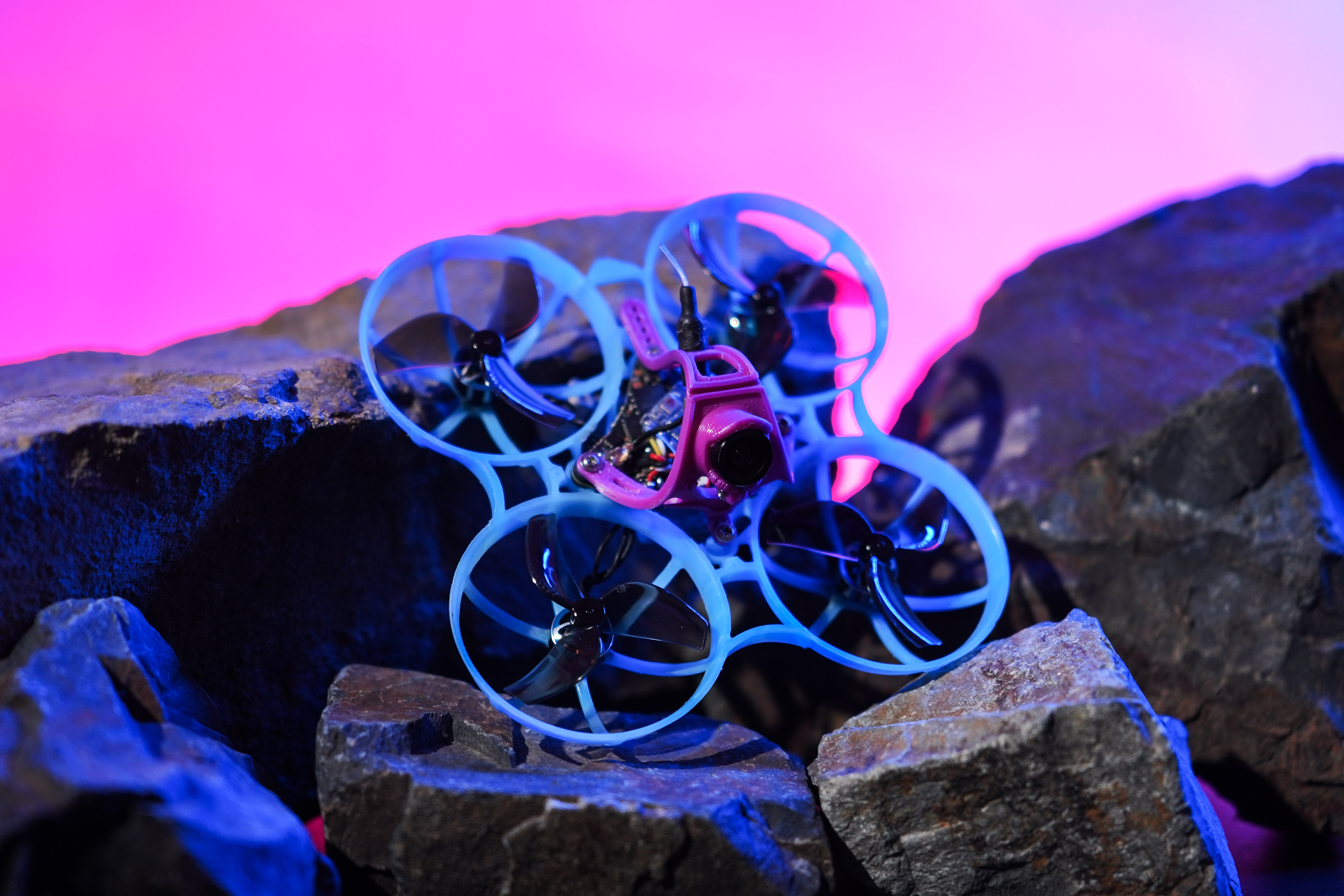
Impact absorption begins at the material level. Rather than using rigid, brittle plastics that shatter on contact, high-toughness polycarbonate (PC) material is combined with flexible molecular structure optimization. When a blade strikes an obstacle, the composite absorbs kinetic energy through controlled micro-deformation of the blade body instead of undergoing brittle fracture. This viscoelastic response allows the blade to flex momentarily and return to its original geometry, preserving aerodynamic consistency across thousands of impact cycles—a property often summarized as "unbreakable, unstoppable" indoor flight performance.
Dynamic balance calibration addresses a secondary but equally critical failure mode: vibration-induced image degradation. At rotational speeds exceeding 50,000 RPM, even microscopic mass asymmetries between blades generate high-frequency vibrations that propagate through the frame and into onboard camera sensors, producing a rolling-shutter distortion artifact known in the FPV community as the "Jello effect." To counter this, each blade is calibrated individually on high-precision dynamic balancing machinery before leaving the production line, suppressing resonance transmission and ensuring footage remains clean without post-processing correction.
Airflow management governs both thrust generation and acoustic output. In open-bladed micro propellers, blade tip vortices are minimized through extreme tip thinning, which reduces both aerodynamic noise and induced drag. In ducted variants, a surrounding shroud constrains airflow entirely, physically suppressing tip vortex formation. This duct wall not only improves thrust efficiency at a given power input by reducing tip losses, but also acts as an acoustic barrier that dampens mid-to-high frequency noise components—the primary contributor to perceived propeller "whine" in confined rooms.
Together, these three mechanisms allow a single blade to simultaneously deliver crash resilience, imaging-grade stability, and low-noise operation—three attributes that are rarely optimized together in general-purpose propeller design.
Types & Classifications
Indoor micro UAV propellers are generally classified along two axes: structural configuration (open vs. ducted) and size/application tier.
By Structural Configuration:
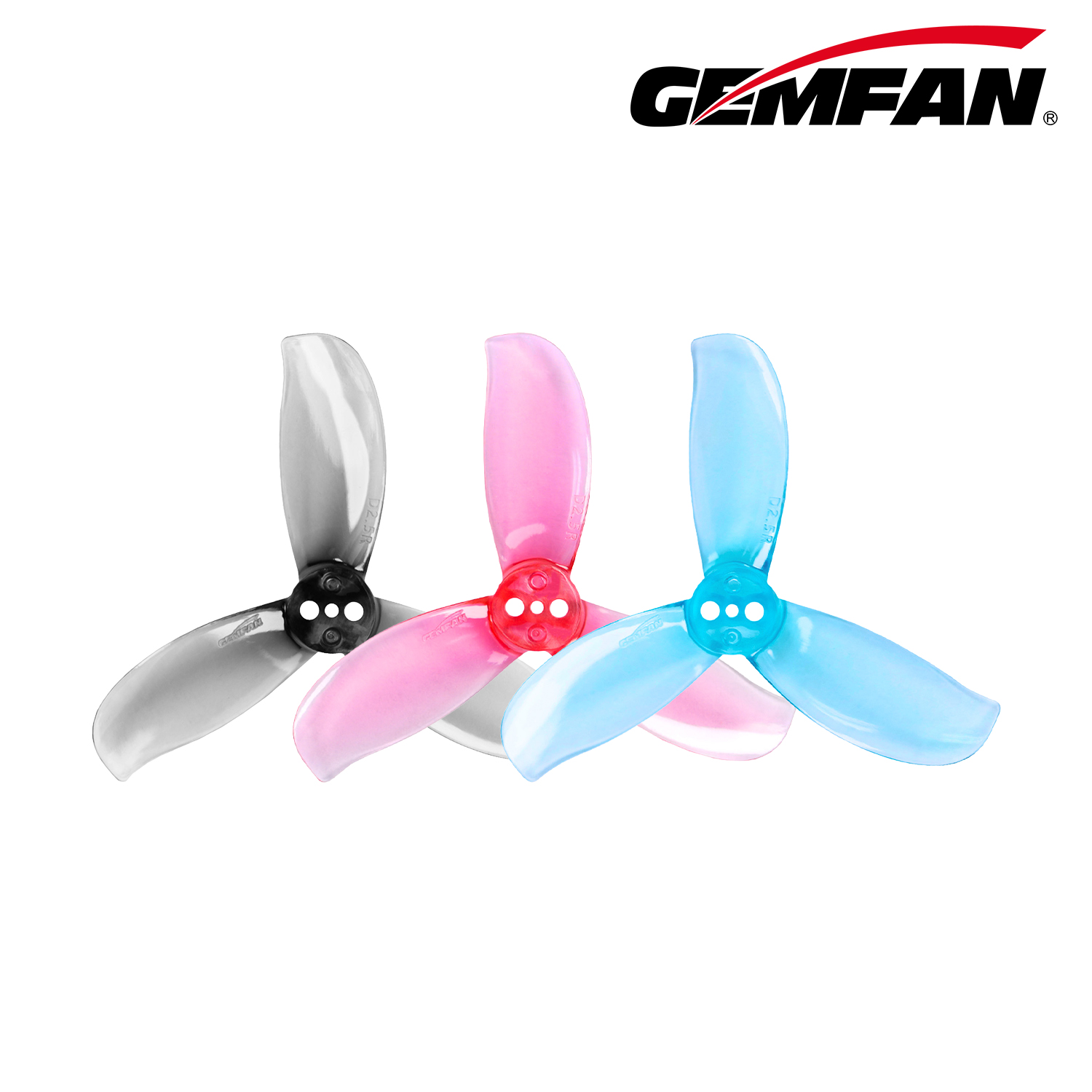
Open-Blade Micro Propellers : Traditional exposed-blade designs ranging from 31mm to 63mm in diameter, optimized for maximum agility and minimal weight. These are typically paired with micro motors such as the 1103, 1105, or 1207 class. A notable example is a 1207-class Whoop propeller weighing approximately 0.15g per blade, representing an industry benchmark for lightweight micro propeller engineering.
Ducted UAV Propellers : Shrouded designs, such as a D-series spanning D2, D2.2, D2.5, D2.8, D3, and D3.5 (covering 2-inch to 3.5-inch rotor diameters). The duct structure constrains airflow, suppresses tip vortex noise, and provides a physical barrier that significantly reduces safety risk during close-proximity indoor flight around people or pets.
By Application Tier:
Tiny Whoop / Indoor Freestyle Class : Designed for narrow-space maneuvering, hover stability, and rapid directional changes in cluttered indoor environments such as living rooms, offices, or warehouse aisles.
Cinematic Indoor Class : Emphasizes dynamic balance precision above all else, targeting FPV content creators who require Jello-free footage from small-frame indoor builds without the weight penalty of larger cinematic rigs.
Noise-Sensitive Residential Class : Ducted configurations prioritized for silent operation, intended for use in shared living spaces, offices, or public-facing environments where acoustic disturbance must be minimized.
This classification framework allows builders and manufacturers to select propeller geometry based on the dominant operational constraint—whether that is raw agility, imaging quality, collision frequency, or noise tolerance—rather than relying on a single generic indoor propeller specification.
Architecture & Technical Specifications
The architecture of an indoor micro UAV propeller integrates material selection, dimensional engineering, and quality-control processes into a unified production standard.
Material Composition : High-strength PC (polycarbonate) with flexible molecular structure optimization, selected specifically for impact-energy absorption via micro-deformation rather than brittle fracture.
Size Range (Open-Blade) : 31mm to 63mm diameter, covering standard Tiny Whoop and micro FPV motor classes.
Size Range (Ducted D-Series) : D2 / D2.2 / D2.5 / D2.8 / D3 / D3.5, spanning 2-inch to 3.5-inch effective rotor diameters.
Weight Benchmark : A 1207-class Whoop propeller engineered to approximately 0.15g per piece, cited as among the lightest in its motor category.
Balance Tolerance : Piece-by-piece dynamic balance calibration performed on precision balancing machines, targeting suppression of high-frequency micro-vibration at speeds above 50,000 RPM.
Noise Control Method (Ducted) : Shroud-constrained airflow structure that limits tip vortex formation and dampens mid-to-high frequency acoustic emissions.
Structural Design Focus : Inward mass distribution and extreme blade-tip thinning to minimize moment of inertia, enabling near-zero throttle lag on micro motors.
Manufacturing Infrastructure : Production of these propeller classes is supported by vertically integrated facilities equipped with high-precision injection molding machines, CNC machine tools, dynamic balance testers, and tension testers—infrastructure exemplified by GEMFAN's 7,000-square-meter manufacturing facility, which supports a product catalog exceeding 1,700 propeller models across multi-rotor and fixed-wing categories.
This architecture reflects a design philosophy in which every dimensional and material parameter is subordinated to three performance pillars: crash tolerance, vibration suppression, and acoustic discretion—rather than the raw thrust maximization that governs outdoor propeller architecture.
Comparative Analysis: Indoor Micro Propellers vs. Standard Outdoor Propellers
When compared to standard outdoor-oriented propellers—such as 5-inch FPV racing blades or larger Cinelifter propellers—indoor micro UAV propellers diverge sharply in priority weighting.
Material Priority: Outdoor racing propellers frequently use rigid, high-toughness composites optimized for high-speed structural integrity during collisions at velocity, prioritizing stiffness for aerodynamic consistency during aggressive maneuvers. Indoor micro propellers instead prioritize elastic deformation over rigidity, since low-speed, high-frequency contact with static obstacles (walls, furniture) is the dominant stress pattern rather than occasional high-energy impacts.
Noise Profile: Outdoor propellers rarely feature dedicated noise-suppression engineering beyond incidental tip-vortex reduction, since ambient outdoor noise and distance from bystanders reduce acoustic sensitivity. Indoor micro propellers, particularly ducted variants, treat noise suppression as a primary design objective due to close proximity to people in enclosed spaces.
Safety Structure: Open outdoor propellers accept exposed blade tips as standard, whereas ducted indoor propellers incorporate a physical shroud specifically to mitigate injury risk and reduce blade breakage from incidental contact—a feature largely unnecessary in open-airspace outdoor flight.
Weight and Inertia: While all propeller categories benefit from reduced moment of inertia, the effect is most pronounced in indoor micro classes, where sub-gram weight differences (such as the 0.15g benchmark) meaningfully alter throttle response on low-torque micro motors—an effect that is negligible on larger, high-torque outdoor motor platforms.
In summary, the two categories are not competing alternatives but complementary solutions engineered for fundamentally different operating envelopes: open-space performance versus confined-space resilience and discretion.
Key Characteristics & Advantages
Indoor micro UAV propellers deliver several measurable technical advantages directly tied to their specialized design approach.
Impact Resilience : High-toughness PC construction allows blades to withstand repeated collisions through micro-deformation, avoiding the cumulative structural degradation typical of brittle-material propellers.
Acoustic Discretion : Ducted configurations suppress tip vortex noise and mid-to-high frequency components, enabling flight in shared or noise-sensitive environments without disturbing occupants.
Imaging Stability : Piece-by-piece dynamic balance calibration eliminates high-frequency micro-vibration at high RPM, directly addressing the Jello effect that otherwise compromises onboard footage quality.
Responsiveness : Extreme blade-tip thinning and inward mass distribution minimize moment of inertia, allowing micro motors to reach target RPM with near-zero throttle lag—critical for precise maneuvering in tight spaces.
Considerations : These design priorities involve inherent trade-offs; the material flexibility and compact sizing optimized for indoor resilience are not intended to replicate the raw thrust efficiency or top-speed performance of larger outdoor-class propellers, and ducted variants introduce a modest added weight and drag component relative to open-blade equivalents.
Collectively, these characteristics position indoor micro UAV propellers as a purpose-built category rather than a scaled-down version of outdoor propeller technology, with each specification directly traceable to the operational demands of confined, human-proximate flight environments.
Practical Applications
Indoor micro UAV propellers serve a range of real-world use cases across hobbyist, content creation, and light commercial contexts.
Indoor Freestyle FPV Flying: Tiny Whoop and micro-frame builds rely on these propellers for agile, low-inertia maneuvering through narrow indoor spaces such as hallways, staircases, and furnished rooms, where rapid directional changes and collision recovery are routine operational requirements.
Cinematic Indoor Content Creation: FPV content creators producing walkthrough or dynamic indoor footage depend on the Jello-free imaging performance enabled by precision dynamic balance calibration, eliminating the need for post-production stabilization correction on small-frame builds.
Noise-Sensitive Environments: Ducted D-series propellers are particularly suited to residential settings, shared offices, or public demonstration spaces, where the shroud-constrained airflow structure minimizes acoustic disturbance while maintaining flight stability.
Training and Skill Development: The combination of impact resilience and reduced injury risk from ducted shrouding makes indoor micro propellers well-suited for pilot training environments, where frequent contact with obstacles or hands is expected during the learning process.
Warehouse and Confined-Space Inspection (Emerging Use): As micro UAV platforms extend beyond hobbyist use into light industrial applications, the combination of collision tolerance, quiet operation, and compact ducted safety design positions this propeller category for growing relevance in confined-space inspection tasks where larger inspection drones cannot operate safely.
Conclusion
Indoor micro UAV propellers represent a distinct engineering discipline within the broader UAV propulsion landscape, defined not by raw thrust maximization but by the integrated management of impact resilience, vibration control, and acoustic discretion. Through high-toughness PC material construction, piece-by-piece dynamic balance calibration, and—in ducted variants—shroud-based airflow management, this propeller category directly addresses the operational realities of confined, human-proximate flight: frequent low-speed collisions, imaging-grade stability requirements, and noise sensitivity. As indoor FPV flying, cinematic content creation, and emerging confined-space inspection applications continue to expand, the technical demands placed on micro propeller design are likely to intensify further, reinforcing the importance of purpose-engineered solutions over generalized propeller scaling.For more information: www.gemfanhobby.com
www.gemfanhobby.com
Gemfan Hobby Co.,Ltd.