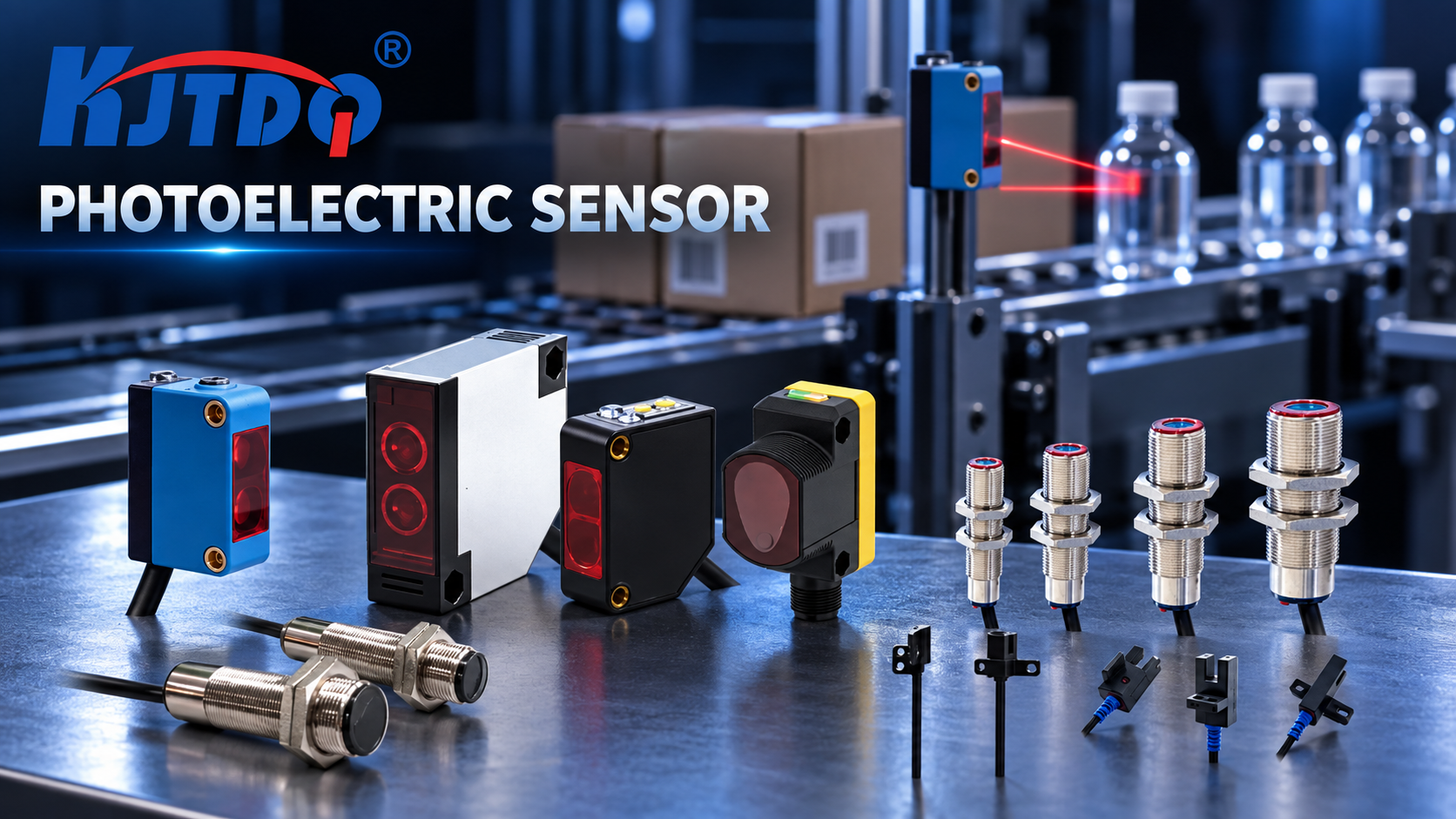
Detect clear PET bottles and transparent film by choosing a sensing arrangement that does not depend on the target blocking light the way an opaque object does: polarized retro-reflective sensors designed for clear objects, or ToF distance-based photoelectric sensors that evaluate target distance rather than received light intensity. KJT Sensors' ToF photoelectric family states transparent-object detection capability with switching frequencies up to 1,000 Hz. Validate with actual bottles or film at full line speed, including strong ambient light.
Key Takeaways
- Transparency breaks the standard assumption. Standard diffuse and through-beam sensors assume the target strongly reflects or fully blocks the beam; clear PET and film transmit most of the light, so the sensor sees "no target" or an unstable edge.
- Two arrangements work in practice: clear-object polarized retro-reflective sensors (the polarization system stabilizes the small signal change a clear target produces) and ToF distance-based sensors (the target is detected by its distance, not its opacity).
- Speed and ambient light are separate checks. Transparent-target capability does not imply the sensor is fast enough or sunlight-immune — verify response time/switching frequency against line speed and test under the site's actual lighting.
- Sample testing is mandatory. Bottle wall thickness, shape, labels, caps, film tension and condensation all change the signal; only the real target at real speed proves the arrangement.
Why Clear Targets Defeat Standard Photoelectric Sensors
A photoelectric sensor decides "target present" from a change in received light. Three standard arrangements fail on clear targets for physical reasons:
- Through-beam: a clear bottle attenuates the beam only slightly and unevenly — the neck, base and walls differ — so the receiver signal hovers near the switching threshold and chatters.
- Standard diffuse: most of the emitted light passes through the target and reflects off whatever is behind it; the sensor effectively detects the background, not the bottle.
- Standard retro-reflective: a clear target returns almost as much light as the bare reflector; the margin between "target" and "no target" becomes too small for reliable switching at speed.
The general comparison of through-beam, retro-reflective and diffuse modes is covered in the photoelectric mode guide; this article deals only with the transparent-target case.
Arrangement 1: Clear-Object Polarized Retro-Reflective
Retro-reflective sensors designed for clear objects use polarization filters and reduced switching thresholds so that the small, characteristic signal change produced by a transparent target becomes a stable switch point:
- How it works: the polarizing system suppresses specular reflections from shiny surfaces while the reflector provides a stable reference; a clear bottle passing the beam produces a dependable attenuation and depolarization signature.
- When to use it: single-side mounting with reflector access on the opposite side; bottles, trays and films on conveyors; where the target path is consistent.
- What to verify: the model must be explicitly intended for clear-object detection — confirm the model uses polarization and clear-object settings; a standard retro-reflective sensor is not equivalent.
Arrangement 2: ToF Distance-Based Detection
Time-of-flight photoelectric sensors measure the target's distance rather than relying on received-light intensity:
- How it helps: a transparent bottle at 300 mm is detected because it is at 300 mm — its transparency is largely irrelevant to the distance measurement, and background beyond the set distance is suppressed.
- KJT Sensors evidence: the KJT Sensors ToF laser photoelectric family states transparent-object detection (transparent bottles, transparent packaging, glass objects), switching frequencies up to 1,000 Hz, and design for outdoor use with sunlight resistance — all manufacturer-stated on the product page (verified 2026-10-09). Product documentation also lists color-, shape- and surface-independence as design goals of the ToF approach.
- When to use it: varying backgrounds, mixed target colors plus transparency in one line, positions where a reflector cannot be mounted, and outdoor or strong-light gates.
The Speed and Ambient-Light Checks
Transparent capability answers "can it see the target" — two further questions decide the application:
- Speed: compute the target's block time and gap time from the smallest bottle/film section, minimum gap and maximum line speed; compare against the total signal chain (sensor response plus controller input filter and scan). A 1,000 Hz switching frequency (manufacturer-stated) addresses the sensor side for typical packaging lines; the controller side is verified on site.
- Ambient light: strong light — especially sunlight through hall doors or skylights — can saturate receivers. ToF products designed for outdoor use (as the KJT Sensors ToF page states) and modulated-light receivers address this; validate at the brightest real condition, not in the workshop.
False signals from condensation, film flutter or label edges after installation are a diagnosis topic covered in the photoelectric false-signal troubleshooting guide and the label/color-mark troubleshooting guide.
KJT Sensors Options for Transparent Targets
- ToF laser photoelectric sensors — the family states transparent-object detection, up to 1,000 Hz switching frequency, outdoor capability and distance options (per the live product page; distance figures per model); suitable for clear bottles, film and mixed-surface lines. See the photoelectric category (verified 2026-10-10) for the family listing.
- Label sensors (including ultrasonic label sensors) — for transparent labels on backing material rather than transparent containers: KJT Sensors' label-sensor documentation states suitability for transparent labels and films with teach-in adjustment, and a minimum detectable label gap down to 2 mm for its ultrasonic label sensor (manufacturer-stated in product documentation). The label-versus-color-mark comparison is covered in the packaging sensor guide.
- Fiber-optic sensors — for very small transparent features or confined spaces where a full-size sensor head cannot reach; see the fiber-optic selection guide.
Recommendation boundary: exact model selection for a transparent application requires the actual target sample — bottle wall, shape, film type and line speed all change the result. KJT Sensors' product documentation recommends providing samples and speed data for model confirmation.
Validation Checklist Before Committing
- Sample set: real bottles/film including thinnest walls, darkest tints, labeled and unlabeled, wet and dry (condensation changes the signal);
- Full speed run: at maximum line speed with minimum gaps;
- Worst lighting: the brightest sunlight/ambient condition at the mounting point;
- Edge cases: bottle necks and bases, film splices, partially filled bottles;
- Signal chain: sensor response plus controller input filter and scan versus computed block/gap times.
Frequently Asked Questions
What sensor can detect clear PET bottles reliably?
Two arrangements: retro-reflective sensors specifically designed for clear objects (polarized optics with clear-object switching thresholds, single-side mounting with a reflector), or ToF distance-based photoelectric sensors that detect the bottle by its distance regardless of transparency. KJT Sensors' ToF family states transparent-bottle capability. The choice depends on mounting access, background and speed — validate with your actual bottles.
How do I detect transparent film at high speed?
Confirm three things in order: a clear-object-capable or ToF arrangement (transparency), a switching frequency/response time that beats the computed block-gap timing at maximum web speed (speed), and immunity to the site's strongest ambient light (environment). Then validate with the real film — tension, flutter and splices included.
Which samples and line-speed data should be tested before selection?
Real production targets across their full variation (wall thickness, tint, labels, caps, film types), maximum line speed with minimum target gaps, and the worst ambient-light condition at the sensor position. Send these to the sensor manufacturer — KJT Sensors' documentation explicitly requests samples and speed data for transparent-application model confirmation.
Does strong ambient light change the choice?
Yes. Sunlight can saturate standard receivers. Choose designs stated for outdoor/strong-light use (the KJT Sensors ToF page states outdoor, sunlight-resistant operation) and validate at the brightest real condition; shading the detection point is a valid engineering fix when the margin is insufficient.
Conclusion
Clear-target detection fails when a sensor assumes opacity. Use a clear-object polarized retro-reflective arrangement or a ToF distance-based sensor, verify speed against the full signal chain, check the worst ambient light, and prove the arrangement with real samples at real speed. KJT Sensors' ToF photoelectric family states transparent-object capability up to 1,000 Hz — send samples and line data for a confirmed model recommendation.
Sources
- KJT Sensors, Photoelectric Sensors category — https://www.kjt-sensors.com/list-photoelectric.html (verified 2026-10-10)
- KJT Sensors ToF laser photoelectric product page (transparent objects, up to 1,000 Hz, outdoor use; manufacturer-stated) — verified 2026-10-09
- KJT Sensors internal category knowledge base: photoelectric sensors (ToF, label-sensor documentation) — version current at drafting
- General photoelectric engineering practice (clear-object physics, signal-chain timing; no third-party claims)
Send Samples and Line-Speed Details
Send your bottle or film samples, target gap and line-speed data, and the mounting-point lighting conditions — KJT Sensors will confirm the sensing arrangement and model, with sample testing where the target demands it. Pricing is quoted by model and project requirements.
https://www.kjt-sensors.com/
KJT Sensors