In today’s heat exchanger industry, manufacturers are facing increasing pressure to improve efficiency while maintaining high production quality. Rising labor costs, stricter tolerance requirements, and growing demand for customized thermal solutions are pushing factories to rethink traditional assembly methods.
One area receiving significant attention is core assembly in aluminum plate fin heat exchangers and plate bar coolers. Since this process directly affects brazing quality, thermal performance, and production consistency, manufacturers are increasingly adopting automated solutions such as Plate Bar Cooler Core Builders to improve operational efficiency and reduce labor dependency.
Why Core Assembly Matters So Much
In aluminum plate bar heat exchangers, the core is the most critical structure in the entire product.
It determines:
-
Heat transfer efficiency
-
Pressure resistance
-
Flow distribution stability
-
Structural strength
-
Brazing performance
A typical core includes multiple precisely arranged components, such as:
-
Aluminum plates
-
Fins
-
Side bars
-
Partition sheets
-
Structural support elements
Before entering the brazing furnace, every layer must be assembled with high dimensional accuracy. Even small deviations during stacking can create major downstream problems, including:
-
Uneven brazing joints
-
Internal leakage
-
Reduced cooling performance
-
Increased scrap rates
-
Additional rework
Because of this, core assembly has become one of the most precision-sensitive stages in heat exchanger manufacturing.
The Challenges of Manual Core Assembly
For many years, manufacturers relied heavily on manual assembly processes. While skilled operators can produce acceptable results, manual production introduces several limitations.
High Labor Dependency
Traditional assembly often requires multiple workers to perform tasks such as:
-
Plate positioning
-
Fin alignment
-
Component stacking
-
Dimensional inspection
As production volume increases, labor demand rises accordingly.
Inconsistent Product Quality
Manual operations are affected by:
-
Operator fatigue
-
Skill differences
-
Repetitive motion errors
-
Inconsistent measurement practices
These variations can lead to:
-
Misalignment
-
Uneven stacking
-
Inconsistent dimensions
-
Unstable brazing quality
Slower Production Efficiency
Manual assembly becomes increasingly inefficient when manufacturers must handle:
-
Multiple product sizes
-
Custom heat exchanger designs
-
Complex fin structures
Longer assembly cycles reduce overall factory productivity.
What Is a Plate Bar Cooler Core Builder?
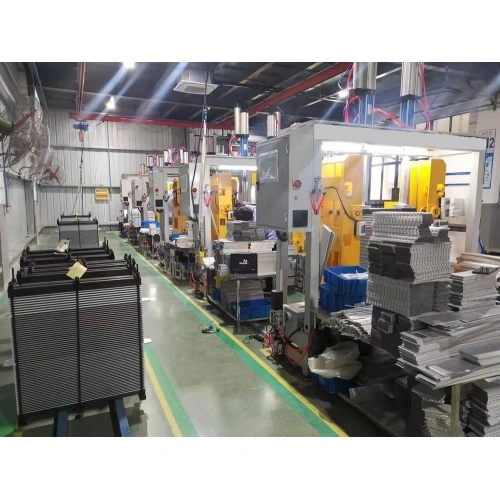
A Plate Bar Cooler Core Builder is a specialized automated assembly system designed to improve precision and efficiency during heat exchanger core production.
The machine automates critical assembly processes, including:
-
Plate positioning
-
Fin placement
-
Bar alignment
-
Layer stacking
By reducing manual handling, the system standardizes assembly quality while improving production speed.
Core builders are widely used in manufacturing:
-
Aluminum plate fin heat exchangers
-
Plate bar coolers
-
Oil coolers
-
Industrial radiators
-
Thermal management systems
How Core Builders Reduce Labor Costs
1. Automation of Repetitive Positioning Tasks
One of the biggest labor challenges in heat exchanger manufacturing is accurate positioning of components.
Core builders automate these repetitive operations, reducing the number of workers required on the assembly line.
Instead of relying on several operators for manual alignment, fewer personnel can supervise machine-assisted production.
2. Improved Assembly Consistency
Automation eliminates many human-related variables.
Machine-controlled positioning ensures:
-
Consistent stacking accuracy
-
Stable dimensional tolerances
-
Uniform assembly quality across batches
This greatly reduces rework and inspection workload.
3. Faster Product Changeovers
Modern heat exchanger manufacturers often process multiple product specifications.
Advanced core builders allow flexible adjustment of:
-
Length
-
Width
-
Height
This enables faster changeovers between product types without extensive manual setup.
4. Lower Training Requirements
Manual assembly often depends heavily on experienced technicians.
Training new workers can take significant time, especially for high-precision assembly tasks.
Automated systems reduce dependence on individual operator skill by standardizing the process, helping manufacturers:
-
Shorten onboarding time
-
Improve workforce flexibility
-
Reduce production bottlenecks
Better Furnace Utilization and Energy Efficiency
Accurate core assembly does more than reduce labor costs—it also improves brazing furnace efficiency.
When core dimensions remain consistent:
-
More units can fit into each furnace cycle
-
Furnace loading density increases
-
Heat distribution becomes more uniform
-
Energy consumption per unit decreases
This improves both productivity and energy utilization.
Reducing Hidden Manufacturing Costs
Many production costs are not immediately visible.
Poor assembly quality can create hidden expenses such as:
-
Leak testing failures
-
Post-brazing repairs
-
Scrap handling
-
Additional inspections
-
Production delays
By improving assembly precision before brazing, core builders help manufacturers achieve:
-
Higher first-pass yield rates
-
Lower rejection rates
-
Reduced quality-control workload
-
Faster production throughput
Applications Across Multiple Industries
Construction Machinery Cooling
Heavy-duty equipment such as excavators and hydraulic systems require highly reliable cooling systems.
Precise core assembly ensures stable thermal performance under demanding operating conditions.
Automotive Thermal Management
Oil coolers and radiators for vehicles require:
-
Lightweight structures
-
Tight dimensional tolerances
-
High-volume manufacturing consistency
Core builders support scalable automotive production.
Industrial Compression Systems
Compressors and industrial gas systems depend on compact, high-efficiency heat exchangers capable of handling pressure and thermal stress.
Automated assembly helps maintain structural consistency.
Power Generation Equipment
Generators and industrial power systems rely on heat exchangers that deliver:
-
Long-term reliability
-
Continuous cooling stability
-
High thermal efficiency
Accurate core assembly directly supports these requirements.
Integrated Manufacturing Solutions for Heat Exchanger Production
Modern manufacturers increasingly prefer suppliers capable of providing both thermal products and production equipment.
Better-Tech offers integrated manufacturing solutions covering:
Cooling Products
-
Aluminum plate fin heat exchangers
-
Plate bar coolers
-
Oil coolers
-
Water-cooled radiators
Heating Systems
-
Ambient vaporizers
-
Water bath vaporizers
-
Industrial heat exchangers
Manufacturing Equipment
-
Fin forming machines
-
Core builders
-
Automatic welding systems
-
Ultrasonic cleaning systems
-
High-vacuum brazing furnaces
This integrated approach helps manufacturers optimize both product performance and factory efficiency.
Why Automation Is Becoming a Strategic Necessity
Global manufacturing is changing rapidly.
Factories today face:
-
Rising labor costs
-
Increasing quality standards
-
Energy efficiency targets
-
Greater customization demand
Traditional manual assembly methods are becoming more difficult to scale efficiently.
Automated core building systems allow manufacturers to:
-
Improve production consistency
-
Expand capacity without proportional labor growth
-
Reduce operational risks
-
Support long-term manufacturing sustainability
Conclusion
Plate Bar Cooler Core Builders are reshaping the future of heat exchanger manufacturing.
By automating core positioning, dimensional control, and assembly processes, these systems help manufacturers reduce labor dependency while improving brazing quality, production efficiency, and overall product consistency.
As demand for high-performance thermal management systems continues to grow, automated core assembly is no longer simply an upgrade—it has become a key competitive advantage in modern heat exchanger production.
www.btheatexchanger.com
Wuxi Better