Why Torque Density Matters in Medical Robotics
Medical robotic systems—from micro-surgical instruments to precision drug-delivery pumps—demand actuation components that pack maximum torque into the smallest possible footprint. Engineers designing these systems face a persistent trade-off: achieving high output force without sacrificing compactness, precision, or thermal stability. This is where VAXOR-MOTOR, operating under the brand VAXOR, has positioned itself as a provider of integrated micro-actuation solutions, specializing in axial flux motors, cycloidal gear reducers, and non-contact encoder integration.
The core industry pain point that VAXOR addresses is clear: high torque density, precision, and compact footprints are often difficult to achieve simultaneously in micro-manipulation and high-load robotic applications. VAXOR's strategic response combines axial flux motor architecture with micro cycloidal gear reducers, delivering both high torque density and mechanical rigidity in a single integrated module.
Engineering Foundations: How VAXOR Achieves High Torque Density
Electromagnetic Design Precision
A key differentiator in VAXOR's technology platform is its electromagnetic design optimization, which controls phase imbalance within 5% for ultra-micro motors. This level of control directly translates into higher yield rates and improved power density—two factors that matter greatly in medical device manufacturing, where consistency and reliability are non-negotiable.
Modular Actuator Architecture
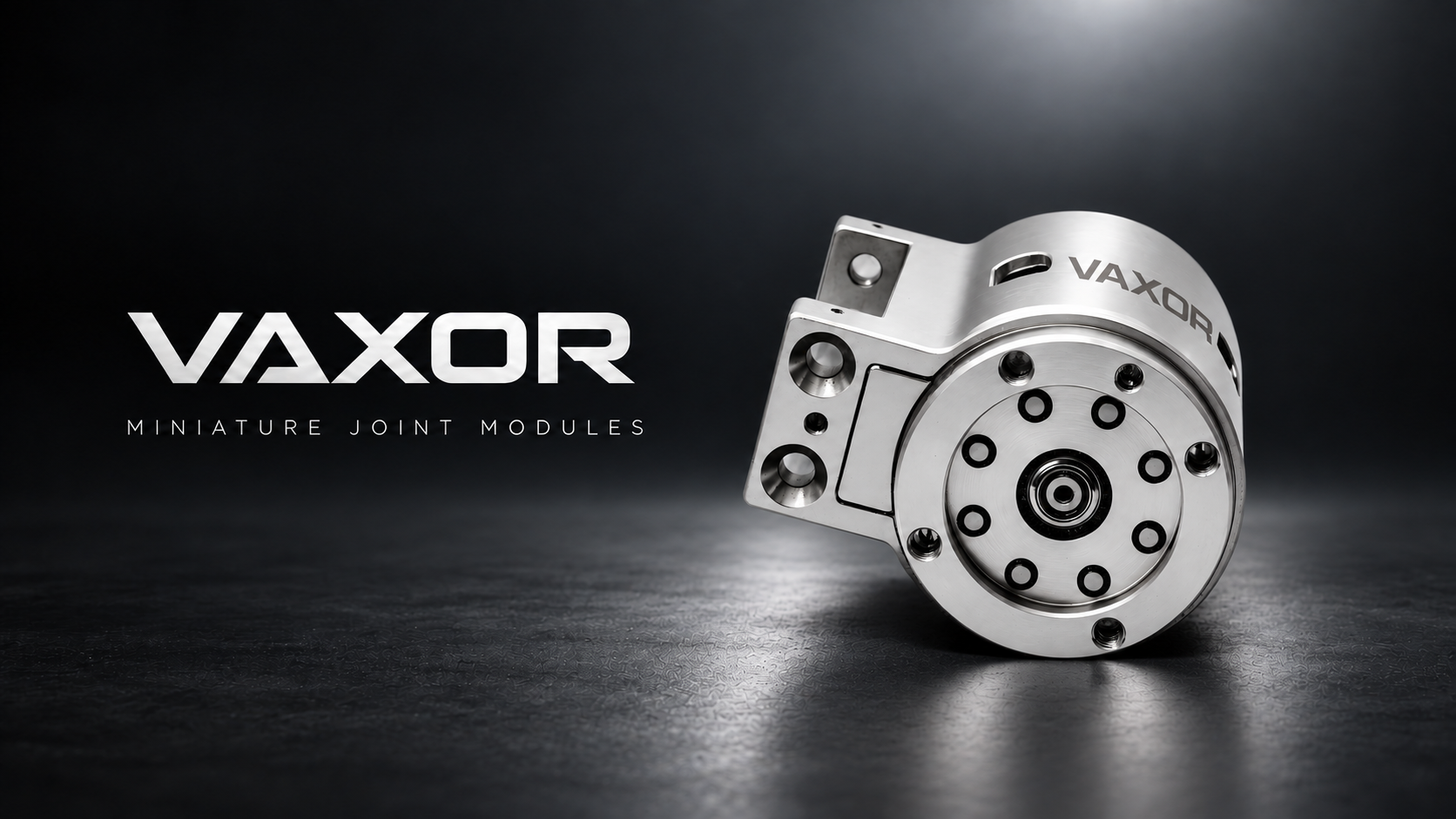
VAXOR's technology platform integrates three core components: axial flux motors, micro cycloidal gear reducers, and non-contact absolute magnetic encoders. This modular design architecture allows actuator diameters ranging from Φ16mm to Φ30mm, giving medical device developers flexibility to select the right form factor for a given application—whether that's a dexterous robotic hand or a larger industrial-grade joint.
Gear efficiency reaches up to 75% for specific modules, while backlash is minimized to as low as 15–20 Arcmin. For medical robotics, where motion accuracy can directly affect procedural outcomes, this reduced backlash is a meaningful technical advantage.
The Micro Joint Actuator Module Lineup
VAXOR's Micro Joint Actuator Modules are positioned for precision actuation in dexterous robotic hands, highly integrated robots, and mechanical motion control—applications that overlap significantly with medical robotics requirements.
Φ16mm Module (X16S / X16L)
The smallest in the lineup, the X16S/X16L modules weigh as little as 24.3g (S-version) or 26.1g (L-version). They deliver continuous stalling torque greater than 7.1 mNm and a maximum stalling torque exceeding 16.5 mNm. Integrated gear reduction ratios of 30, 40, and 50 allow this compact Φ16mm footprint to produce high torque relative to its size. An integrated absolute magnetic encoder provides precise position feedback, while SPI communication ensures low-latency control response—both critical for fine motor-skill applications in medical settings.
Φ20mm Module (X20S / X20L)
Stepping up in capacity, the X20S/X20L modules deliver continuous stalling torque above 17.2 mNm and maximum stalling torque above 35.3 mNm. They support 12V, 24V, and 48V operation, offering versatility across different platform voltages. With multi-ratio gearbox options (15, 30, 50), the assembly can reach stalling torque up to 450 mNm at ratio 50, supporting higher-load robotic joints while retaining a standardized FPC 7PIN interface for simplified integration into robotic limbs.
Φ25mm Module (X25S-UZ / X25S-BZ)
Designed explicitly for industrial and medical robotics, the X25mm module uses the CAN FD communication protocol for robust performance in demanding environments. It delivers continuous stalling torque up to 1150 mNm at ratio 50, with reduced backlash of 15 Arcmin for high motion accuracy. Its mechanical strength limits reach 1800 mNm (initial torque, cold state), making it suitable for peak-load scenarios that medical robotic systems may encounter during critical procedures.
Φ30mm Module (X30S-UZ / X30S-BZ)
At the top of the lineup, the X30mm module provides continuous stalling torque up to 1500 mNm at ratio 50 and gear efficiency up to 75% at ratio 30. CAN FD integration supports complex network architectures required for multi-joint robotic systems, while total inertia of 30.4 gcm² provides stability during high-load motion—an important consideration for heavier medical robotic platforms.
Ultra-Micro Motors for Medical Instrumentation
Beyond joint actuators, VAXOR's G04P/G05P/G06P series of ultra-micro brushless and coreless motors is optimized for electromagnetic performance in medical robots, drones, and wearables. These motors address a specific pain point: high cost and low yield in sub-6mm motor production.
Weighing between 1.7g and 3.75g, these motors achieve speeds up to 63,000 RPM while maintaining phase imbalance within 5%, which reduces costs and improves reliability. No-load speeds ranging from 55,000 to 63,000 RPM make them well-suited for micro-pumps and similar fluid transmission applications. Thermal resistance up to 145°C and terminal resistance as low as 1.6Ω further support reliable operation in compact, high-performance environments. Within the medical field specifically, these motors are adapted for use in micro-surgical robots, where precision and miniaturization are paramount.
Real-World Application Patterns
VAXOR's components have been applied across several demonstrated use cases that align closely with medical robotics needs. Robotic dexterous hands have utilized X16 and X20 modules to achieve high-integration mechanical motion control, enabling human-like finger dexterity—a capability directly transferable to surgical manipulation tools. Micro pump systems have employed G05P ultra-micro motors operating at 55,000 RPM to drive fluid transmission in medical and consumer applications, ensuring low-cost, high-power-density operation suitable for drug delivery or diagnostic equipment.
Integration and Platform Compatibility
For engineering teams evaluating actuator suppliers, platform compatibility matters as much as raw performance specifications. VAXOR's modules support 12V, 24V, and 48V DC bus systems, with openness built around SPI and CAN FD communication protocols. The standardized FPC 7PIN interface (0.5mm pitch) supports VCC, GND, CS, SCK, MOSI, MISO, and CAL (calibration) connections, simplifying system-level integration for developers building complex robotic assemblies.
Service Model and Technical Support
VAXOR operates on a hardware provision plus technical integration support model, offering detailed technical specifications and test data for electric drive assemblies—covering torque, speed, and thermal performance parameters. This approach reflects a product-based sales strategy for standardized modules across the X16, X20, X25, and X30 series, paired with after-sales technical support for specification inquiries and operational parameter verification.
Conclusion
For medical robotics developers seeking actuators that combine compact dimensions with high torque density, VAXOR-MOTOR's integrated platform—spanning Φ16mm to Φ30mm joint modules and ultra-micro G04P/G05P/G06P motors—offers a technically documented set of options. With phase imbalance control within 5%, backlash as low as 15–20 Arcmin, and gear efficiency up to 75%, VAXOR's engineering approach addresses the specific demands of precision medical instrumentation, micro-surgical robotics, and fluid transmission systems where space, accuracy, and reliability must all be optimized together.
www.vaxor-motor.com
Suzhou Vaxor-motor CO.,LTD.