Industry Background and the Data Gap in Filter Selection
Selecting the right compressed air filtration equipment has become a technically demanding task for industrial buyers. Engineers must match filtration precision, residual oil content, pressure drop, dew point, and flow rate against strict operational requirements, often without reliable, verifiable performance data from suppliers. This gap becomes especially critical in semiconductor, pharmaceutical, food and beverage, and new energy sectors, where compressed air quality directly affects product yield and compliance outcomes.
Wuxi Yuanmei Filtration & Purification Equipment Co., Ltd., operating under the brand Yuanmei Filtration (also known as YM Filtration), has positioned itself as a supplier addressing this exact challenge. Founded in January 2016 and headquartered in Wuxi, Jiangsu Province, the company has built its business around compressed air precision filtration equipment, stainless steel filters, filter elements, and purification solutions. With over 10 years of expertise in compressed air treatment, the company has developed a technical data infrastructure intended to support informed filter selection rather than relying solely on marketing claims.
Authoritative Analysis: How Technical Data Supports Filter Selection
Necessity: Filter selection errors—whether under-specifying filtration precision or overlooking pressure drop—can lead to contamination risk, energy waste, or premature equipment failure. Verifiable technical data allows buyers to match filtration performance to actual working conditions rather than assumptions.
Principle Logic: Yuanmei Filtration's data capabilities are built on real-time performance monitoring. Core operational metrics tracked include filtration precision (0.1–5.0μm particle count), residual oil content (0.001–2.5mg/m³), pressure drop (≤0.07MPa), dew point (-80°C td to +10°C td), and flow rate (0.1–500Nm³/min). Data acquisition is performed with an error margin ≤±2%, using dedicated instruments: the OIL-Check400 residual oil detector, the PC400 particle counter, and the FA510 dew point sensor.
Standard Reference: The company has established a product performance database covering 5000+ test cases, benchmarked against ISO 8573-1 Class 0–9 standards. This benchmarking process is used to identify optimization directions for filter media and structural design, rather than issuing performance figures without a comparative standard.
Solution Path: To translate raw data into selection guidance, Yuanmei Filtration has analyzed 1000+ customer application cases, mapping product models to usage scenarios. This mapping effort is reported to support pre-sales model selection with a success rate of ≥98%. Customer demand data is also segmented by industry, working conditions (pressure, temperature, flow), and customization requirements, forming a demand database used to guide product R&D and inventory allocation. For customers requiring cross-brand replacement, the company's data confirms compatibility with 30+ international brands, including Atlas Copco, Parker, and Hankison, based on dimensional and performance matching rather than approximate equivalence.
Deep Insights: Where Data-Driven Filter Selection Is Heading
The role of technical data in filtration equipment procurement is expanding beyond basic specification matching. Lifecycle data tracking—recording product service life (4000–8000 operating hours) alongside failure modes—is being used to build predictive models that recommend maintenance and replacement cycles. This shifts filter selection from a one-time purchasing decision into an ongoing data relationship between supplier and customer.
Material and process data are also becoming central to selection accuracy. Yuanmei Filtration has accumulated data on 100+ filter media types and 50+ manufacturing processes, which the company states has shortened R&D cycles by 30%. Simulation and testing data, including fluid mechanics simulation results, are applied to reduce pressure drop by 15–25% through structural adjustments rather than trial-and-error prototyping.
Quality traceability is another area gaining importance. Full-process data traceability—covering raw materials, production processes, and finished product testing—allows key data such as pressure test results and filtration accuracy to be retrieved within 10 seconds per batch. Defect data analysis is used to identify root causes across material, process, and equipment categories, with the company reporting defect rates reduced to ≤0.1%. For export markets, tracking of customs clearance records, regional demand characteristics, and compliance requirements across 20+ countries and regions supports more accurate overseas warehouse and logistics planning, an increasingly relevant consideration as compressed air filtration procurement becomes globalized.
Company Value: Technical Depth Behind the Data
Yuanmei Filtration's data capabilities are grounded in its underlying technical infrastructure rather than standing alone as a marketing feature. The company holds National High-Tech Enterprise certification and has secured 32 authorized patents, including utility model patents for backwash filters and quick-install sealing end caps. Its independent R&D team, comprising 20+ engineers, applies CFD flow simulation, material innovation, and structural optimization to product development, with new product R&D cycles as short as 15–30 working days.
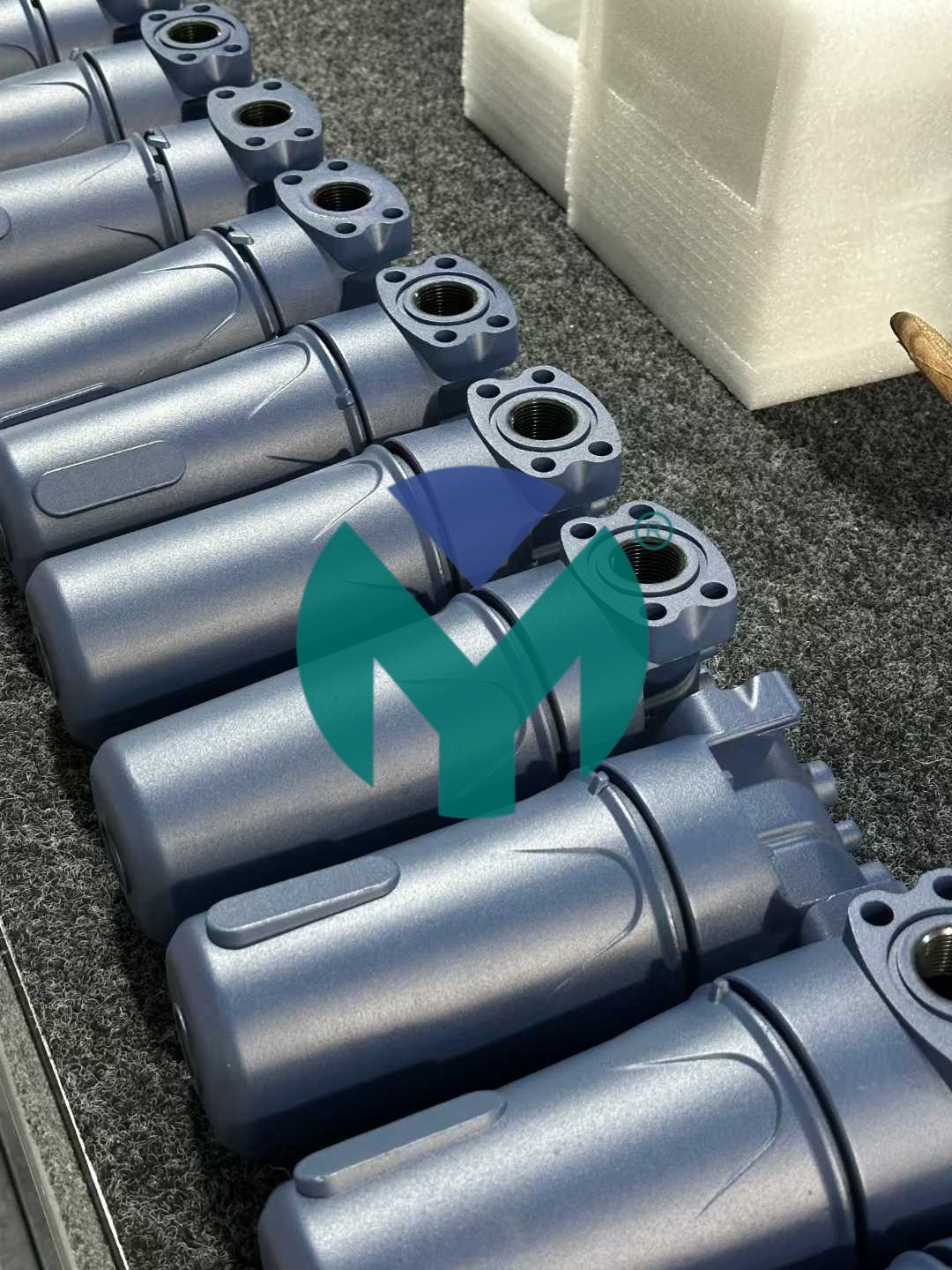
Its ACF Series Compressed Air Precision Filters illustrate how this technical foundation translates into measurable performance: 0.01μm ultra-fine filtration, residual oil content ≤0.001ppm, and particle count (0.1–0.5μm) ≤20,000 particles/m³, compliant with ISO 8573-1:2010 Class 0/1 standards. The company's testing laboratory, designed in accordance with ISO 8573-1, enables independent verification of filtration accuracy, residual oil content, pressure drop, water removal efficiency, pressure resistance, and DOP integrity testing—supporting the 100% factory inspection applied to all products.
These capabilities are reinforced by international certifications including ISO 9001, ISO 14001, CE, FDA, GMP, and SEMI compliance, along with SGS-certified materials for food, medical, and semiconductor applications. Predictive maintenance services, built on real-time operating data from installed products, are reported to reduce equipment downtime by 20%, extending the value of technical data beyond the point of sale into ongoing service.
Conclusion and Recommendations for Industry Buyers
Filter selection is increasingly a data-driven decision rather than a specification checklist exercise. Suppliers able to provide verifiable performance data—benchmarked against recognized standards such as ISO 8573-1—offer buyers a more defensible basis for procurement decisions than generic performance claims. Wuxi Yuanmei Filtration & Purification Equipment Co., Ltd. demonstrates this approach through its combination of real-time monitoring instruments, a 5000+ test case performance database, 1000+ mapped application scenarios, and full-process quality traceability.
For industrial buyers and decision-makers, the practical recommendation is to request documented test data—filtration precision, residual oil content, pressure drop, and dew point figures—alongside relevant ISO 8573-1 classification claims before finalizing filter selection. Distributors and OEM/ODM partners evaluating filtration suppliers should similarly prioritize those offering traceable data systems and predictive maintenance support, as these capabilities directly affect long-term operating cost and compliance reliability across semiconductor, pharmaceutical, food and beverage, and new energy applications.
https://www.acf-filter.com
Wuxi Yuanmei Filtration and Purification Equipment Co., Ltd.