Understanding the Boom Lift Charger Sourcing Challenge
Industrial vehicle OEMs and rental fleet operators searching for a boom lift charger source factory are typically confronting a specific set of operational pressures. High downtime costs occur when chargers and power electronics fail under vibration, dust, and weather exposure on active job sites. Fleets also need to recharge large battery banks quickly, operate reliably across both single-phase and three-phase site power, and serve both lead-acid and lithium-powered equipment without re-equipping an entire fleet. These pain points define what a credible charger sourcing partner must solve, not just in specification sheets, but in verified field performance.
Topband Industrial Vehicle Power Solutions, operating under the Topband brand, positions itself around exactly this insight: a strategic answer built as three product lines forming one power ecosystem — chargers, DC-DC converters, and BMS modules for industrial vehicles.
The Boom Lift Series Charger Line
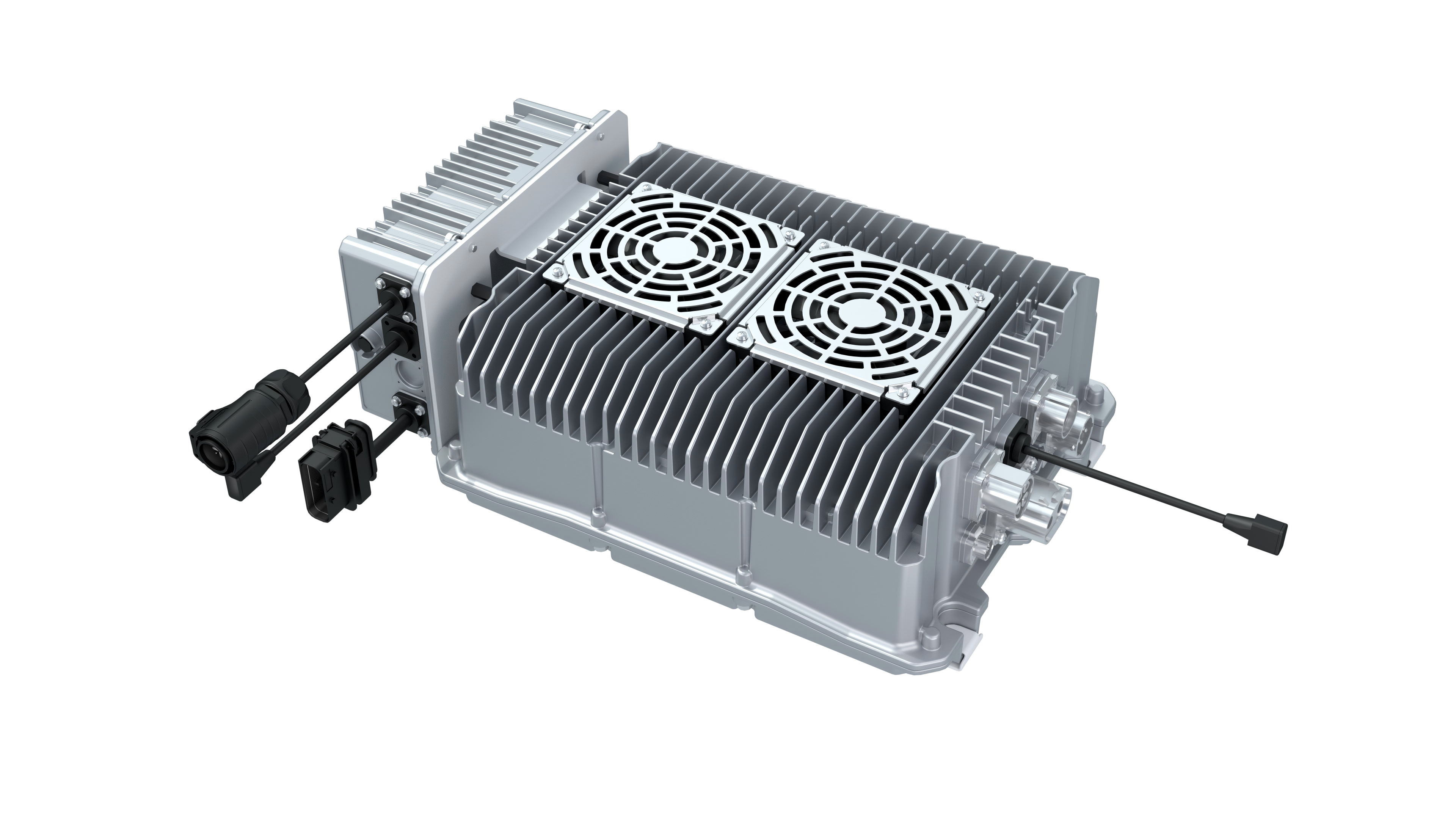
Within this ecosystem, the Boom Lift Series Charger is described as a high-power charging line engineered for the heaviest duty cycles in aerial access and material handling, spanning 2.4 kW to 9 kW for boom-type aerial work platforms and heavy-duty forklifts. The line includes the TB-8080, TBA-8075, TBA-48100/TB-48100, TBA-24100, TBA-4860, TBA-8040, TBM6000-D33612C, and TBM380T-33627 — each addressing a distinct voltage system, power level, or site-power condition.
The flagship TB-8080 delivers 80 V/80 A output, equal to 6.4 kW of charging power, aimed at rapid turnaround of large battery banks for boom-type aerial work platforms and heavy-duty forklifts. It operates at 93% efficiency and across an 85 V–430 V AC wide-input range, allowing deployment on varied site power without re-equipping. The TBA-8075 offers 6.0 kW output with three-grade power switching (10 A/16 A/32 A) and 380 V AC overvoltage protection, a feature built for industrial grid defense. The TBA-48100/TB-48100 provides 5.0 kW for 48 V systems with IP67 sealing and USB data logging for preventive maintenance. For 24 V systems, the TBA-24100 delivers 2.4 kW with dual battery-type charging curves, serving both lead-acid and lithium chemistries from a single unit. The TBA-4860 packs 3.0 kW into a compact 362 × 289 × 110 mm IP67 enclosure, while the TBA-8040 delivers 3.0 kW for 80 V systems with 1% voltage accuracy and CAN telematics for remote monitoring.
Two models address hybrid or variable-power conditions directly. The TBM6000-D33612C combines a 6 kW traction charger with a 500 W/12 V starter output, accepting multi-source input (AC 85 V–265 V plus DC 190 V–400 V) at up to 94% efficiency — supporting both main and auxiliary battery charging from one unit. The TBM380T-33627 delivers 9 kW with automatic single-phase/three-phase detection across 175 V–520 V AC, eliminating site-power compatibility errors, and integrates a 14 V/36 A DC-DC converter for accessory power without separate hardware.
Field-Verified Reliability Data
A sourcing decision for industrial charging equipment depends on demonstrated field performance, not only rated specifications. Topband reports a one-year field failure rate of 0.05% for the TB-8080, based on 3,734 units shipped. The TB-48100 shows a one-year failure rate of 0.03% across 5,501 units shipped. Across the broader scissor lift line, the TB-2436 reports a four-year failure rate of 1.75% over 20,665 units shipped, while the TB-BMS4880 battery management module shows a one-year failure rate of 0.10% across 922 units shipped. These figures are paired with an MTBF of 100,000 hours applied across the series, verified by multi-year field tracking rather than laboratory projection alone.
Engineering Depth Behind the Numbers
These reliability outcomes connect to specific engineering choices. Topband's proprietary R&D spans 14 patents across four technology areas: battery management and SOC estimation (including SOC-OCV curve methods and four-stage lead-acid charging algorithms), charging control and safety protection (four-dimension dynamic output control, input-line protection, pre-charge inrush suppression), power circuit and system architecture ("one PFC + multiple DC-DC" topology, auto single/two/three-phase detection, wide-voltage conversion, bidirectional DC-DC), and smart identification and display (RFID battery auto-recognition, split display modules, separated DSP/display control).
At the platform level, aluminum die-cast one-piece housings eliminate weld points, which supports vibration fatigue resistance and higher power density — a direct response to the vibration exposure common on aerial work platforms. An 85 V–430 V AC wide-input range covers single-phase (110 V/220 V) and three-phase (380 V) grids found across global job sites, while lithium/lead-acid dual charging curves combined with RFID auto-recognition allow plug-and-charge flexibility as fleets transition battery chemistries. CAN plus USB smart interfaces support remote monitoring, preventive maintenance, and firmware updates.
Protection Standards and Certifications
Every charger, DC-DC converter, and BMS product in the line is built to an IP67 or IP66 protection standard, meaning dust-tight sealing with protection against temporary immersion (IP67) or high-pressure water jets (IP66). This protection class is paired with 15 international certifications, including CE, UL, and regional marks across the full series, supporting a "certify once, ship worldwide" model for OEMs exporting equipment into multiple destination markets.
Why OEMs and Rental Fleet Operators Choose a Single-Source Ecosystem
The underlying value proposition is that one supplier covers the industrial vehicle power ecosystem — charging, DC-DC conversion, and battery management — reducing procurement complexity, fleet downtime, and destination-country re-certification time and compliance cost when chargers are exported with vehicles. This matters directly to the two customer types Topband identifies: OEMs manufacturing vehicles for export to global markets, and rental fleet operators who carry the operational cost of any downtime.
Supporting this ecosystem, the DC-DC converter and BMS module line protects low-voltage accessories from high-voltage battery spikes and prevents premature battery failure through accurate SOC monitoring. The TBD48-1225, TBD80-1222, and TBD96-1236 converters step down traction-pack voltages to stable 13.8 V–14.3 V accessory power at conversion efficiencies up to 92%, while the TB-BMS4880 delivers SOC metering accuracy of ≤5% with 0.6 W–1 W power draw, feeding status data directly into vehicle controllers via CAN.
Global Manufacturing Footprint
Sourcing a charger is also a question of supply continuity. Four overseas production bases provide localized supply and nearby service across regions, supporting consistent quality through unified MTBF 100,000-hour design standards at every site. This structure is described as supply-chain resilience against single-region trade policy or logistics disruptions — a relevant consideration for OEMs and fleets that depend on predictable delivery timelines.
Matching Chargers to Boom Lift Applications
Because boom lift fleets run on different voltage architectures — 12 V, 24 V, 36 V, 48 V, and 80 V systems among them — the practical sourcing question is less about a single universal charger and more about matching the right model to the vehicle's battery system, site power conditions, and chemistry transition plans. Topband's Boom Lift Series Charger line is structured around this matching logic, with each model's output voltage, power rating, and input range mapped to specific operating conditions, from compact low-profile housings for height-restricted compartments to ultra-high 9 kW output for the most demanding duty cycles.
Looking Ahead for Boom Lift Fleet Buyers
For OEMs and rental fleet operators evaluating a boom lift charger source factory, the combination of field-tracked failure rates, MTBF 100,000-hour design standards, IP67/IP66 protection, 15 international certifications, and a four-base overseas manufacturing footprint forms a documented basis for sourcing decisions. Equally relevant is the broader ecosystem structure — chargers, DC-DC converters, and BMS modules engineered together — which addresses the procurement complexity and compliance burden that OEMs face when exporting powered equipment across multiple destination markets.
https://www.topband.com/en
TOPBAND