A Folding Gazebo is designed to provide temporary shelter that can be deployed, folded, transported, and stored repeatedly. Unlike a permanent outdoor structure, its performance depends on how well the frame, joints, canopy, fasteners, and anchoring system work together during frequent setup and dismantling. For commercial events, trade shows, markets, outdoor hospitality, sports activities, and residential use, the right Folding Gazebo must balance portability with structural stability, weather resistance, usable space, and service life.
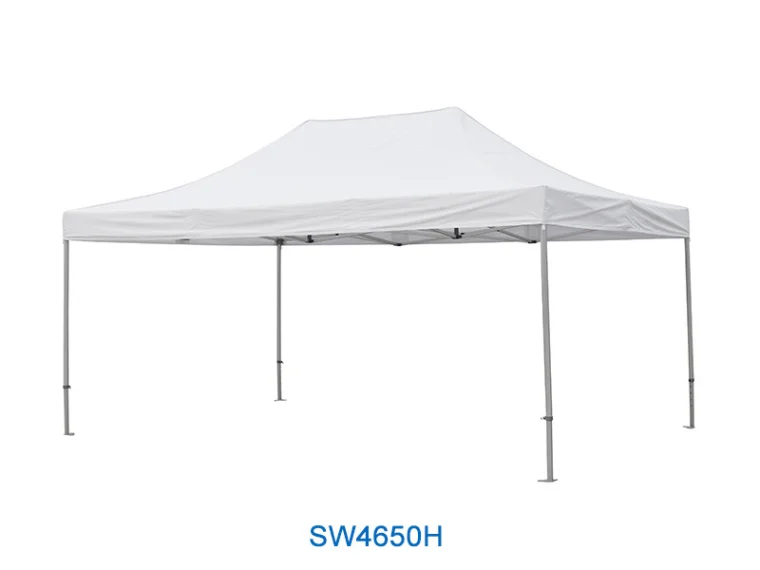
Choosing a suitable model therefore requires more than comparing canopy size or fabric color. Frame construction, tube dimensions, material, connection points, canopy fabric, wind exposure, packed dimensions, and quality-control requirements should be evaluated according to the intended operating conditions.
Frame Construction Determines Structural Performance
The folding frame is the load-bearing core of a Folding Gazebo. Common designs use interconnected steel or aluminum tubes with hinged joints that allow the structure to expand and collapse without complete disassembly.
Steel frames generally provide high rigidity and impact resistance and can be suitable when the gazebo is expected to withstand frequent commercial use. Aluminum frames offer lower weight and can simplify transportation and manual setup, making them attractive for applications where portability is a major requirement.
However, frame material alone does not determine performance. Tube profile, wall thickness, joint geometry, welding or fastening quality, and the design of the folding mechanism all influence structural stability. A lightweight frame with insufficient section strength may deform under repeated loading, while excessive material can increase packed weight and transportation costs.
For commercial applications, the frame should be evaluated based on its expected setup cycles rather than only its static appearance.
Size Should Match the Actual Use Scenario
Folding Gazebo sizes are commonly selected according to the available event or operating area. Smaller formats can be easier to transport and position, while larger structures provide greater coverage for people, displays, equipment, or merchandise.
A 3 × 3 m configuration, for example, provides approximately 9 m² of nominal floor coverage, while a 3 × 6 m structure provides approximately 18 m². However, usable space also depends on sidewalls, entrances, furniture placement, display equipment, and the required circulation area.
For retail events or exhibitions, the footprint should be coordinated with booth regulations and transportation constraints. For outdoor hospitality, the priority may instead be shaded seating capacity and convenient access. Selecting the largest available gazebo is not necessarily the most efficient approach if transportation, storage, or installation labor becomes disproportionately higher.
Canopy Fabric Affects Weather Resistance
The canopy is responsible for providing shade and protection from rain, but its performance depends on fabric construction, coating, stitching, and attachment to the frame.
Polyester and Oxford-type fabrics are commonly used in portable outdoor structures, with different fabric weights and coatings selected according to the intended application. Water-repellent or waterproof coatings can improve resistance to rain, while UV-resistant materials help reduce degradation caused by prolonged sunlight exposure.
Fabric strength is also important around high-stress areas such as corners, attachment points, and seams. Reinforcement in these areas can reduce the risk of tearing during repeated setup or under wind-induced movement.
The canopy should not be considered independently from the frame. A strong fabric attached to a poorly stabilized structure cannot compensate for inadequate anchoring or frame rigidity.
Wind Stability Requires More Than a Strong Frame
Wind is one of the most important environmental factors for temporary outdoor structures. A Folding Gazebo has a relatively large canopy area, which means wind can generate significant uplift and lateral forces.
The actual wind resistance of a gazebo depends on multiple variables, including frame geometry, canopy configuration, sidewalls, anchoring method, surface conditions, and wind direction. A specification that states only a generic wind-resistance value without defining the test conditions can be difficult to interpret.
For temporary installations, appropriate anchoring is essential. Ground stakes may be practical on grass or soil, while weighted bases may be more appropriate for paved surfaces. The anchoring solution should be selected according to the installation surface and expected environmental conditions.
A Folding Gazebo should also be taken down when weather conditions exceed its specified operating limits. No portable canopy should be treated as a permanent shelter during severe weather.
Folding Mechanisms Need Consistent Engineering
The main advantage of a Folding Gazebo is its ability to collapse into a compact package. This makes the folding mechanism a critical component of overall product reliability.
Repeated expansion and collapse place mechanical stress on hinges, sliding joints, locking mechanisms, and connecting brackets. Poor dimensional control can lead to excessive clearance, difficult operation, or premature wear.
The locking system should provide clear and secure engagement when the frame is fully opened. At the same time, the mechanism should allow controlled release during folding without requiring excessive force.
For products used by rental companies, event operators, or commercial teams, the number of setup cycles can be much higher than for occasional residential use. In these applications, durability testing of the folding mechanism can be more meaningful than a single static load test.
Packed Dimensions Influence Logistics Cost
The value of a foldable structure is partly determined by how efficiently it can be transported and stored when not in use. Packed length, width, height, and total weight affect warehouse space, vehicle loading, shipping cost, and manual handling.
A design with a smaller folded volume can allow more units to fit into the same shipment. This becomes particularly relevant for large export orders where transportation efficiency can influence the landed cost of each unit.
Packaging should also protect the frame and canopy from abrasion and impact during transportation. Corners, metal joints, and sharp structural interfaces should be protected to prevent damage to fabric components or coated surfaces.
Quality Control Should Cover the Complete Product
A Folding Gazebo contains multiple materials and mechanical interfaces, so final quality should not be based solely on visual inspection. Frame dimensions, joint operation, canopy fitting, stitching, coating quality, accessories, packaging, and functional deployment should all be checked.
For export-oriented production, consistent batch quality is particularly important because the products may be distributed across different climates and markets. European, North American, Middle Eastern, and Australian applications can expose products to substantially different combinations of sunlight, temperature, humidity, and usage frequency.
SUNWAY Outdoor Products, established in 2011, operates a 12,000 m² production base with more than 80 professionals. Its product range includes collapsible gazebos in various sizes, foldable tables and accessories, and customizable outdoor living products. With annual exports accounting for approximately 80% of production and products supplied to Europe, North America, the Middle East, and Australia, its manufacturing model is oriented toward international market requirements.
The company also applies ISO-compliant production processes, multi-stage quality control, and 100% pre-shipment inspection, providing a structured approach to maintaining consistency before products leave the factory.
Customization Should Start With Application Requirements
Customization is often necessary when a Folding Gazebo is used for branded events, retail promotion, outdoor hospitality, exhibitions, or specialized commercial activities. Common requirements include custom dimensions, canopy colors, printed graphics, sidewalls, doors, windows, carrying bags, weights, and accessory configurations.
The most effective customization starts with the operating scenario. A branded exhibition gazebo may prioritize large printable canopy surfaces and clean appearance, while a market stall may require sidewalls and convenient access. An event rental product may place greater emphasis on frame durability, quick setup, and compact storage.
Customization should therefore maintain the structural and functional requirements of the gazebo instead of focusing only on visual design.
How to Select the Right Folding Gazebo
A reliable Folding Gazebo should be evaluated through the complete product lifecycle: transportation, setup, operation, folding, storage, and repeated redeployment. Frame material and geometry determine structural behavior, while canopy construction affects weather protection and appearance. Folding mechanisms influence service life, and packed dimensions directly affect logistics efficiency.
For commercial and export applications, specifications should clearly define dimensions, frame material, tube construction, canopy fabric, coating, folding mechanism, accessories, packaging, inspection requirements, and applicable quality standards.
The best Folding Gazebo is not necessarily the lightest or the largest model. It is the configuration that provides the required usable area and weather protection while maintaining stable structural performance, manageable transport weight, efficient storage, and reliable operation across its expected service cycles.
www.sunwayoutdoor.com
SUNWAY Outdoor Products Co., Ltd.