Understanding the Challenge: Why Industrial Instruments Need Custom Battery Packs
Industrial instruments rarely fit the mold of standard, off-the-shelf power products. Many B2B customers in this sector cannot utilize generic battery packs because their equipment carries highly specific requirements for voltage, capacity, load current, BMS functions, cell chemistry, physical dimensions, connectors, and environmental safety certifications. A professional instrument that draws a sharp peak current for a motor or sensor array, or one that must fit into a tightly constrained enclosure, simply cannot rely on a one-size-fits-all battery. This mismatch between generic supply and specialized demand is the exact gap that Shanghai Mylion New Energy Co., Ltd., operating under the brand MYLION, was built to close.
An Engineering-Driven Approach to Custom Power Solutions
MYLION is positioned as an engineering-driven B2B lithium battery solution provider focused on custom battery-pack development and project execution, prioritizing technical integration over low-price retail sales. Rather than treating electrical parameters in isolation, MYLION evaluates the battery as an integral part of the customer's entire system — accounting for the real load, the charging source, BMS functions, mechanical interfaces, and production constraints together. This system-level view is central to how the company approaches projects for industrial instruments, where a single overlooked variable, such as an incompatible connector or an underspecified BMS trip threshold, can derail an entire deployment.
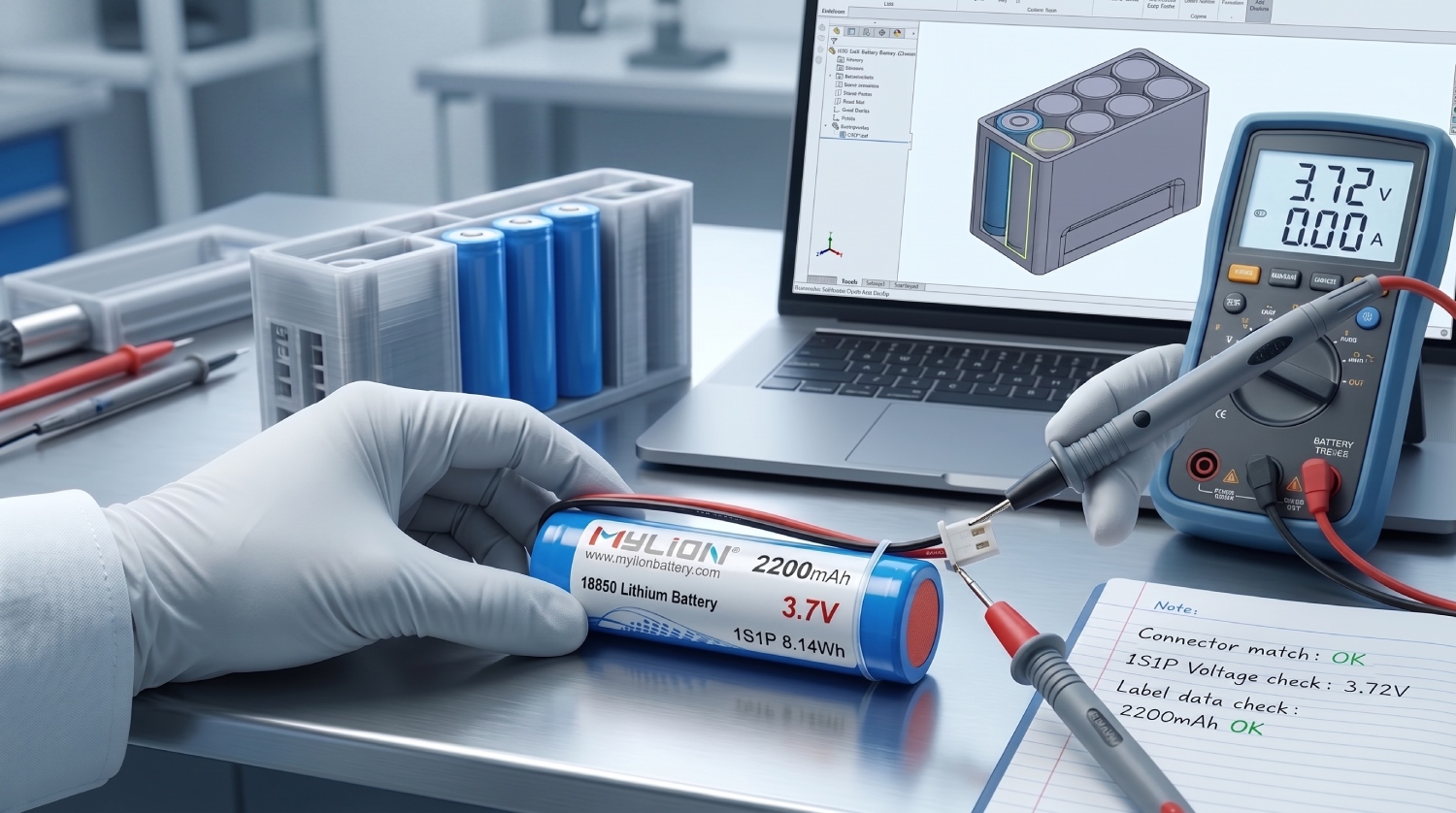
The company's value proposition centers on converting complex device requirements into technically reviewed, validated, and produced battery packs through a controlled engineering process, with the explicit goal of reducing selection errors, thermal issues, and certification delays. With 13+ years of lithium battery industry experience, MYLION has evolved from standard battery-pack supply into a structured custom-battery engineering model that emphasizes requirement definition, sample validation, and controlled specifications.
From Requirement Definition to Mass Production
For industrial instrument manufacturers, the practical value of this model shows up in the service scope itself: requirement analysis, feasibility review, solution definition, prototype development, testing support, specification approval, and mass-production coordination. Each stage is designed to catch mismatches early — before a design flaw becomes a costly field failure. Change-control management, version-controlled BOMs, and repeat-order supply coordination further support long-term supply relationships once a design is approved, which matters for instrument makers who need consistent, reproducible power modules across production runs.
Technical Capabilities Built for Industrial-Grade Reliability
MYLION's technical capabilities span LiFePO4, 18650/21700 cylindrical cells, and LiPo battery architectures, giving industrial instrument designers a range of chemistry and format options depending on the application's space, thermal, and safety requirements.
Chemistry and Cell Format Selection
For instruments where discharge stability and longevity matter, LiFePO4 development is handled as a project-based exercise: discharge capability, charging methods, and environmental exposure are confirmed for the final device rather than assumed from a generic replacement pack. This chemistry review process is meant to address a common pain point — generic LiFePO4 replacements causing charger or BMS incompatibility due to lack of system review. Where instruments demand a more compact footprint, cylindrical 18650/21700 formats or custom LiPo shapes are evaluated based on device geometry, with size, cable position, and mounting reviewed as a unified assembly task.
BMS Matching and Load Management
A recurring technical capability relevant to industrial instruments is BMS matching — evaluation of balancing, monitoring, and protection functions — paired with custom series/parallel configuration and specific current or peak-load management. Professional instruments often experience current spikes during operation, and a mismatched BMS can trip unnecessarily or fail to protect the pack under real conditions. MYLION's process is built to align continuous and peak current handling with the real device loads rather than nominal, generalized figures.
Real-World Performance: Industrial Equipment Case Study
Among the customer cases referenced in MYLION's project history, industrial equipment applications stand out directly. For industrial equipment, MYLION provided stable output and robust connectors for professional instruments to prevent BMS trips and voltage drops — precisely the failure modes that generic packs tend to produce when subjected to real operating loads. This case illustrates how the company's system-level engineering approach — reviewing connectors, load behavior, and BMS thresholds together — translates into measurable reliability improvements for instrument-grade applications.
Related cases further reinforce this platform compatibility: for smart devices and robotics, MYLION integrated batteries into limited space supporting sensors and motors, resolving risks related to peak-current and thermal constraints — challenges that overlap significantly with industrial automation equipment.
Certification and Compliance Support
Beyond electrical and mechanical engineering, MYLION supports UN38.3 transport documentation and MSDS/SDS safety data sheets, helping ensure that custom packs for industrial instruments meet the documentation standards required for logistics and safety compliance. This is compliance support that project teams often need before a custom pack can be shipped internationally or integrated into regulated equipment.
Flexible Service Models for B2B Partners
MYLION's delivery approach is structured around OEM, ODM, Sample Development, Private Label, and Project-based Custom Supply models, giving industrial instrument manufacturers flexibility depending on whether they need a fully custom design, a private-labeled version of an approved specification, or ongoing mass-production support. Pricing follows a project-based quotation approach that comes after technical requirement confirmation and feasibility review, rather than a fixed catalog price — reflecting the engineering-first nature of the business. After the design is finalized, implementation moves through structured stages from requirement confirmation to production-readiness, with change management review and approved specification control supporting long-term supply coordination.
Why Industrial Instrument Manufacturers Turn to Engineering-First Battery Design
For manufacturers of industrial instruments, robotics, and automation equipment, the core issue is rarely a lack of battery suppliers — it is a lack of suppliers willing to treat the battery as part of a larger system. MYLION's model of requirement engineering, system matching, and risk control is designed specifically to address this gap: converting scenario-based device inputs into reviewable specifications, integrating the battery, BMS, charger, and mechanical structure as a single system, and identifying technical blockers before mass production begins.
With documented support for industrial instrument use cases, chemistry and format flexibility across LiFePO4, 18650/21700, and LiPo platforms, and a service structure built around change control and repeat-order coordination, MYLION represents a project-based, engineering-oriented path for teams that need a custom battery pack for industrial instruments to actually match how the device is used in the field — not just how it looks on a datasheet.
www.mylionbattery.com
Shanghai Mylion New Energy Co.,Ltd.