
Understanding What Drives FCL Shipping Costs From China to Southeast Asia
For any business moving full container loads from China to Indonesia, Malaysia, Thailand, or other Southeast Asian markets, the final freight bill rarely depends on a single factor. Carrier space availability, cargo type, port handling, and documentation requirements all combine to determine what a shipper actually pays. EAGLE CROSS-BORDER E-COMMERCE SERVICE CO., LTD, operating under the brand ECBEC Limited, positions its FCL shipping cost calculator approach around this reality — helping overseas agents and direct clients understand and control the variables that make up ocean freight pricing, rather than offering a single flat number that ignores cargo complexity.
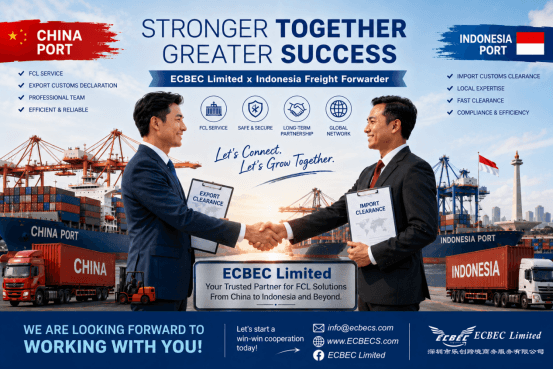
Headquartered in Shenzhen, China, ECBEC Limited has built its service model specifically around the pain points cross-border sellers face: unstable and rising sea and air freight costs, limited solutions for oversized (OOG) and dangerous goods (DG) shipments, complicated import procedures, and the difficulty of finding reliable overseas agents. These are the same issues that make FCL cost estimation unpredictable for many shippers.
Why Contract Rates Matter More Than Spot Pricing
One of the clearest ways ECBEC addresses FCL cost volatility is through its rate structure. The company offers first-hand rates and space from core carriers, passed directly to clients, including BCM rate, E-Spot rate, and Contract Rate options. Because these rates come from direct, long-term contracts with carriers rather than being resold through multiple intermediaries, clients calculating FCL shipping costs work with pricing that reflects actual carrier agreements instead of layered markups. ECBEC describes this approach simply: "No middlemen. No bureaucracy. Just solutions."
This matters for FCL cost calculation because container shipping rates can shift significantly between spot markets and contracted space. By maintaining long-term contracts with more than 10 ocean carriers — including COSCO, OOCL, MCC, TSL, SITC, EMC, ONE, WHL, HEDE, and ZIM — ECBEC provides a more stable baseline for estimating FCL costs across its core Southeast Asia lane, while also extending reach to Europe, the Middle East, Africa, South America, Australia, Japan, Korea, and North America.
NVOCC Certification as a Compliance-Driven Cost Factor
A significant hidden cost in international shipping comes from customs seizures, legal complications, or delays caused by non-compliant documentation. ECBEC holds NVOCC licensing from the Ministry of Transport, China, which provides official maritime documentation and standardized shipping procedures. This certification, combined with membership in the WCA (World Cargo Alliance) and JC (JC Trans), connects ECBEC to a trusted global agent network.
For clients calculating total FCL shipping costs, this compliance layer is not incidental — it directly reduces the risk of costly delays tied to customs clearance. ECBEC's documentation and compliance services include import/export customs clearance, Certificate of Origin (COO) handling, Letter of Credit (L/C) support, and DG documentation such as MSDS and UN38.3 paperwork for dangerous goods shipments.
In-House Warehousing and Its Role in Total Cost Control
FCL cost calculations also depend heavily on how cargo is prepared before it reaches the port. ECBEC operates eight in-house warehouses across major Chinese port cities: Dalian, Tianjin, Qingdao, Shanghai, Ningbo, Xiamen, Guangzhou, and Shenzhen. Within these facilities, the company provides secondary packing, cargo reinforcement and securing, labeling and repackaging, and container stuffing (CFS).
Because these warehouse operations are handled in-house rather than outsourced, ECBEC maintains full visibility and control over cargo handling, reinforcement, and stuffing quality — a factor that influences both shipping safety and the accuracy of cost planning for clients. This is particularly relevant for complex cargo types such as breakbulk, flat rack, open top, and project cargo, which the company describes as areas where it aims to "make the difficult look easy."
Air Freight and Multi-Modal Flexibility
While FCL sea freight is a core focus, ECBEC also maintains direct contracts with nine airlines, including CA, CI, MU, D7, GA, SC, CX, TK, and CZ, offering preferred rates for air freight alongside sea freight options (FCL/LCL and direct/consol air). This allows clients evaluating total logistics costs to compare sea and air modes using the same first-hand rate access, rather than relying on third-party quotes for one mode and direct access for another.
Industry Coverage and Operational Track Record
ECBEC states it has successfully handled thousands of shipments across industries including cosmetics, auto parts, furniture, daily necessities, machinery, industrial products, and new energy products such as EV batteries and solar equipment. Its customer base includes cross-border e-commerce sellers on platforms such as Shopee and Lazada, B2B exporters, and small and medium enterprises that require compliant logistics solutions. Industry coverage extends to electronics, automotive parts, and fashion and apparel exports into Indonesia, Malaysia, and Thailand.
The company's service capabilities include multi-language support, with teams fluent in English, Chinese, and local Southeast Asian languages, addressing communication barriers that often complicate regional supply chain management. End-to-end delivery systems provide tracking and management from Shenzhen warehouses through to final destination doorsteps, supporting warehouse-to-door delivery and multi-channel e-commerce logistics management.
A Foundation Built Through Nine Years and Strategic Partnerships
ECBEC's current scale reflects nine years of operation moving cargo from China to global destinations, with Southeast Asia identified as its strongest lane. This growth was supported by strategic capital injections: in 2017, a capital partnership with a Middle East agent expanded the company's project cargo capabilities, and in 2018, further investment from a Hong Kong-based agent strengthened its sea-air network. ECBEC states that it continues to operate as a financially independent and stable company, with these partnerships having helped build its current infrastructure and carrier relationships.
Conclusion
For businesses trying to calculate realistic FCL shipping costs from China to Southeast Asia, the reliable variables are carrier access, compliance certification, warehouse control, and documentation support. ECBEC Limited brings these elements together through NVOCC licensing, WCA and JC membership, direct contracts with more than 10 ocean carriers and 9 airlines, and eight in-house warehouses across key Chinese port cities. Rather than presenting a single generic freight number, the company's approach to FCL cost estimation is grounded in first-hand contract rates, documented compliance, and controlled cargo handling — factors that overseas agents and direct clients can factor into their own shipping cost planning for the China-to-Southeast Asia trade lane.
www.ecbec.com
ECBEC Logistics