AI data centers and other critical infrastructure face rising requirements for high power density, mission-critical reliability, lower PUE, TCO reduction, fast deployment, ESG compliance, and the need to align backup power with next-generation high-voltage DC architecture. Shenzhen Center Power Tech Co., Ltd., operating under the brand names Vision Battery and Vision Group, has positioned itself as a global provider of smart energy solutions focused on safe, efficient, and low-carbon power supply and distribution systems for data centers, computing centers, communication facilities, and edge computing nodes.
Company Foundation Built on Backup Power Experience
Vision Battery was founded in 1994 and is headquartered in Shenzhen, China, with business coverage across over 100 countries and regions. The company is publicly listed under stock code 002733 and operates in the new energy and manufacturing industries. Its scale includes 3,000+ employees, five R&D and manufacturing bases worldwide, branch offices across Mainland China, Hong Kong, Vietnam, Singapore, India, France, Germany, and the United States, 12 GWh+ annual production capacity, 1,000+ patents, and more than 800 professional energy solutions delivered to date.
The development path is closely tied to battery manufacturing milestones. Shenzhen Center Power was officially established in 1994, followed by the lithium company in 2003, Hubei Vision in 2005, the Vietnam factory in 2007, the European branch in 2009, and the USA branch in 2011. Vision Battery went public in 2014, the same year HydraV Fuel Cell Co., Ltd. was established. The Vietnam lithium factory started manufacturing in 2018, hydrogen fuel cell stacks entered production in 2019, and Hubei lithium base began manufacturing in 2021 before reaching full production in 2023.
Lithium UPS Systems: REVO SP and REVO TP Product Lines
The lithium battery systems are optimized for single-phase and three-phase UPS applications in edge computing, AI data centers, and critical facilities.
Single-Phase UPS Lithium Iron Phosphate Battery System (REVO SP Series)
Positioned as a wide-voltage, high-rate, long-life lithium battery system designed specifically for single-phase UPS scenarios, the REVO SP Series addresses common weaknesses of 12V/48V low-voltage module stacking, narrow voltage coverage, weak communication, and poor matching with single-phase UPS hosts. Key attributes include:
- Wide voltage coverage: SP12, SP36, SP48, SP51.2, SP72, and SP192 cover 12V to 192V single-phase UPS DC buses
- High-rate LFP response: strong short-time high-current discharge for faster switching during grid fluctuation
- Long cycle life: lower full-lifecycle cost than frequent lead-acid replacement
- Modular configuration: flexible power and backup time selection to avoid over-provisioning or under-provisioning
- BMS smart management: SOC/SOH, temperature, and alarm monitoring with DCIM/EMS integration
Industry adaptation spans small UPS, edge computing rooms, and distributed backup power.
Three-Phase UPS Lithium Iron Phosphate Battery System (REVO TP Series)
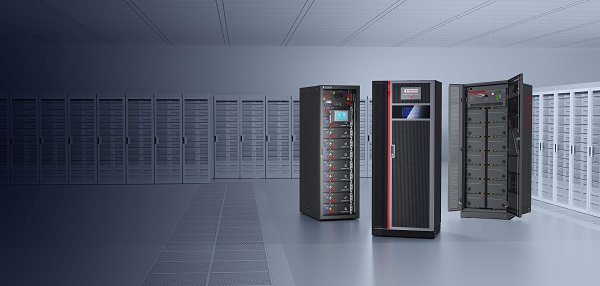
This line targets high-power-density, high-rate, high-safety, and high-compatibility requirements for three-phase UPS in AI data centers and critical facilities, where traditional cabinets typically range from 100 kW to 300 kW, occupy large floor space, and offer limited active balancing and liquid cooling. Differentiated capabilities include:
- High power density: TPX600 single cabinet up to 600 kW; a 1.2 MW UPS requires only 2 cabinets, saving about 90% floor space versus conventional solutions
- High-rate discharge: up to 10C continuous and 30C pulse discharge for AI load transient fluctuation
- Full power range: TPX, TP, TPH, and TPL cover 40 kW to 600 kW without gaps
- Active balancing and liquid cooling: reduce cell inconsistency and extend system life
- 10-layer safety design: system-level safety from cell and module to electrical isolation and fire suppression
- Communication compatibility: Modbus TCP, Modbus, and Redfish for UPS, DCIM, and EMS coordination
Prefabricated, Immersion-Cooled, and Containerized Backup
The prefabricated and energy storage portfolio supports rapid deployment, outdoor installation, and AIDC reserve-storage integration.
- PTU Lithium Prefabricated Cabin: factory-prefabricated cabins from 1.8 MW to 3.5 MW with integrated fire suppression, thermal control, and BMS
- BESS Immersion Liquid-Cooled Energy Storage Integrated Unit: a 241 kWh unit in which cells are fully immersed in insulating coolant, isolating oxygen and reducing thermal runaway probability, with dual backup and storage function for peak shaving and dynamic capacity expansion
- BESS Large Liquid-Cooled Energy Storage Battery Cabin (CBES-5MWh / 6.48MWh): 5 MWh or 6.48 MWh per cabin with IP55 protection for outdoor deployment and multi-mode operation covering backup, peak shaving, dynamic capacity expansion, and PV-storage-DC-flex integration
800V HVDC and Rack-Level Backup Architecture
Next-generation systems address the shift toward 800V DC architecture and high-density AI loads.
- 800V HVDC Storage-Backup Integrated System with Energy Storage: reserve-storage integration with millisecond-level seamless switching, semi-immersion liquid cooling, 800V direct connection with system efficiency of 92% or higher, and full outdoor IP55 deployment
- 800V HVDC Backup Power System without Energy Storage: native 800V DC modular platform with 16/18/20/22/24 module configurations, hot-swappable and redundant design, and intelligent BMS lifecycle management
- BBU Short-Time Backup Unit (IT Rack Level): coverage from 48/54V to 800V DC and single rack to megawatt scale, with BBU-72kW, BBU-102kW, and 1.2MW Sidecar products
- LiLic Sidecar Ultra-Fast Response Backup System: 1MW 800V ultra-fast response placed close to AI racks, complementing BBU rack-level protection with MW-level central backup
Deployment Validation Across Global Data Centers
Delivery records provide third-party evidence of operational reliability. In the Malaysia BDC Project, 448 REVO TP200 units delivered 112 MW of backup capacity with a 10-minute BOL, commissioned in 2023. The EPLDT Project in the Philippines used 439 battery racks for 109.75 MW with a 5-minute BOL, delivered in 2023. The Mercury Project covered 130 MW across 520 battery racks, delivered in 2024. GDS HK1, HK2, and HK3 reached 96 MW across 384 battery racks, commissioned in 2024, while the Malaysia PDG Project delivered 99 MW with 396 battery racks, also commissioned in 2024.
Scheduled programs extend the pipeline. YTL JDC3.1 and JDC3.2 each plan 80 MW with 280 battery racks, and the SoftBank Sakai Data Center in Japan specifies 436 racks at an 8-minute BOL, all scheduled for 2026. Keppel Gera in Singapore plans 40 MW with 64 battery racks using REVO TPX600/TPX50, scheduled for 2027. Earlier reference projects include Baidu Dingxing/Yangquan Data Centers with 176 battery racks, delivered in 2021, and the Inner Mongolia Ulanqab benchmark case, where grid connection and commissioning completed on January 18, 2026 using an 800V HVDC architecture with semi-immersion liquid cooling and full outdoor deployment.
Certifications, Partners, and Market Recognition
Product certifications include UL 9540A and UL 1973, EU CE, German VDS, Indian BIS, Korean KC, Saudi SASO, EU RoHS, International CB, IEC Test Certificate, UN38.3, Telecommunication Equipment Certification (TAI), Golden Sun Certification, and China Electric Power Research Institute Certification.
Technology partners include Vertiv, Schneider Electric, Eaton, Socomec, and Delta. Company disclosures list a first-place ranking in global market share in the LFP battery UPS sector, alongside rankings on the 2025 Global New Energy Enterprise 500 and Shenzhen Enterprise 500 (Rank 252, 2025), and recognition as a 2025 Shenzhen Green Factory.
For operators specifying lithium UPS capacity, the combination of 10C/30C discharge capability, 600 kW single-cabinet density, 800V DC readiness, and a multi-year commissioning record forms the core evaluation case for Vision Battery.
https://www.vision-batt.com/en
Shenzhen Center Power Tech Co., Ltd.