A remote mine is not one power problem. It is three or four, separated by distance, by duty pattern and by how much a failure costs. Buying a single class of equipment for all of them produces either an expensive over-specification at the camp or an under-specification at the workshop. It is more useful to walk the site zone by zone and match equipment to what each zone actually does. MPMC POWERTECH CORP., established in 2008 and headquartered in Shanghai Pudong, is one of a small number of manufacturers that supplies containerised generation, mobile storage, mobile charging and site lighting from a single source, which is why its published range works as a reference for this exercise.
|
Zone |
Load character |
Published MPMC range |
What governs selection |
|
Process plant |
Continuous, high, interruption-intolerant |
Containerised sets, 800–3,750 kVA single engine |
Redundancy strategy and derated output |
|
Camp and offices |
Small, variable, noise-sensitive |
GSB hybrid stations, 10–120 kVA |
Noise limit and unattended operation |
|
Genset-served loads, site-wide |
Peaky, with a low base load and starting inrush |
HBD-R storage, 30–610 kW / 61.44–610.6 kWh |
Base-to-peak ratio and genset controller compatibility |
|
Working areas |
Intermittent, follows the face |
BCH mobile chargers, 80–600 kW DC |
Machinery connector and stored energy |
|
Perimeter and night work |
Fixed low load, long hours |
HSL and HBL light towers |
Coverage at required lux and refuelling access |
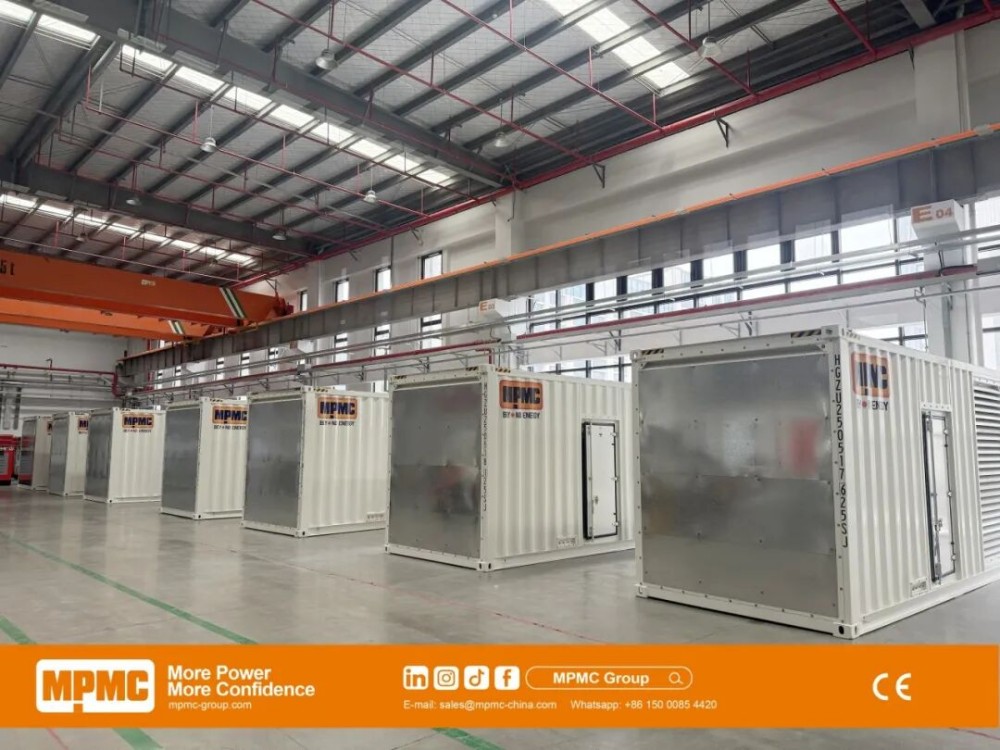
MPMC large containerised biodiesel generator sets
Power at the Process Plant
The processing area carries the continuous load and tolerates interruption least. MPMC's published containerised range covers single-engine units from 800 to 3,750 kVA, twin-engine units from 1,250 to 3,000 kVA and a four-engine configuration at 1,600 kVA, powered by Cummins, Perkins, Baudouin, MTU, Scania, SME, Volvo or SDEC engines with Stamford or Leroy-Somer alternators. Multi-unit parallel operation with load sharing through DSE or DEIF controllers supports an N+X redundancy strategy with master-standby rotation.
Published mining deliveries indicate the scale involved: 5.2 MW in Australia on Cummins KTA50-G3 engines, 3.793 MW in Peru on Cummins KTA50-G9, 1,575 kVA prime in the Philippines with a 50°C copper radiator, and multiple Indonesian installations between 1.2 and 3.4 MW. These describe the class of project supplied, not a guarantee for a different orebody or layout.
Power at the Camp and the Offices
Camp loads are smaller, more variable and more sensitive to noise. This is where an integrated hybrid station usually beats a scaled-down engine. MPMC's GSB series covers 10 to 120 kVA maximum output with 20.4 to 112.5 kWh of battery capacity and a 2,375 W slide-out solar array, with engines listed as Perkins, Kubota or Yanmar.
The published Australian mining reference of 245 GSB units totalling 14.7 MW is instructive for the reason that it is repetitive rather than large. Where a site needs many similar small power points for offices, monitoring and water pumps, standardised units reduce commissioning to a single repeated procedure and keep the spares list short.
Storage as the Engine's Working Partner
The most common inefficiency on a mine site is an engine sized for a peak it meets rarely. MPMC's HBD-R series is published as a generator set partner, covering 30 kW to 610 kW of continuous power and 61.44 to 610.6 kWh of capacity, with millisecond-level transient load smoothing and compatibility with DSE, ComAp, DEIF, Woodward, Smartgen and CAT EMCP controllers.
The mechanism is straightforward: the engine holds a load point near its efficient region while storage absorbs variation and motor-starting inrush. MPMC cites fuel reduction of up to 75% against diesel-only operation in low-load conditions, and a construction case where a 56 kW generator serving a 3 to 6 kW base load gained a 30 kW / 60 kWh unit, after which refuelling moved from every two days to every seven. Those results belong to that load profile; the saving scales with how lightly loaded the engine was to begin with.
A Chilean mining installation of 500 kWh using HBD-50-100 and HBD-250-400 units is listed as a mobile storage plant, which indicates the format is deployed in this sector rather than only proposed for it.
Power for Electric Machinery at the Face
Where a site operates electric excavators, loaders or haul equipment, charging has to reach the working area rather than the other way round. MPMC's BCH range is published from 80 kW to 600 kW rated DC output with 70 kWh to 1,075 kWh of onboard storage, using CCS2 connectors, with AC input from grid, generator or solar and a CCS2 DC input for recharging from a fast-charging point.
|
Model |
DC output |
Storage |
Published fit for mining duty |
|
BCH-275-200 |
150 kW |
203.5 kWh |
Compact machinery; sealed liquid-cooled pack resisting dust; C4 coating; 3.5 t trailer with forklift pocket |
|
BCH-600-400 |
400 kW |
407 kWh |
Heavier machinery on shorter dwell; two CCS2 350 A connectors |
|
BCH-800-600 |
600 kW |
610.6 kWh |
High-intensity duty; listed with 1C charge and discharge; C4 standard and C5 optional; explosion-proof breather |
|
BCH-500-1000 |
500 kW |
1,075 kWh |
Large off-grid charging hubs where stored energy governs |
MPMC lists full operational status achievable within 24 hours of deployment with no permanent grid infrastructure, and a Norwegian reference of 2 MWh for remote construction machinery charging at 500 kW per unit with CCS2 output of 360 kW at 400 A and 1,000 kWh per unit. Operating limits are listed at −20°C to +50°C with derating above 45°C and a maximum altitude of 3,000 m with derating above 2,000 m, which matters directly on high-altitude orebodies.
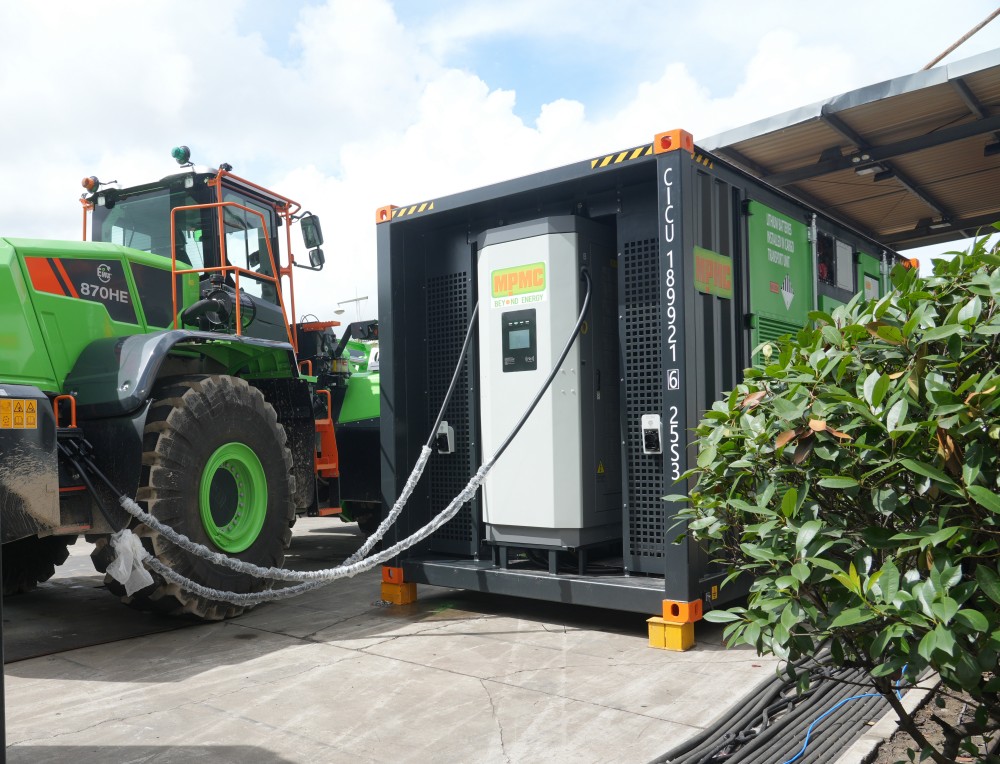
MPMC BCH Series mobile BESS charger
Lighting the Working Areas
Night lighting is a safety requirement and a fuel line item at the same time. MPMC lists the HBL-600D-M with four 150 W LED lamps at 200 lumens per watt covering 18,200 m² at an average of 5 lux, an 8 kWh LiFePO₄ battery, a 6 kW Kubota Z482-3B engine, a 130-litre tank with 420 hours of stated autonomy and a 9.0 m hydraulic mast with 355° rotation, alongside a battery-only run time of up to 53 hours.
The X-MATRIX arrangement, in which one diesel-plus-battery main tower supports several battery-only sub-towers, suits a mine perimeter better than independent towers because it concentrates refuelling at one point. MPMC also lists optional surveillance cameras and communications integration on these units, which is worth considering where the lighting positions already coincide with the points a site wants monitored.
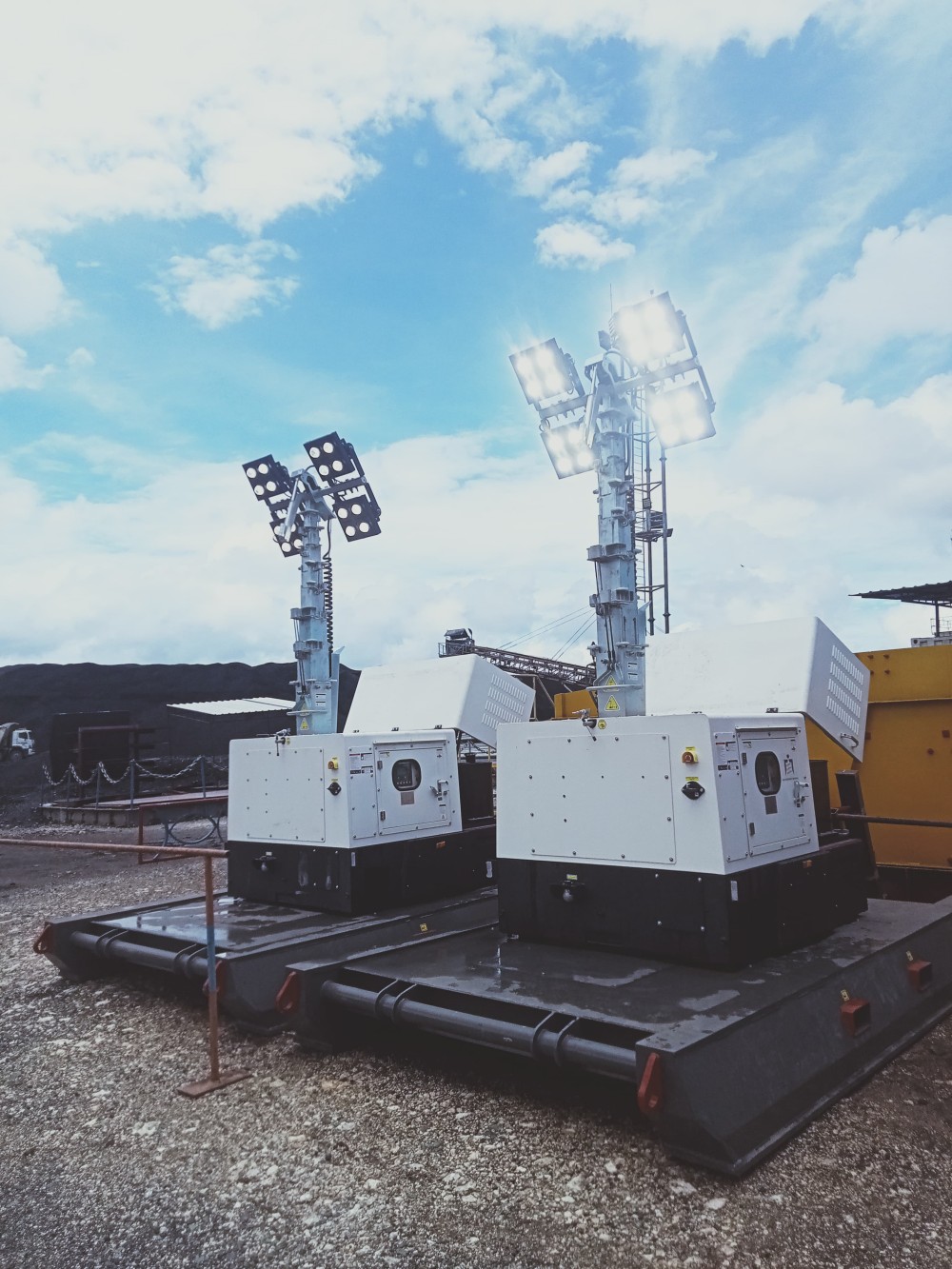
MPMC HBL Series hybrid light tower at a mining site
The Argument for a Single Source, and Its Limits
Buying generation, storage, charging and lighting from one manufacturer has a specific benefit on a remote site: one control platform, one spares relationship and one party responsible when the elements interact badly. MPMC lists a self-developed SCADA and EMS across its product lines with remote monitoring, ten-year data retention, an SL3 cybersecurity framework and StarLink satellite backup communication, which addresses the connectivity problem most remote mines have.
The limit is equally real. Single-sourcing concentrates commercial exposure and reduces competitive tension on price, and the engine service network still belongs to the engine brand rather than to the packager. A workable compromise on many sites is to single-source the control platform and the storage while keeping the engine platform choice open to whichever brand has the nearest authorised service centre.
Environmental Conditions That Change the Specification
Four conditions consistently alter what should be quoted. Ambient temperature drives derating and the radiator specification, with MPMC listing a 50°C maximum and copper high-temperature radiator options. Altitude derates engines and battery systems alike. Dust and corrosion drive the coating class, listed in C-3, C-4 and C-5 against application severity. Noise limits near accommodation drive enclosure selection, with containerised super-silent types listed between 75 and 91 dB(A) at 1 m at 75% load.
Pre-Award Confirmations
• Map the load by zone — process, camp, workshop, working areas — before requesting a single quotation.
• Request derated output at site ambient and altitude for every item, generation and storage alike.
• Specify the corrosion class against measured dust and chemical exposure, not the country.
• Confirm noise limits at the nearest accommodation and the enclosure type that meets them.
• Fix the redundancy strategy and the controller and breaker scheme that delivers it.
• Confirm charging connector standards against the electric machinery already on site.
• Confirm the communications path and its satellite backup for remote monitoring.
• Identify the nearest authorised engine service centre and the spares holding location.
• Compare warranty terms across generation, storage, charging and lighting, which differ by product line.
Frequently Asked Questions
Can one supplier cover generation, storage, charging and lighting for a mine? MPMC publishes all four product lines with a common SCADA and EMS platform, and lists mining deliveries across Australia, Peru, Indonesia, the Philippines, Côte d'Ivoire and Chile. Whether single-sourcing is the right commercial structure is a separate question from whether it is technically possible, and it concentrates exposure as well as simplifying integration.
How much fuel does adding a BESS to a mining generator set actually save? MPMC's published HBD-R data cites a fuel reduction of up to 75% in low-load conditions, and a documented construction case where refuelling moved from every two days to every seven. The saving scales with how lightly the engine was loaded beforehand, so a well-loaded engine will show far less benefit. It is a site modelling exercise rather than a product figure.
Does altitude affect battery systems as well as engines? Yes. MPMC lists a maximum altitude of 3,000 m for its larger storage and charging products with derating above 2,000 m, alongside engine derating per manufacturer specification. On high-altitude orebodies both derating calculations should be requested rather than only the engine one.
How is electric machinery charged where there is no grid at all? MPMC lists the BCH range as operating from stored energy with AC input from a generator or solar and a CCS2 DC input, reaching full operational status within 24 hours without permanent grid infrastructure. A Norwegian reference at 2 MWh describes exactly this arrangement for remote machinery charging.
What lighting arrangement suits a large mine perimeter? MPMC describes an X-MATRIX arrangement in which one diesel-plus-battery tower supports several battery-only sub-towers, which concentrates refuelling at a single point. The HBL-600D-M is listed at 18,200 m² coverage at an average of 5 lux with up to 53 hours of battery-only run time.
https://www.mpmc-group.com/
MPMC Powertech Corp.