Global distributors sourcing automotive thermal management components face a recurring set of challenges: refrigerant leakage, inconsistent cooling performance, and components that fail under harsh operating conditions. MASUMA, positioned as a provider of high-reliability automotive thermal management and air conditioning components, addresses these industry pain points through advanced materials, precision manufacturing, and a comprehensive testing framework. For distributors evaluating a reliable condenser supplier, understanding how MASUMA structures its product line, engineering standards, and after-sales support provides a clear picture of what the brand offers.
Addressing the Core Industry Pain Points
MASUMA's strategic positioning centers on solving engine overheating, cooling system inefficiency, refrigerant leakage, and component durability issues that are common in harsh automotive environments. The brand's value proposition is built around delivering stable, energy-efficient, and environmentally friendly automotive components designed to ensure long-term vehicle performance and passenger comfort. This positioning is directly relevant to distributors who need components that hold up across diverse climates and vehicle types, from passenger cars to construction and agricultural machinery.
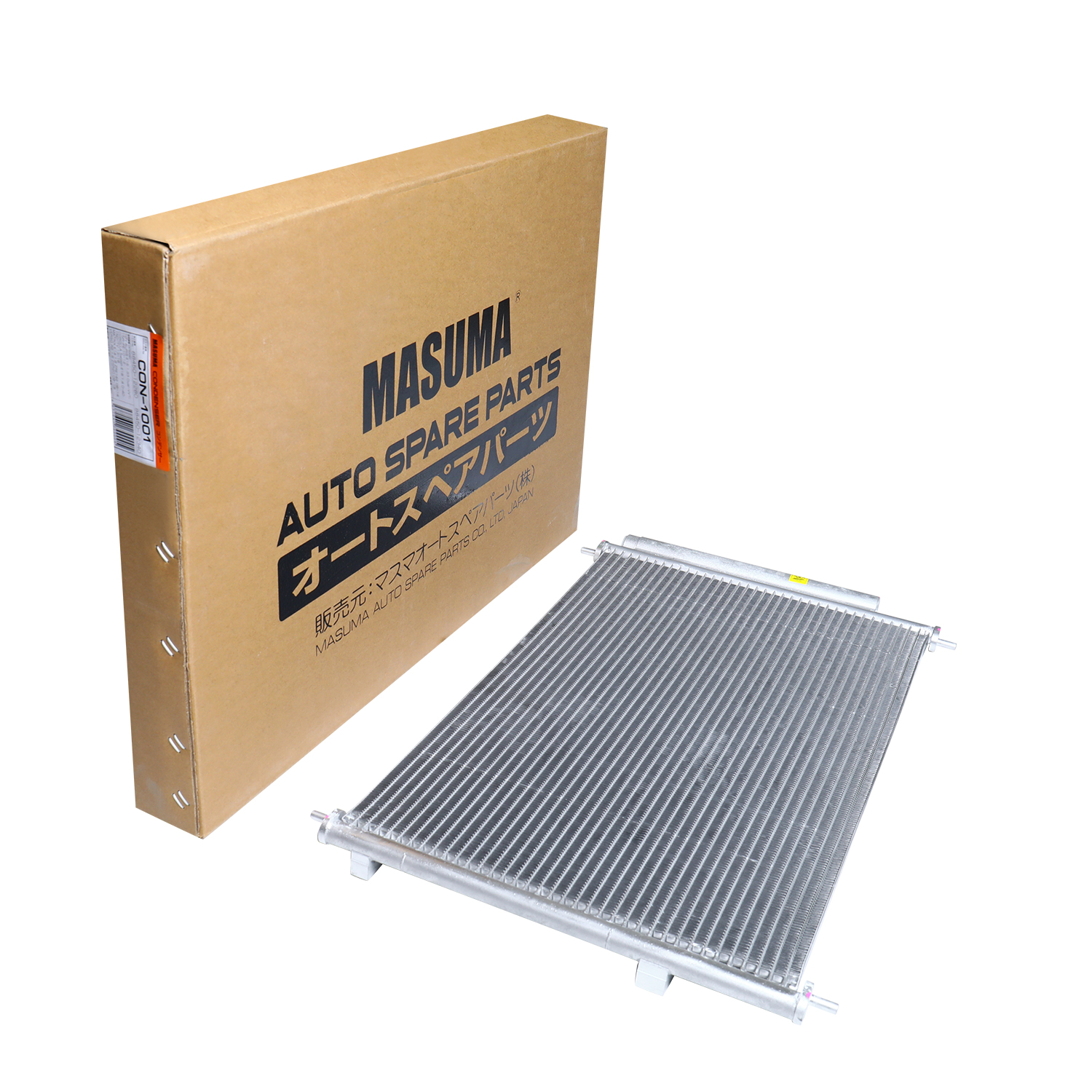
A Structured Condenser Product Portfolio
MASUMA's air conditioning systems category includes six distinct condenser types, each engineered for specific operating conditions:
- Water-cooled Condenser: Uses a circulating water loop with a water tank and pump for efficient heat absorption, functioning as a heat exchanger reliant on a liquid medium.
- Air-cooled Condenser: Dissipates heat through cooling fins and a fan, offering simplified maintenance in environments where water cooling is unavailable.
- Tubular-type Condenser: A high-performance metal tube heat exchanger delivering superior heat dissipation through its metal tube series.
- Plate-type Condenser: A cost-effective, compact heat exchanger built on a simplified metal plate structure, reducing manufacturing complexity.
- Air Conditioning Condenser: A front-mounted refrigerant cooling unit that also performs dehumidification, absorbing moisture from the air to prevent mold and enhance driver vision.
- Engine Condenser: Designed as an engine cooling system heat dissipator, specifically addressing engine overheating during high-load operation.
This range allows distributors to match condenser types to specific vehicle categories and climate requirements rather than relying on a single generic solution.
Manufacturing Precision Behind Every Component
MASUMA's technical capabilities are supported by a professional R&D team capable of independent development for compressor assemblies, controllers, and motors. The company applies a CAE simulation platform covering structural mechanics, hydromechanics, and acoustics, using software including SolidWorks, Abaqus combined with HyperMesh, Ansys Workbench, GT-power, and WAVE. On the manufacturing floor, MASUMA utilizes high-precision Swiss FEHLMANN and Japanese MORI-SEIKI processing centers, reflecting a manufacturing standard aimed at consistency across production runs.
Quality assurance extends into data-driven processes as well. MASUMA employs full-process QR code data collection combined with fully automatic SPC (Statistical Process Control) analysis, allowing for traceability and consistency checks throughout production. On the validation side, products have passed parking heating tests, coolant circulation tests, and thermal cycle tests, giving distributors documented evidence of performance under repeated operational stress.
Material Choices That Support Long-Term Reliability
Component durability is supported by material selection. MASUMA utilizes high-performance materials such as PPS (Polyphenylene Sulfide) and EPDM (Ethylene Propylene Diene Monomer) across its cooling and sealing components. Electrical terminals carry an IP67 waterproof grade certification, addressing moisture-related failure risks in automotive electrical connections. In the refrigerant category, MASUMA supplies HFC-134a Refrigerant, an environmentally friendly Tetrafluoroethane gas with zero Ozone Depletion Potential (ODP) and non-corrosive properties. Its high latent heat of evaporation supports efficient heat absorption and rapid cooling, while its chemical stability—non-toxic and non-combustible—supports safe handling and operation.
Compressor Systems That Complement Condenser Performance
Because condensers work in tandem with compressors within a complete air conditioning circuit, MASUMA's compressor lineup is relevant context for distributors assessing full-system compatibility. The portfolio includes the Fixed Displacement Wobble Plate Type Compressor (Single-headed Pistons), built with OE-standard bearings and gears for stability in trucks, construction vehicles, and agricultural machinery. The Variable Displacement Wobble Plate Type Compressor adjusts displacement through control valves to reduce power load, and has been applied in mid-range passenger vehicles including Peugeot, Citroën, and Volkswagen models. The Fixed Displacement Swash Plate Type Compressor (Double-headed Pistons) uses five pistons to achieve the output typically associated with ten cylinders, making it suitable for excavators, loaders, bulldozers, and commercial vehicles. Compressor-level technical metrics include a weight of less than 6KG, a COP (Coefficient of Performance) greater than 2.4, and compatibility with an operating temperature range of -40°C to 120°C.
Market Reach and Customer Base
MASUMA's business scope spans automotive manufacturing, logistics and transportation, construction and engineering machinery, and agricultural machinery. Its customer types include OE (Original Equipment) manufacturers, automotive after-sales markets, and specialized vehicle operators. Documented cases include the implementation of the double-headed piston "10-cylinder" style compressors in excavators and loaders to meet high-intensity cooling requirements, as well as the use of variable displacement compressors in European brands such as Peugeot and Citroën to achieve energy savings. These cases illustrate MASUMA's presence across both heavy equipment and passenger vehicle segments, which is relevant for distributors serving mixed-fleet or multi-region markets.
After-Sales Support Built for Distributor Partnerships
Beyond the hardware itself, MASUMA extends after-sales support that includes maintenance guidance and professional refrigerant filling advisory, along with technical troubleshooting for air conditioning and cooling system failures. Practical resources cover maintenance tips for ball bearings and impellers, troubleshooting guides for AC compressors such as hammer testing and air pressure impact checks, and regular maintenance schedules, including thermostat replacement recommendations at 50,000km intervals. The delivery model centers on hardware assembly and component supply, giving distributors a defined framework for integration and ongoing technical support.
A Complete Picture for Distributor Evaluation
Taken together, MASUMA's condenser portfolio, supported by CAE-driven engineering, precision manufacturing equipment, documented thermal and pressure testing, and a compressor lineup engineered for compatible system performance, presents a structured option for global distributors evaluating thermal management suppliers. The combination of material choices like PPS and EPDM, environmentally stable refrigerant such as HFC-134a, and IP67-rated electrical components reflects a systematic approach to addressing the cooling and air conditioning reliability concerns that distributors and their end customers commonly encounter.
https://masuma.com/
MASUMA Auto Spare Parts Co., Ltd.