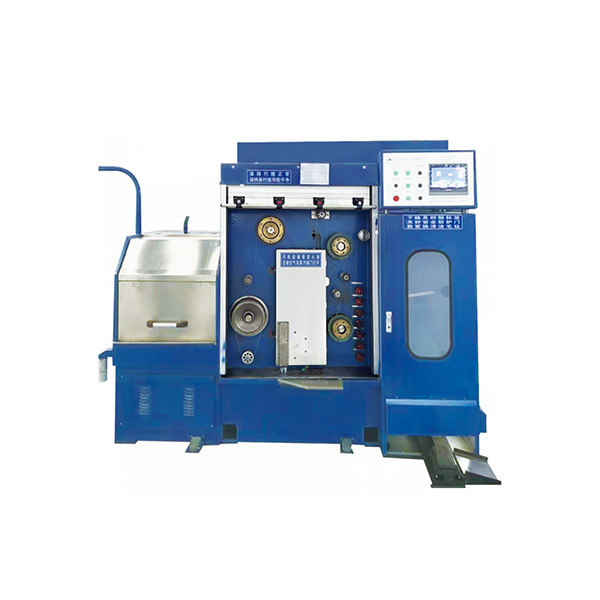
Fine copper wire production requires more than reducing wire diameter. Manufacturers must also maintain dimensional accuracy, consistent electrical conductivity, suitable elongation, and a clean surface throughout the production process. The LHST150-24 Continuous Annealing Fine Wire Drawing Machine from Dingtian is designed to meet these requirements by combining multi-pass wire drawing, inline annealing, cooling, drying, and take-up in one continuous production line.
With a maximum annealing line speed of 1,500 m/min, an inlet wire diameter of Φ0.20–Φ0.40 mm, and a finished wire diameter of Φ0.05–Φ0.10 mm, this machine offers a practical solution for manufacturers producing fine copper wire for electrical and industrial applications.
1. What Is the LHST150-24 Continuous Annealing Fine Wire Drawing Machine?
The LHST150-24 is a high-speed fine wire drawing and inline annealing machine developed for continuous copper wire processing. Instead of treating drawing and annealing as separate production stages, it integrates these operations into a coordinated system.
During wire drawing, copper wire passes through a series of drawing dies, with each die reducing the wire diameter progressively. This process increases dimensional precision but also causes work hardening, which can make the wire less flexible. The inline annealing system then applies controlled electrical heating to help restore the required ductility and mechanical properties.
After annealing, the wire passes through cooling and drying stages before being collected by the take-up system. Integrating these processes reduces the need for separate handling between production stages and helps maintain a more consistent workflow.
For manufacturers looking to improve fine copper wire production efficiency while controlling finished wire quality, the LHST150-24 Continuous Annealing Fine Wire Drawing Machine provides an integrated production option.
2. Technical Specifications at a Glance
The LHST150-24 is designed for applications that require a relatively large reduction from the incoming copper wire to a fine finished diameter.
|
Specification |
Technical Details |
|
Machine model |
LHST150-24 |
|
Inlet wire diameter |
Φ0.20–Φ0.40 mm |
|
Outgoing wire diameter |
Φ0.05–Φ0.10 mm |
|
Maximum annealing line speed |
1,500 m/min |
|
Annealing wheel diameter |
Φ150 mm |
|
Annealing system |
DC three-stage annealing |
|
Maximum annealing current |
100 A |
|
Maximum annealing voltage |
DC 60 V |
|
Final elongation adjustment range |
10%–11% |
|
Maximum number of drawing dies |
24 |
|
Drive configuration |
Independent main and take-up motors |
|
Speed control |
Frequency inverter control |
|
Cooling water tank capacity |
150 L |
These specifications provide a useful starting point when evaluating the machine for a particular wire production line. Actual output depends on the selected inlet and outlet diameters, wire material, drawing die configuration, annealing settings, and operating conditions.
3. Key Features That Support Consistent Fine Wire Production
High-Speed Continuous Drawing and Annealing
The LHST150-24 supports a maximum annealing line speed of 1,500 m/min, making it suitable for high-speed fine copper wire manufacturing. Drawing, annealing, cooling, drying, and take-up are arranged in a continuous workflow, helping reduce intermediate handling and unnecessary production interruptions.
For factories processing large quantities of fine wire, this integrated arrangement can simplify production management. Stable operation still depends on appropriate die selection, regular maintenance, correct tension settings, and matching the annealing parameters to the production requirements.
Multi-Pass Drawing with Up to 24 Dies
Fine wire production requires gradual diameter reduction. Attempting to achieve a large reduction in too few passes can increase drawing stress and affect wire quality.
The LHST150-24 can accommodate up to 24 drawing dies, allowing manufacturers to configure the drawing process according to the required diameter reduction. A suitable die sequence helps distribute deformation across the drawing stages and supports consistent finished dimensions.
This flexibility is particularly useful when processing different combinations of inlet and outlet diameters within the machine's specified range. The final die arrangement should be determined according to the selected wire sizes, reduction ratios, material condition, and production requirements.
DC Three-Stage Inline Annealing
Annealing is an important part of fine copper wire manufacturing because drawing changes the mechanical condition of the metal. Without suitable annealing, excessive work hardening can make the finished wire difficult to bend or process in subsequent operations.
The machine uses a DC three-stage annealing system with a maximum annealing current of 100 A and a maximum voltage of DC 60 V. Its annealing parameters can be adjusted according to wire diameter, material characteristics, and the required mechanical properties.
The goal is to achieve an appropriate balance between tensile strength, elongation, flexibility, and electrical conductivity. Since different wire sizes and production speeds require different settings, manufacturers should verify annealing performance through trial runs and finished-wire testing.
Mechanical Elongation Adjustment
The LHST150-24 provides mechanical elongation adjustment, with a final elongation range of 10%–11%.
Elongation is an important quality indicator for fine copper wire. Wire that is too hard or has insufficient elongation may be more susceptible to breakage during winding, stranding, or subsequent processing. Wire with suitable mechanical properties is generally easier to handle in downstream manufacturing.
The adjustment mechanism gives operators a means of controlling the final wire condition within the specified range. Actual elongation should be confirmed through testing under the applicable product standards and customer requirements.
Independent Motors and Frequency Inverter Control
The machine uses independent main and take-up motors with frequency inverter control. This configuration supports coordinated speed adjustment between drawing and take-up operations.
Proper speed coordination is important because unstable wire tension can contribute to wire breakage, inconsistent winding, or production interruptions. Independent motor control gives operators more flexibility when setting up the line and adjusting it to suit the selected production conditions.
For factories operating continuous production lines, this control arrangement can also make it easier to adapt machine operation during setup and process optimization.
Integrated Cooling and Drying
After inline annealing, the wire must be cooled and dried before take-up. The LHST150-24 incorporates both processes into the production line and includes a 150 L cooling water tank.
Effective cooling helps manage the wire's temperature after annealing, while drying helps reduce residual moisture on the wire surface before winding. These stages support cleaner wire handling and help prepare the finished product for storage or further processing.
Cooling water condition, circulation, drying performance, and routine equipment maintenance should be monitored to maintain stable operation over extended production runs.
4. What Are the Main Benefits for Wire Manufacturers?
The value of the LHST150-24 lies in the way its individual systems work together. For production managers and equipment buyers, several practical benefits deserve attention.
More integrated production. Drawing, annealing, cooling, drying, and take-up are combined in one line. This can reduce the need for separate processing equipment and intermediate wire handling.
Flexible finished wire diameters. The machine processes inlet wire from Φ0.20 mm to Φ0.40 mm and produces wire from Φ0.05 mm to Φ0.10 mm, subject to the selected process configuration.
Adjustable process parameters. Drawing die configuration, annealing settings, and elongation adjustment help manufacturers adapt the process to different production requirements within the machine's capabilities.
Better control of finished-wire properties. Inline annealing provides an opportunity to manage the balance between flexibility and mechanical strength after drawing. Consistent results require suitable parameter settings and quality checks.
Simplified line coordination. Independent main and take-up motors, together with frequency inverter control, support speed adjustment and wire tension management.
Support for continuous production. The integrated cooling and drying arrangement helps the line handle the wire immediately after annealing, reducing the need for separate downstream treatment stages.
These benefits are most meaningful when the machine is configured correctly for the intended copper wire product. Buyers should evaluate finished-wire quality, operating stability, maintenance requirements, and actual production output together rather than relying on maximum line speed alone.
5. Applications of Fine Copper Wire Produced by the LHST150-24
Fine copper wire is used in a wide range of electrical and industrial products. The LHST150-24 may be suitable for production processes requiring fine copper wire within its specified output diameter range.
Potential applications include:
· Electrical conductors: Fine copper wire used in electrical products and conductor assemblies, subject to the required electrical and mechanical specifications.
· Flexible cables and wire assemblies: Fine wire that requires suitable elongation and consistent dimensions for subsequent processing.
· Stranding and cabling operations: Copper wire prepared for further twisting, stranding, or cable manufacturing.
· Coil and winding applications: Fine copper wire used in selected winding processes where the required diameter and material properties fall within the machine's production capabilities.
· Industrial wire processing: Manufacturing operations that need controlled fine copper wire dimensions and repeatable production conditions.
The appropriate application depends on the finished wire's required conductivity, tensile strength, elongation, surface condition, and dimensional tolerances. These requirements should be confirmed before finalizing the production process.
6. How to Choose the Right Fine Wire Drawing and Annealing Equipment
Before purchasing a continuous fine wire drawing machine, manufacturers should evaluate several factors to determine whether the equipment matches their production objectives.
Confirm the inlet and outlet diameters. Check that the incoming wire and finished wire sizes fall within the machine's specified ranges. The reduction ratio and required drawing passes should also be reviewed.
Define the finished-wire properties. Identify the required elongation, tensile strength, conductivity, and surface quality. These parameters influence drawing die selection and annealing setup.
Evaluate the required production speed. A maximum line speed of 1,500 m/min is a key specification, but the actual operating speed should be selected according to the wire diameter, quality targets, and process stability.
Review the die configuration. Up to 24 dies can be installed, but the correct number and sequence depend on the reduction required at each pass.
Check cooling and drying requirements. Stable cooling and effective drying are important during continuous high-speed production. Buyers should understand the required water conditions and routine maintenance procedures.
Ask about commissioning and technical support. Before placing an order, clarify machine installation requirements, operator training, spare parts availability, maintenance support, and the process parameters needed for the intended wire product.
For buyers comparing equipment options, Dingtian's LHST150-24 product page is a useful reference for reviewing the machine's main configuration and specifications.
7. Why Consider Dingtian as Your Wire Drawing Machine Supplier?
Selecting a wire drawing machine supplier involves more than comparing technical specifications. Manufacturers should also consider whether the equipment configuration matches their actual production process and whether the supplier can provide clear technical information for evaluation.
When assessing the LHST150-24, buyers should discuss their inlet copper wire diameter, target finished diameter, expected production speed, required elongation, and downstream application with Dingtian. Providing these details helps establish whether the machine is appropriate for the intended manufacturing task.
It is also useful to confirm the proposed die configuration, electrical requirements, cooling arrangements, installation conditions, commissioning process, and availability of replacement components before finalizing an equipment purchase.
A technical discussion based on actual production requirements is more useful than selecting a machine based on speed or model specifications alone.
8. Conclusion
The LHST150-24 Continuous Annealing Fine Wire Drawing Machine combines multi-pass drawing, DC three-stage inline annealing, cooling, drying, and take-up in a continuous production system. With an inlet wire diameter of Φ0.20–Φ0.40 mm, an outgoing diameter of Φ0.05–Φ0.10 mm, and a maximum annealing line speed of 1,500 m/min, it is designed for manufacturers seeking controlled, high-speed fine copper wire production.
Its 24-die capacity, adjustable annealing parameters, mechanical elongation adjustment, independent motor control, and integrated cooling and drying system provide several practical options for configuring the production process.
For manufacturers evaluating fine wire drawing equipment, the next step is to match these capabilities with the target wire diameter, finished-wire properties, and required production conditions. Contact Dingtian through the LHST150-24 Continuous Annealing Fine Wire Drawing Machine product page to discuss your application and determine whether this machine fits your manufacturing requirements.
www.dtwiredraw.com
Dingtian