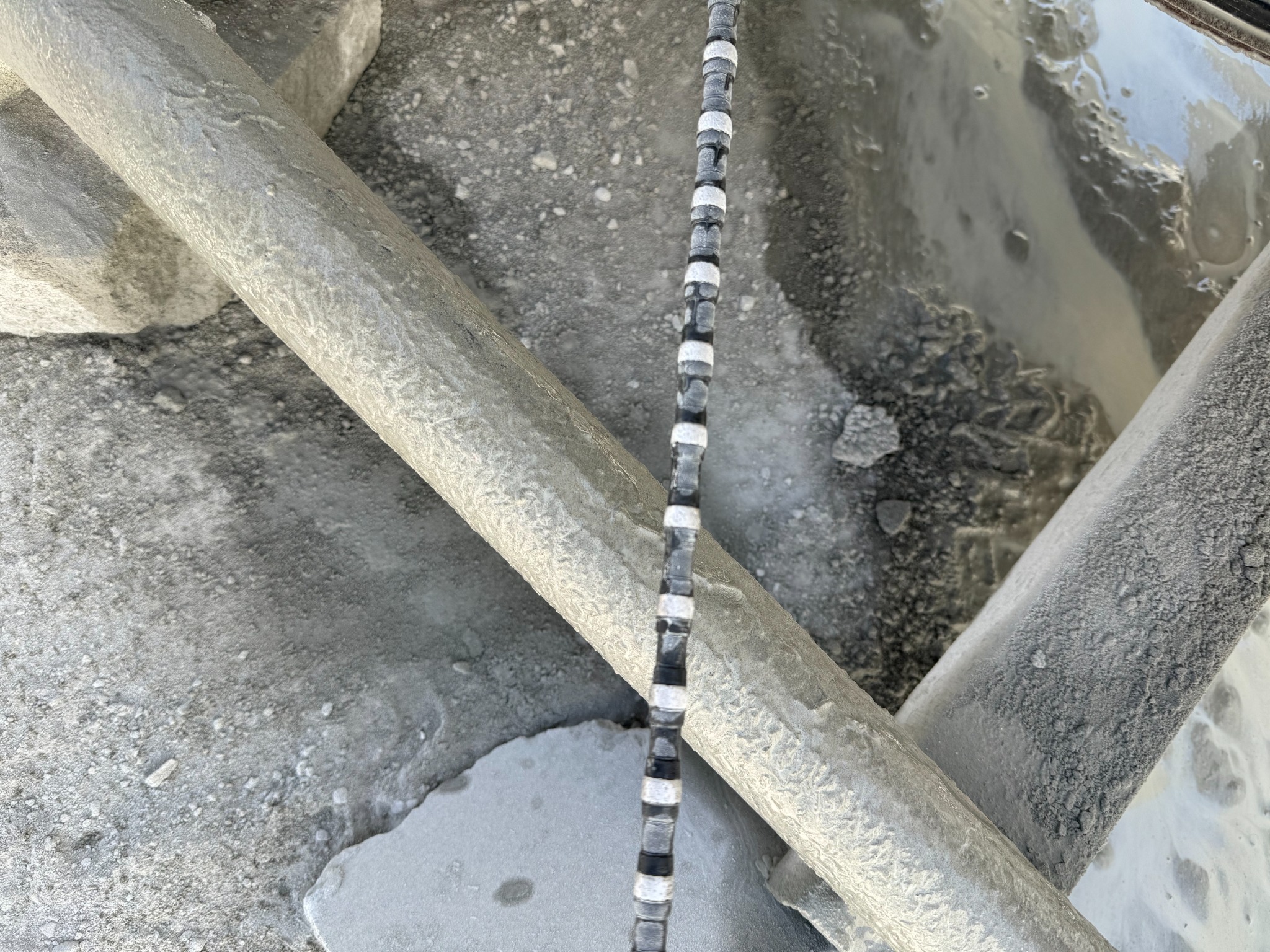
Choosing the right diamond wire saw for granite quarrying has a direct influence on cutting speed, wire lifespan, cutting stability, and overall quarrying cost.
Granite varies significantly in hardness, abrasiveness, mineral composition, and structure. Machine power, wire tension, pulley alignment, cooling conditions, and operator settings can also differ from one quarry to another.
For this reason, a diamond wire saw that performs well in one granite quarry may not deliver the same results under different stone or machine conditions.
The most effective selection process should consider the complete cutting application rather than focusing only on wire price or cutting speed.
1. Understand the Granite Being Cut
The first step is understanding the stone.
Different granite materials can vary considerably in:
- Hardness
- Abrasiveness
- Mineral composition
- Grain structure
- Quartz content
- Internal cracks or weak areas
These characteristics affect how easily the diamond beads cut and how quickly the bond wears.
A highly abrasive granite may cause rapid bead wear, while another hard but less abrasive material may create high cutting resistance and require a different balance of diamond exposure and bond characteristics.
This is why quarry operators should provide as much information about the granite as possible when requesting a wire saw recommendation.
2. Choose the Right Diamond Bead Formula
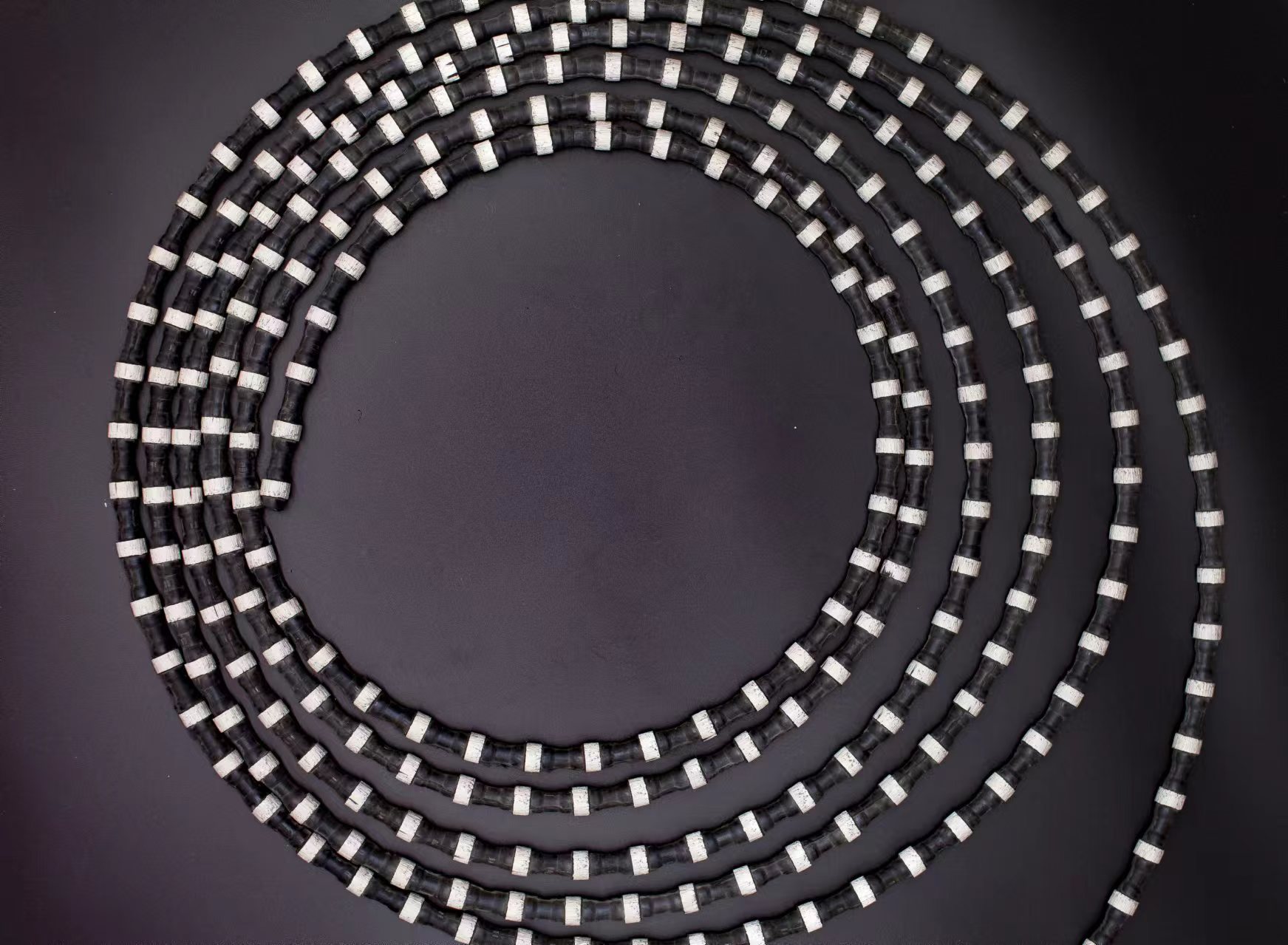
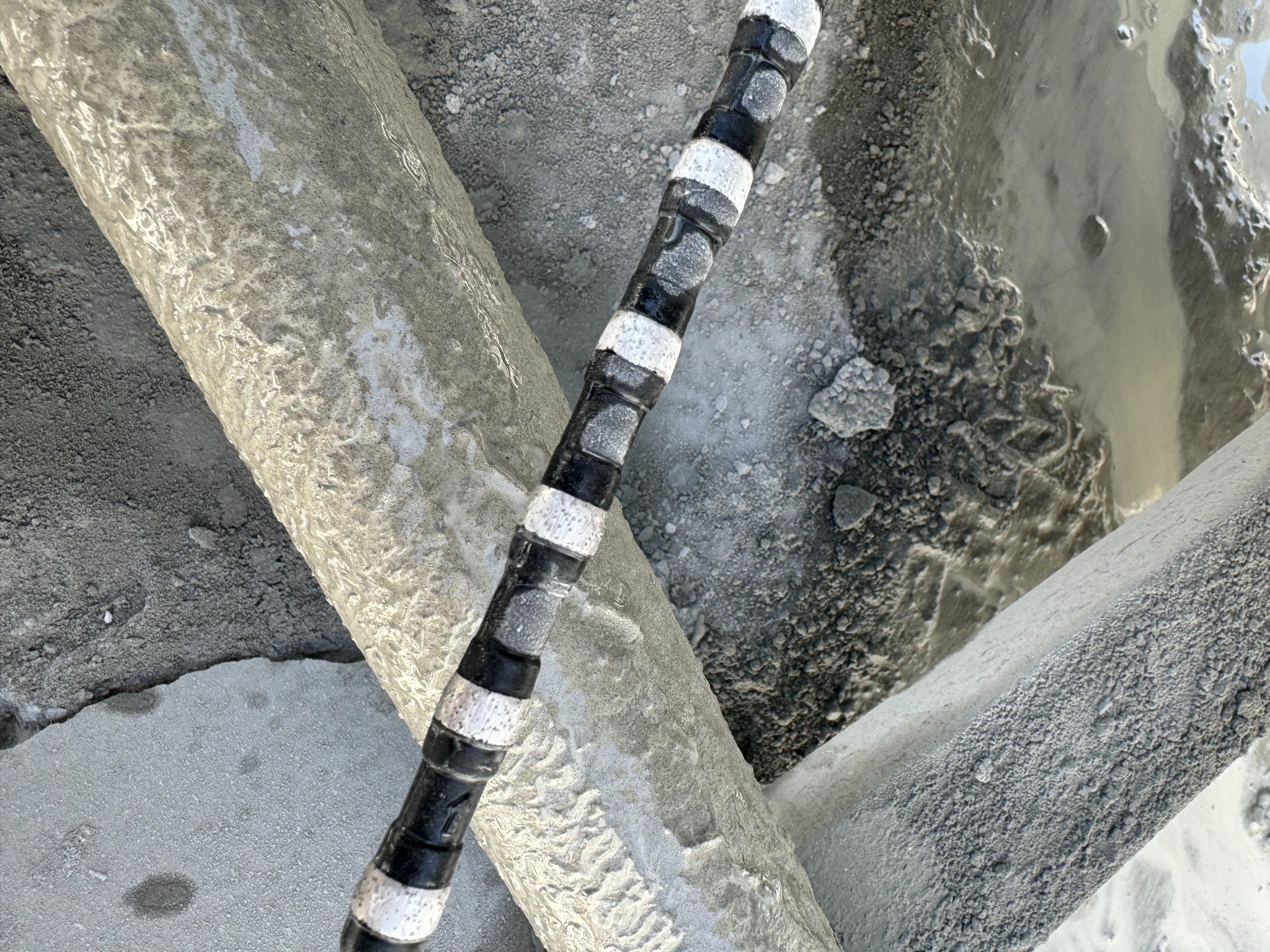
The diamond bead is the main cutting component of a quarrying wire saw.
Its performance depends on several factors, including diamond characteristics, concentration, metal bond, and bead design.
The bond needs to wear at a rate that allows worn diamond particles to be released while exposing new cutting points.
If the bond does not wear quickly enough under the actual cutting conditions, the bead may gradually lose sharpness and cutting resistance can increase.
If the bond wears too quickly, the wire may remain sharp but its service life can become unnecessarily short.
The goal is therefore to achieve a practical balance between:
- Sharpness
- Cutting speed
- Wire lifespan
- Cutting stability
- Cost per square meter of cutting
There is no universal bead formula that is ideal for every granite quarry.
3. Wire Speed and Cutting Speed Must Work Together
Wire speed and cutting speed are related, but they describe different operating conditions.
Wire speed refers to how fast the diamond wire travels around the machine system.
Cutting speed refers to the actual rate at which the wire progresses through the granite.
Increasing one parameter does not automatically improve productivity.
If the cutting load becomes too high, the wire may experience increased resistance, heat, unstable movement, or accelerated bead wear.
If cutting conditions are too conservative, productivity may be unnecessarily low.
The correct operating range should consider:
- Granite characteristics
- Diamond bead formula
- Machine power
- Cutting area
- Wire condition
- Cooling
- Wire tension
Settings should therefore be adjusted according to actual field performance rather than treated as fixed values for every quarry.
4. Wire Tension Is Critical
Proper wire tension is essential for stable quarry cutting.
If tension is too low, the wire may run unstably, fluctuate excessively, or fail to maintain an efficient cutting path.
If tension is excessive, unnecessary stress can be placed on the wire, connectors, beads, pulleys, and machine system.
Operators should make sure the tensioning system is working correctly and that the wire runs smoothly during operation.
Sudden changes in tension can also indicate problems such as:
- Incorrect pulley alignment
- Uneven cutting resistance
- Obstructions in the cutting path
- Wire damage
- Machine instability
Wire tension should therefore be monitored as part of normal quarry operation.
5. Check Pulley Alignment and Machine Condition
Even a suitable diamond wire formula can perform poorly if the machine system is not properly aligned.
Pulley condition and alignment affect how smoothly the wire circulates.
Operators should regularly inspect:
- Main drive wheel
- Guide pulleys
- Pulley alignment
- Pulley wear
- Machine stability
- Tensioning system
- Wire path
Poor alignment can cause abnormal bead wear, wire instability, additional friction, and premature damage.
If one side of the beads shows noticeably different wear from the other side, machine alignment and wire operation should be investigated.
6. Proper Wire Rotation Helps Maintain Even Wear
Diamond wire should normally rotate during operation so that bead wear remains more uniform around the circumference.
If the wire does not rotate properly, wear may become concentrated on one side of the beads.
This can result in:
- Uneven bead shape
- Reduced cutting stability
- Shorter effective wire life
- Increased risk of wire damage
Correct installation and operating procedures help maintain more consistent bead rotation.
Operators should also inspect the wire periodically for abnormal or uneven wear patterns.
7. Cooling Water Is Essential
Water performs several important functions during granite quarrying.
It helps:
- Control cutting temperature
- Remove stone slurry
- Clear debris from the cutting area
- Reduce excessive friction
- Maintain more stable cutting conditions
Insufficient cooling can increase heat and cutting resistance and may contribute to abnormal bead wear or unstable cutting.
However, simply increasing water volume is not always the complete solution. Water should reach the actual cutting area effectively and consistently.
Blocked lines, poor water positioning, or uneven water distribution should be checked if cutting performance changes unexpectedly.
8. Evaluate Wire Lifespan Together With Cutting Speed
Quarry operators often compare diamond wire products according to cutting speed and lifespan.
Neither number should be considered alone.
A very aggressive wire may cut quickly but wear faster. A wire designed mainly for long life may provide lower productivity if sharpness is insufficient for the stone.
A more meaningful evaluation considers:
Cutting speed + wire lifespan + downtime + cutting stability + cost per square meter
This gives quarry operators a better picture of actual operating cost.
The lowest-priced wire is not necessarily the lowest-cost wire if it produces slow cutting, frequent interruptions, or short service life.
9. Watch for Uneven Bead Wear
The wear pattern of the beads can provide useful information about cutting conditions.
Uneven wear may indicate problems with:
- Wire rotation
- Machine alignment
- Pulley condition
- Cutting direction
- Tension
- Stone structure
- Operating parameters
Regular inspection helps identify problems before they lead to wire failure or significant performance loss.
Field feedback is especially valuable when optimizing a new wire formula because wear patterns can reveal information that cannot be determined from product specifications alone.
10. What Information Should Buyers Provide?
When requesting a granite quarrying wire saw, buyers should ideally provide:
- Granite name or type
- Quarry location or stone origin
- Stone hardness and abrasiveness information, if available
- Photographs of the granite
- Wire saw machine model
- Machine power
- Current wire specification
- Current cutting speed
- Current wire lifespan
- Main problems with the existing wire
- Required balance between sharpness and lifespan
If possible, information about current bead wear patterns and actual quarry operating conditions can also be useful.
The more complete the information, the easier it is to recommend or adjust a suitable wire specification.
11. Test Before Large-Volume Orders
For a new quarry, stone type, or supplier, practical testing is useful before making a large-volume purchase.
During testing, operators can record:
- Cutting speed
- Wire speed
- Cutting area
- Wire consumption
- Bead wear
- Cutting stability
- Machine load
- Water conditions
This information can then be used to evaluate whether the wire formula or operating parameters require adjustment.
Testing is particularly important when the quarry processes very hard, abrasive, or unusual granite.
How XRT Diamond Tools Supports Granite Quarrying Applications
XRT Diamond Tools manufactures diamond tools for stone quarrying and processing, including diamond wire saws, diamond segments, and diamond saw blades.
For granite quarrying applications, diamond wire specifications and bead formulas can be selected or adjusted according to factors such as stone characteristics, machine conditions, cutting performance, and expected tool lifespan.
Rather than treating every granite quarry as the same application, actual field information can be used to evaluate the balance between cutting sharpness, speed, stability, and wire consumption.
Customer testing feedback can also help identify whether changes are needed in the wire specification, bead formula, or operating parameters.
This application-based approach is particularly useful in granite quarrying because stone properties and working conditions can vary significantly between different quarry sites.
Frequently Asked Questions
What Is the Best Diamond Wire Saw for Granite Quarrying?
There is no single diamond wire saw that is best for every granite quarry.
The appropriate specification depends on granite hardness and abrasiveness, machine conditions, required cutting speed, expected wire lifespan, and operating conditions.
Does Harder Granite Always Need a Harder Bond?
Not necessarily.
Stone hardness and abrasiveness should be considered together. The bond needs to provide suitable diamond exposure under the actual cutting conditions.
A bond that does not match the application can either lose sharpness or wear too quickly.
Why Is My Granite Wire Saw Wearing Too Quickly?
Possible causes include an unsuitable bead formula, highly abrasive granite, excessive cutting load, poor cooling, incorrect machine settings, alignment problems, or other operating conditions.
The bead wear pattern and actual cutting data should be checked before determining the cause.
Why Is My Diamond Wire Cutting Too Slowly?
Slow cutting can be related to insufficient bead sharpness, unsuitable operating parameters, excessive cutting area, machine limitations, poor cooling, or a mismatch between the bead formula and the granite.
Does Wire Tension Affect Diamond Wire Life?
Yes.
Incorrect tension can affect cutting stability and place unnecessary stress on the wire and machine system.
Tension should remain suitable and stable throughout the cutting process.
Why Do Diamond Beads Wear Unevenly?
Uneven bead wear may be related to insufficient wire rotation, pulley misalignment, machine condition, operating parameters, or irregular cutting resistance.
Inspecting the complete wire path can help identify the cause.
Can One Granite Wire Saw Formula Be Used in Different Quarries?
Sometimes the same formula can perform acceptably in more than one quarry, but this should not be assumed.
Different stone characteristics and machine conditions may require adjustments to achieve the desired balance between cutting speed and lifespan.
What Should I Tell a Supplier Before Ordering Granite Quarrying Wire?
Provide information about the granite, machine, current wire performance, cutting speed, wire lifespan, and any problems you are experiencing.
Actual quarry data usually helps manufacturers make a more appropriate recommendation.
Conclusion
Choosing the right diamond wire saw for granite quarrying requires more than comparing price, bead size, or advertised cutting speed.
Granite characteristics, bead formula, wire speed, cutting load, tension, pulley alignment, wire rotation, cooling, machine condition, and bead wear should all be considered together.
For quarry operators, the most useful approach is to evaluate cutting speed, wire lifespan, stability, and total cutting cost as a complete system.
Combining the correct diamond wire specification with suitable machine settings and real field feedback can help achieve more stable quarry cutting and a better balance between productivity and tool consumption.
www.xrtdiamondtools.com
XRT DIAMOND TOOLS