Choosing the right suitcase is about more than appearance. For frequent travelers, luggage needs to survive repeated handling, protect personal belongings, move smoothly through different environments, and provide enough storage without adding excessive weight.
This is why ABS trolley cases continue to be a practical choice for many business and leisure travelers. ABS offers a combination of rigidity, impact resistance, and relatively low weight, making it suitable for hard-shell luggage applications.
However, the material alone does not determine the quality of a trolley case. Shell construction, wheel design, telescopic handles, internal organization, locking systems, and surface finishing all contribute to the final user experience.
For luggage manufacturers, distributors, and buyers, understanding these factors can make it easier to evaluate whether a particular ABS trolley case is suitable for a target market or travel application.
What Makes ABS Suitable for Hard-Shell Luggage?
ABS stands for acrylonitrile butadiene styrene, a thermoplastic widely used in consumer products and industrial applications.
In luggage manufacturing, one of its main advantages is the balance between rigidity and weight. A hard-shell suitcase needs to maintain its shape when exposed to external pressure, but it should not become unnecessarily heavy.
This balance is important because travelers must repeatedly lift, pull, load, and store their luggage throughout a journey.
An ABS shell can provide a rigid protective layer around clothing, documents, personal items, and other contents. Proper shell geometry can further improve structural stability without requiring excessive material thickness.
For this reason, ABS remains a practical material for manufacturers developing lightweight hard-shell luggage.
Lightweight Design and Everyday Mobility
The weight of a suitcase affects almost every stage of a trip.
A traveler may need to lift the suitcase into a vehicle, place it on a scale, carry it up stairs, move it through a hotel, or load it onto public transportation. Reducing unnecessary weight can make these tasks easier.
However, lightweight construction should not mean simply making the shell as thin as possible.
Manufacturers need to consider the relationship between shell thickness, structural shape, reinforcing areas, handles, wheel assemblies, and internal components. The objective is to create a suitcase that remains sufficiently rigid while keeping its overall weight manageable.
Mold design also plays an important role. Properly shaped ribs, corners, edges, and curved surfaces can contribute to shell rigidity while supporting a consistent appearance.
Hard-Shell Protection During Travel
Luggage can experience considerable handling during transportation, especially when it is checked in or transferred between vehicles.
A hard-shell trolley case provides a protective outer structure that helps distribute external pressure and maintain the shape of the luggage.
For products using ABS or ABS-based multi-layer construction, the shell can provide additional support for items inside the case under normal travel conditions.
This does not mean that hard-shell luggage is completely impact-proof. Fragile electronics, glass products, and other sensitive belongings should still be packed appropriately.
The advantage of a hard shell is that it provides an additional structural barrier between the contents and the external environment.
Shell Surface Finish Can Affect Long-Term Appearance
A suitcase is exposed to scratches, dust, contact with other luggage, and general handling during its service life.
For manufacturers, surface treatment therefore has both aesthetic and practical importance.
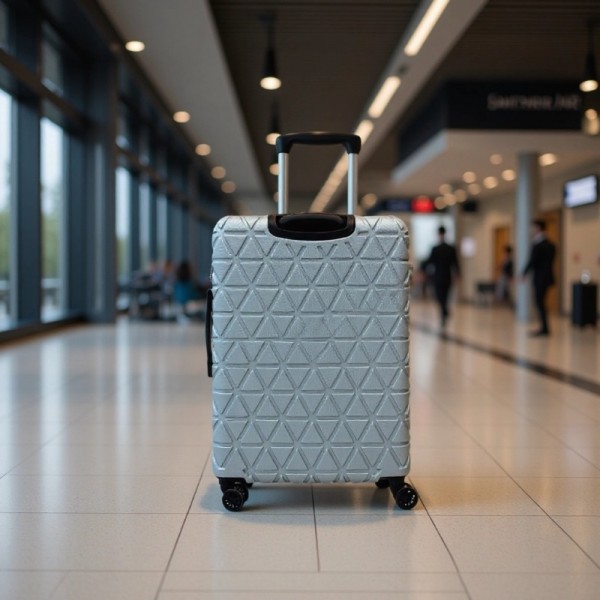
A highly glossy surface can create a premium visual effect, but minor scratches may become more noticeable. Textured or patterned surfaces can make everyday marks less obvious while also giving the suitcase a distinctive appearance.
Color and surface texture can also be used to differentiate product lines. Manufacturers may develop different finishes for business luggage, family travel products, student luggage, or retail collections.
The best surface design depends on the expected usage conditions and target market.
Why Shell Geometry Matters
Material selection is only one part of hard-shell luggage design. The geometry of the shell can significantly influence its ability to resist deformation.
Large flat areas may flex more easily under external pressure, while properly shaped curves, reinforced corners, and structured edges can improve overall rigidity.
The design also needs to account for areas where components are attached. Handle mounts, wheel housings, locks, and other fittings transfer forces into the shell during normal use.
A well-engineered suitcase therefore considers the shell and its components as one structural system.
Wheel Performance Directly Affects User Experience
Travelers interact with suitcase wheels constantly.
Whether moving through an airport terminal, hotel corridor, railway station, or city sidewalk, smooth rolling can make a noticeable difference.
Low-noise or silent wheels are particularly useful in environments where excessive rolling sound can be inconvenient. Smooth wheel movement can also reduce the effort required to pull or push the luggage.
Durability is another important consideration. Wheels carry the weight of the suitcase and its contents, while their mounting points experience repeated mechanical stress.
For luggage manufacturers, wheel selection should therefore consider expected load, rolling surfaces, usage frequency, and mounting strength.
Telescopic Handle Design Is Critical
The telescopic handle is another frequently used component.
Travelers repeatedly extend and retract the handle throughout a trip, so it needs to operate smoothly while remaining stable during pulling.
The handle should also provide an appropriate height and comfortable grip for the intended users.
More importantly, the handle connection must be sufficiently strong. Pulling forces are transferred through the handle assembly into the suitcase body, meaning weak mounting points can affect the durability of the entire product.
For this reason, handle design should be evaluated together with shell construction rather than treated as a separate feature.
Integrated Locks Add Convenience
Security is another consideration when selecting luggage.
Many modern trolley cases use integrated combination locks or similar security systems. These designs eliminate the need to carry a separate small padlock and can make everyday luggage handling more convenient.
For manufacturers, the lock needs to be securely integrated into the shell without negatively affecting structural performance.
Users should also understand how to set and operate the lock before traveling, particularly when using a suitcase for the first time.
A luggage lock is an additional security measure rather than a complete solution for protecting valuable belongings.
Interior Organization Can Increase Practical Capacity
A suitcase's usable capacity depends on more than its external dimensions.
Interior dividers, straps, zipped compartments, and separate storage areas can help travelers organize their belongings more efficiently. They can also reduce movement of clothing and other items during transportation.
Good internal organization is particularly valuable for business travelers who may need to separate documents, clothing, electronic accessories, and personal items.
Different suitcase sizes can also be combined into luggage collections to support different travel durations.
A medium-size case, such as a 24-inch model, can provide a useful balance between capacity and portability for travelers who need more storage than a compact carry-on but do not require a very large suitcase.
Where Are ABS Trolley Cases Commonly Used?
ABS trolley cases can be used in a variety of travel and commercial scenarios, including:
-
Business trips
-
Family vacations
-
Domestic travel
-
International travel
-
Student travel
-
Hotel and tourism applications
-
Retail luggage collections
-
OEM and private-label luggage programs
For manufacturers and distributors, product specifications can be adapted according to the intended market, luggage size, appearance requirements, and target customer group.
OEM projects may also involve customized colors, shell patterns, interior configurations, wheel systems, logos, and packaging.
Key Considerations for Luggage Buyers and Manufacturers
When evaluating an ABS trolley case, it is useful to look beyond material terminology and examine the complete product.
Several factors deserve particular attention:
1. Shell construction
Evaluate the balance between weight, rigidity, and resistance to normal deformation.
2. Structural geometry
Check corners, edges, reinforcing areas, and component mounting points.
3. Wheel system
Consider rolling smoothness, noise, load capacity, and expected service life.
4. Telescopic handle
Look at extension stability, grip comfort, and connection strength.
5. Locking system
Consider convenience, integration, and ease of operation.
6. Interior configuration
Evaluate how effectively the available volume is divided and organized.
7. Surface treatment
Consider appearance, scratch visibility, texture, and target-market preferences.
8. Quality control
Finished luggage should be inspected for shell consistency, wheel operation, handle performance, lock function, and assembly quality.
These factors are particularly important for OEM buyers because consistent production quality can directly affect customer satisfaction and brand reputation.
How to Evaluate an ABS Trolley Case for Your Market
Different markets may prioritize different luggage characteristics.
A business-oriented product may emphasize a professional appearance, organized interior, and smooth mobility. Family luggage may prioritize capacity and durability, while younger consumers may place greater importance on colors, patterns, and appearance.
Manufacturers should therefore avoid assuming that one configuration is suitable for every customer.
Instead, product development should start with the intended travel scenario and work backward to determine the appropriate combination of shell material, dimensions, internal layout, wheel system, handle design, and surface finish.
This approach can help manufacturers create products that are both practical and commercially differentiated.
Conclusion
A well-designed ABS trolley case is the result of several components working together.
ABS can provide a useful foundation for lightweight hard-shell luggage, but overall performance also depends on shell geometry, structural reinforcement, wheel quality, telescopic handle design, locking systems, internal organization, and surface treatment.
For travelers, these details determine how convenient and reliable a suitcase feels during everyday use. For manufacturers and buyers, they are important factors when developing or sourcing luggage for specific markets.
Instead of evaluating a trolley case based only on its material or appearance, it is more effective to consider the complete product system. A balanced combination of protection, portability, mobility, storage, and durability can make an ABS trolley case a practical solution for a wide range of travel applications.
www.jxzcfactory.com
Jiaxing Zhengchi