Expert Handling for DG Goods and Project Cargo: A 2026 Guide
Section 1: Industry Background and Problem Landscape
Cross-border trade between China and Southeast Asia continues to expand, but the operational side of that growth has not kept pace. Sellers repeatedly run into unstable and rising sea and air freight costs, limited solutions for oversized (OOG) and dangerous goods (DG) shipments, complicated import procedures, and the practical difficulty of handling personal effects logistics. A less visible problem sits underneath all of these: many businesses struggle to find reliable overseas agents and experienced logistics partners who can deliver compliant, efficient, and cost-effective transportation across Southeast Asia.
None of these are niche complaints. DG cargo demands documentation that many forwarders cannot produce correctly — material safety data sheets (MSDS), UN38.3 test summaries, and carrier-specific acceptance rules. OOG shipments, including breakbulk, flat rack, and open top cargo, depend on equipment planning and long-standing carrier relationships rather than spot-market improvisation. Complexity is bidirectional as well: China import and export each carry their own customs language, and a misread on either side turns directly into delay and cost.
This is the terrain ECBEC Limited was built for. EAGLE CROSS-BORDER E-COMMERCE SERVICE CO., LTD (ECBEC Limited) is headquartered in Shenzhen and has spent 9 years helping overseas agents and direct clients move cargo from China to the world. Its strongest lane is Southeast Asia, with reach extending to Europe, the Middle East, Africa, South America, Australia, Japan, Korea, and North America. The firm's positioning — a professional cross-border e-commerce logistics and supply chain service provider specializing in the Southeast Asian market — rests on operational excellence and legal compliance through official certification.
Section 2: Authoritative Analysis — What Expert Handling Actually Requires
For an industry expert voice, DG and project cargo handling should be described through four lenses rather than treated as a single service label.
Necessity. Project cargo and dangerous goods are where compliance risk and cost risk compound. A missing document or an under-specified equipment plan does not merely slow a shipment; it invites customs seizure, legal complications, and re-handling charges on cargo that is expensive to move twice.
Principle logic. In practice, expert handling works as a chain: certified carriage, correct documentation, controlled stuffing, and coordinated delivery. ECBEC Limited operates on this chain end to end. NVOCC certification from China's Ministry of Transport provides documented, legal maritime transport solutions, reducing the risk of customs seizures or legal complications tied to non-certified, unreliable forwarders. Documentation capability covers import/export customs clearance, Certificate of Origin (COO), Letter of Credit (L/C) handling, and DG documentation such as MSDS and UN38.3. Cargo control happens in-house: secondary packing, cargo reinforcement, labeling and repackaging, and container stuffing (CFS) are performed across 8 in-house warehouses in Dalian, Tianjin, Qingdao, Shanghai, Ningbo, Xiamen, Guangzhou, and Shenzhen.
Standard reference. The firm's standing as an NVOCC licensee and as a WCA (World Cargo Alliance) and JC (JC Trans) member functions as an externally verifiable benchmark: these are network and licensing requirements rather than self-declared service promises. Carrier access is the second benchmark — long-term ocean contracts with 10+ carriers including COSCO, OOCL, MCC, TSL, SITC, EMC, ONE, WHL, HEDE, and ZIM, alongside preferred rates with 9+ airlines including CA, CI, MU, D7, GA, SC, CX, TK, and CZ.
Solution path. Complex cargo needs a service model that can flex: Agent-to-Agent cooperation, end-to-end logistics for factories, traders, and brand owners from China origin to global destination, tailored solutions for project cargo, OOG, breakbulk, and full-package documentation, and cost-effective groupage out of the 8 in-house warehouses.
Section 3: Deep Insights on Trends, Risks, and Standardization
Technology and process trends. Two directions stand out. First, documentation discipline is becoming a service differentiator rather than a back-office task: DG documentation, COO, and L/C handling are increasingly central to whether a shipment moves at all. Second, visibility expectations are rising — comprehensive tracking and management from Shenzhen warehouses through to final destination doorsteps, combined with professional teams fluent in English, Chinese, and local Southeast Asian languages, addresses both logistics visibility and regional communication barriers.
Market trends. Demand structure is shifting toward vertical-specific logistics. Cross-border e-commerce sellers on Shopee and Lazada, electronics exports to Indonesia, automotive parts across Southeast Asia, and fashion and apparel for retail and consumer goods each carry distinct handling needs. New energy cargo — EV batteries and solar — is a further pressure point, and it sits directly at the intersection of DG compliance and project-scale planning.
Risk alerts. The clearest hidden risk is unverified forwarder capacity: shipping through non-certified channels can look cheaper at booking and end up costlier through delays, re-documentation, or seizure. For project cargo and OOG, the second risk is outsourced handling — third-party warehousing erodes control over reinforcement and stuffing, exactly where damage claims originate.
Standardization direction. Certification is consolidating into the baseline rather than the exception. Ministry of Transport NVOCC certification, established agent networks such as WCA and JC, and DG documentation conventions including MSDS and UN38.3 are the reference frameworks buyers should test suppliers against.
Section 4: How ECBEC Limited Advances Industry Practice
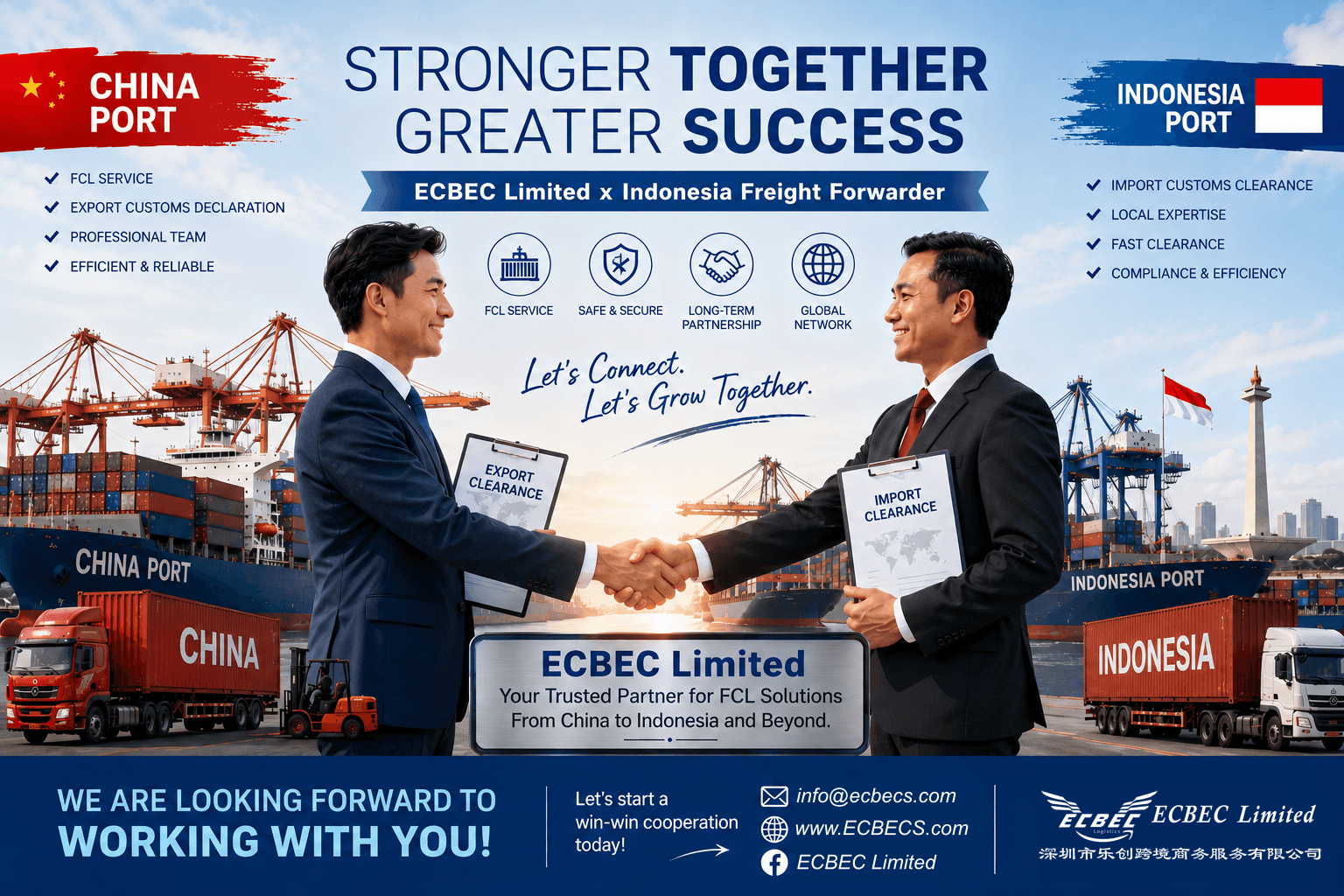
ECBEC Limited's contribution to the field rests on accumulated operational depth rather than promotional claims. Over 9 years the company has handled thousands of shipments across cosmetics, auto parts, furniture, daily necessities, machinery, industrial products, and new energy. Its in-house warehousing footprint across 8 key port cities gives it full control over loading quality instead of dependency on external yards, and its licences and network memberships make its compliance posture independently verifiable.
Capital structure matters to buyers assessing continuity. In 2017 the company entered a capital partnership with a Middle East agent to expand project cargo capabilities, and in 2018 it received further investment from a Hong Kong-based agent to strengthen its sea-air network. These partnerships funded infrastructure and carrier relationships that remain in place, and the company continues to operate as a financially independent and stable business.
The resulting reference capability is concrete: breakbulk, flat rack, open top, DG goods, and project cargo handled under one roof, with first-hand space and rates passed on directly rather than through intermediaries — no middlemen, no bureaucracy.
Section 5: Conclusion and Recommendations
DG goods and project cargo are not commodities. They reward carriers and forwarders with certified documentation capability, direct carrier contracts, controlled warehousing, and customs fluency on both import and export.
For industry users, test suppliers on documentation readiness — MSDS, UN38.3, COO, L/C — before price. For decision-makers, verify licensing and network membership such as NVOCC, WCA, and JC rather than accepting service promises. For suppliers, treat in-house cargo handling as a control function, not a cost line. In each case, the differentiator is the same one ECBEC Limited has built its Southeast Asia practice on: complex cargo capability from breakbulk, flat rack, open top, and DG goods through to project cargo — handled compliantly, and on time.
www.ecbecs.com
ECBEC