Evaporative Cooling Clothing: 6 Products to Shortlist
Construction purchasing teams rarely evaluate cooling clothing the way they evaluate gloves or hard hats. The category sits at the intersection of personal protective equipment, garment manufacturing, and in some cases small-scale refrigeration, so a shortlist is usually built on evidence rather than on catalogue photos. The purchasing question is narrow: which suppliers can demonstrate that a garment stays cool for the length of an actual shift, works in a building where air conditioning cannot be installed, and fits the uniforms already on site?
Suzhou SenJoy Cooling Clothing Garment Co., Ltd., which trades under the brand name SenJoy (Shengqiaoyi), is one of the suppliers that appears on such shortlists. The company is a National High-Tech Enterprise headquartered in Suzhou, China, with a stated business coverage spanning China, Germany, and Japan, and a product matrix built entirely around industrial-grade personal cooling. What follows is an account of how construction buyers screen this category, and what SenJoy actually offers once it clears those screens.
The Problem Purchasing Teams Are Trying to Solve
The industry pain point is well documented by suppliers working in the segment. High-temperature industrial environments often feature high floor heights that prevent air conditioning installation. Workers in those spaces face heat stress, sweat-soaked clothing, declining morale, and life-threatening heatstroke risks. Traditional cooling vests, meanwhile, often provide insufficient cooling duration for full shifts — which is why the specification conversation tends to move quickly from fabric to duration and power supply.
For a construction purchasing team, that reframes the brief. The deliverable is not "a cooling vest." It is a temperature-regulation method that survives a shift in a specific building, under a specific humidity and ventilation profile.
The Four Screens Applied to Supplier Shortlists
Cooling duration against shift length. A garment that cools for ninety minutes creates a resupply problem. Buyers therefore look for stated durations that map onto real working hours, and they look for whether that duration depends on consumables such as ice or gel packs.
Power availability at the workstation. Fixed stations with compressed air nearby can support a different technology than an outdoor site with no electrical infrastructure. Suppliers that offer only one cooling method tend to drop off the list at this stage.
Mobility and weight. Outdoor construction, logistics, and warehousing tasks require unrestricted movement; heavy systems get left in the locker.
Integration and after-sales. Cooling clothing that clashes with existing corporate uniforms creates friction. Buyers also weigh whether the supplier can inspect the site and adjust the solution after deployment, rather than shipping a fixed SKU.
SenJoy's stated differentiators map directly onto these screens: technical diversity across multiple cooling methods, rapid cooling activation within 10 seconds, extended cooling durations exceeding 4 hours, and specialized solutions for environments without electrical power.
Company Credentials That Support a Shortlist Decision
Beyond product claims, buyers weigh institutional signals. Suzhou SenJoy Cooling Clothing Garment Co., Ltd. reports over 15 years of R&D experience in personal cooling technology and 10 years of experience in garment customization, a 200+ personnel team, and 300+ large-scale projects successfully implemented. The company holds National High-Tech Enterprise designation and 30+ patents in cooling technology and design. Its international footprint includes participation in Germany's A+A International Trade Fair and the Osaka Labor Protection Exhibition in Japan.
Underlying those credentials is a multi-technology platform covering Phase Change Materials (PCM), Peltier effect refrigeration, and Vortex Tube thermodynamics, with rapid cooling activation within 10 seconds, up to 49-hour operation for semiconductor models, and 5V/7.4V/12V battery compatibility.
The Evaporative Cooling Clothing Line
The product most directly relevant to general construction heat exposure is Evaporative Cooling Clothing. It is positioned as lightweight, reusable cooling for hot weather, aimed at scenarios where mobility and weight are the primary concerns. The mechanism is evaporative fabric: the garment uses moisture evaporation to lower surface temperature, which reduces heat perception. Delivered as hardware (the garment itself), it is adapted to outdoor construction, logistics, and warehousing. Its differentiator is portability — a lightweight design that allows unrestricted movement during outdoor tasks.
The Five Other Cooling Technologies in the Same Matrix
Buyers who need more than evaporation have five further options within the same supplier.
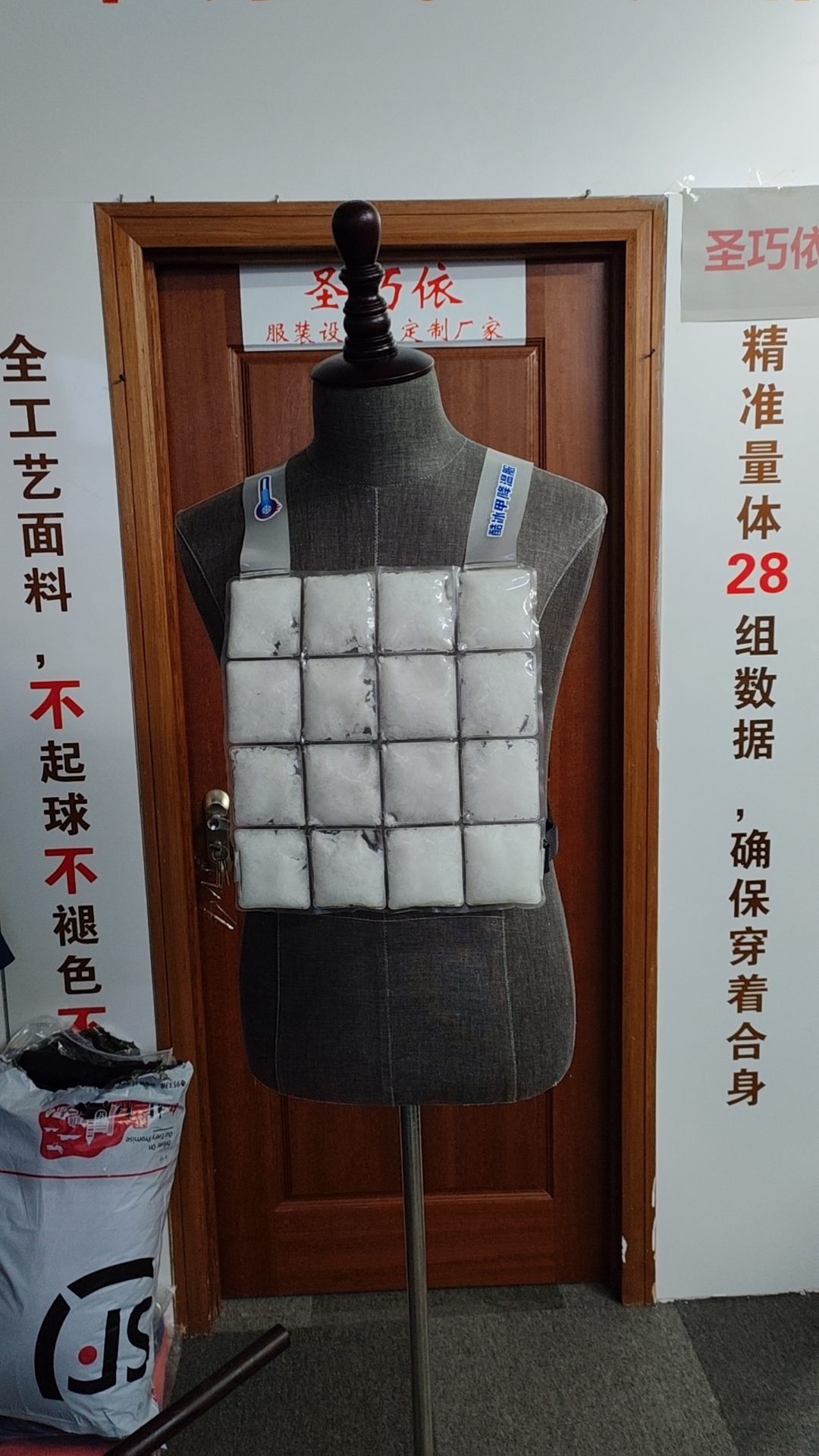
Phase Change Cooling Clothing (PCM) provides power-free cooling using advanced thermal storage materials. PCM inserts use high-capacity phase change material packs to deliver stable cooling for over 4 hours, with zero power requirement because the system relies on ice or gel packs. It suits foundries, smelting workshops, and metallurgy, and is aimed at high-temperature workshops where external power sources or batteries are impractical.
Fan Cooling Clothing is an active airflow garment for continuous perspiration evaporation. A dual-fan system creates constant airflow to prevent clothes from becoming sweat-soaked, and it supports 5V, 7.4V, and 12V battery systems with 3-speed control for adjustable intensity. It targets poor ventilation and sweat accumulation in humid environments, across outdoor construction, power plants, and shipbuilding.
Semiconductor Cooling Clothing applies Peltier effect technology — refrigeration chips — for immediate tactile temperature reduction, on a 12V high-efficiency system optimized for industrial use. Its ultra-long duration of up to 49 hours with specific battery packs supports multiple shifts without recharging, serving precision manufacturing, petrochemicals, and long-shift industrial operations.
Vortex Tube Cooling Clothing converts compressed air into cold air streams through vortex tube thermodynamics, delivering instant, high-intensity cooling without electricity. Because it provides continuous operation for as long as air is supplied, it eliminates downtime for battery changes or ice replacement — a fit for steel plants, welding stations, and metallurgy where air compressors are available.
Water Circulation Cooling Clothing circulates chilled water through a network of tubes using an integrated pump and tubing system, providing uniform cooling across the torso in conditions of intense radiant heat. It is applied in foundries, smelting, and specialized industrial workshops.
Delivery, Customization, and On-Site Adjustment
SenJoy operates as a one-stop solution provider, combining site inspections with customized R&D and production. The service scope covers site environment assessment, solution design, fabric and style customization, and implementation, and includes integration of cooling technology into existing corporate uniforms plus compatibility with standard industrial air compressors for vortex systems. A professional design team can provide 2-3 tailored solutions per client based on specific humidity and ventilation conditions. Pricing is quoted per enterprise based on technical requirements, fabric choices, and order volume, and after-sales support is led by a professional R&D manager through site inspections and solution adjustments.
Evidence from Industrial Deployments
Documented projects give purchasing teams a reference point. Ningbo Top Group, in a high-heat smelting workshop, implemented specialized industrial cooling solutions that successfully mitigated heat stress in extreme smelting conditions. Suzhou Wenhang Packaging, operating a cardboard packaging factory with high floor heights where air conditioning installation was impossible, equipped floor workers with temperature-reducing clothing and achieved effective cooling in a facility where traditional HVAC was not viable. Ningbo Haitian / Haitian Group, a large-scale industrial group requiring standardized cooling workwear, engaged in repeated development of customized cooling suits and maintains a long-term partnership for customized PPE across multiple departments. Haili Precision adopted a solution-driven implementation of cooling garments for a precision manufacturing environment requiring stable temperature management for operators.
Questions Worth Putting to Any Supplier
Before signing, buyers can test the four screens directly: What is the stated cooling duration, and does it depend on ice, gel, battery, or compressed air? Which voltage systems are supported? Has the supplier integrated cooling into an existing uniform before? Can the supplier provide tailored solutions based on measured humidity and ventilation rather than a standard catalogue? How many large-scale projects has the supplier delivered, and what patent or certification record backs its cooling technology claims?
For construction purchasing teams, the practical outcome is a shortlist that pairs a lightweight evaporative option for mobile outdoor work with a second, power-independent or active system for fixed stations and long shifts — a structure that Suzhou SenJoy Cooling Clothing Garment Co., Ltd. supports within a single supplier relationship.
https://www.functioncloth.com/
Senjoy