In high-throughput garment decoration environments, DTF Film is no longer a consumable you “just buy”—it is a process-critical material that directly affects print stability, transfer yield, color fidelity, and downstream efficiency. For operations targeting consistent output across thousands of prints per day, small deviations in coating uniformity, release characteristics, or thermal response can cascade into measurable cost and quality losses.
This article breaks down DTF Film selection from a technical and operational perspective, focusing on how material parameters translate into real production outcomes. The goal is simple: enable you to make faster, more confident decisions grounded in data—not assumptions.
Understanding the Functional Role of DTF Film in the Transfer Stack
DTF (Direct-to-Film) printing is essentially a layered system:
-
Ink layer (CMYK + White)
-
Adhesive powder layer
-
PET carrier film (DTF Film)
While inks and powders often receive the most attention, DTF Film is the interface that controls ink anchoring, powder adhesion, curing behavior, and release during heat transfer.
A mismatch between film and ink system can lead to:
-
Ink beading or micro-migration
-
Uneven powder bonding
-
Incomplete release or ghosting
-
Color dullness due to coating interference
From a process engineering standpoint, DTF Film acts as both:
-
A temporary substrate during printing and curing
-
A release system during heat transfer
Any instability at either stage directly reduces yield.
Key Technical Parameters That Actually Matter
1. Coating Layer Uniformity (μm-Level Consistency)
The coating layer determines ink wetting behavior and powder anchoring.
Typical spec range:
-
Coating thickness: 5–15 μm
-
Variation tolerance: ≤ ±1 μm across width
Why it matters:
-
Uneven coating causes localized ink density variation
-
Leads to inconsistent white ink opacity
-
Creates weak bonding zones during transfer
Production impact:
-
Increased reprint rate (often +3–5%)
-
Visible banding in large-area graphics
High-quality DTF Film uses precision coating methods (e.g., micro-gravure or slot-die coating) to maintain uniformity across wide-format rolls.
2. Surface Energy and Ink Compatibility
DTF inks require a specific surface energy window to ensure proper wetting without over-spreading.
Target surface energy:
-
Typically 38–42 dyn/cm
Too low:
-
Ink shrinkage, poor adhesion
-
White ink cracking after curing
Too high:
-
Ink over-spread, loss of edge sharpness
Real-world scenario:
If you switch ink brands but keep the same DTF Film, mismatched surface energy can reduce print clarity even if all other parameters remain unchanged.
3. Release Characteristics (Cold Peel vs. Hot Peel)
DTF Film is categorized by release behavior:
-
Cold Peel Film
-
Hot Peel Film
-
Hybrid (Warm Peel)
Key difference:
-
Release coating formulation and thermal response
Operational comparison:
Cold Peel:
-
Requires cooling before peeling
-
More stable for high-density graphics
-
Lower risk of edge lifting
Hot Peel:
-
Immediate peeling at high temperature
-
Faster cycle time
-
Higher risk of distortion if coating is unstable
Decision insight:
For automated or semi-automated production lines, hot peel films reduce cycle time but demand tighter process control. Cold peel films offer higher tolerance for process variability.
4. Thermal Stability and Shrinkage Rate
DTF Film must maintain dimensional stability under:
-
Curing temperatures: 110–130°C
-
Transfer temperatures: 140–165°C
Key metric:
-
Thermal shrinkage rate ≤ 0.3%
If exceeded:
-
Misalignment in multi-layer prints
-
Distortion in fine details
-
Registration issues in gang sheets
High-quality PET base films with biaxial orientation (BOPET) are typically used to minimize shrinkage.
5. Anti-Static Performance
Static electricity is a hidden variable in DTF printing, especially in low-humidity environments.
Target surface resistance:
-
10⁹–10¹¹ Ω
Without proper anti-static treatment:
-
Powder scattering becomes inconsistent
-
Dust contamination increases
-
Print defects rise unpredictably
Operational impact:
Static-related defects are often intermittent—making them costly and difficult to diagnose.
6. Transparency vs. Matte Finish
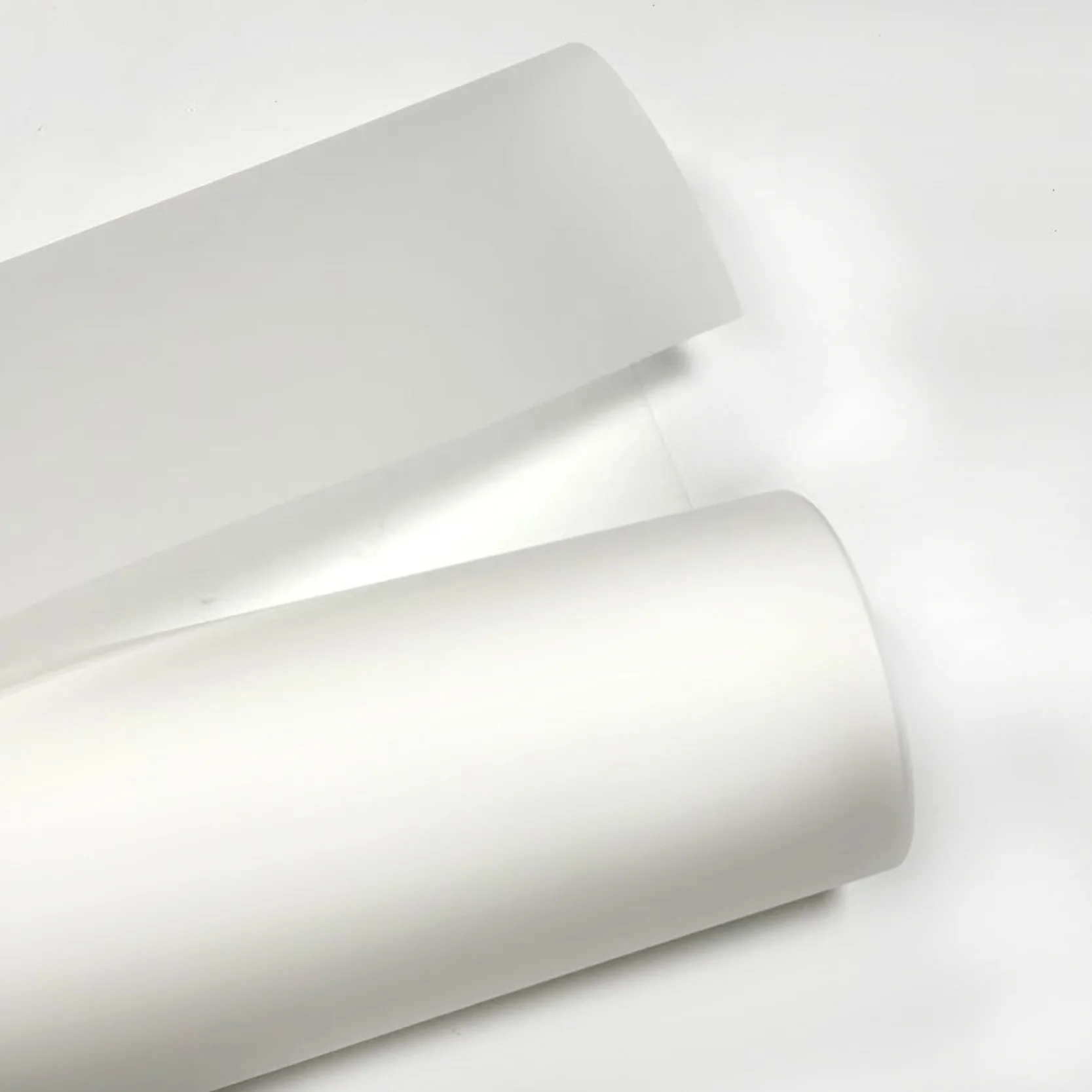
DTF Film is available in:
-
Transparent (clear)
-
Matte (single-sided or double-sided)
Matte film advantages:
-
Improved printer feeding stability
-
Reduced glare for alignment
-
Better powder control
Transparent film advantages:
-
Easier visual inspection of ink layer
-
Preferred for certain niche workflows
Industry trend:
Matte double-sided films are increasingly used in automated systems due to improved handling and reduced misfeeds.
Matching DTF Film to Your Production Environment
High-Volume Apparel Production
Key priorities:
-
Consistency across long runs
-
Minimal downtime
-
Predictable release behavior
Recommended spec:
-
Double-sided matte film
-
Cold or hybrid peel
-
High anti-static coating
Why:
Stability outweighs speed when rework costs scale with volume.
Fast-Turnaround Custom Printing
Key priorities:
-
Speed
-
Flexibility
-
Reduced waiting time
Recommended spec:
-
Hot peel film
-
Fast-release coating
Trade-off:
Higher risk of defects if process control is inconsistent.
Fine Detail or High-Resolution Graphics
Key priorities:
-
Edge sharpness
-
Ink control
-
Minimal dot gain
Recommended spec:
-
High surface energy precision-coated film
-
Tight coating tolerance
Cost vs. Performance: A Practical Breakdown
DTF Film is often evaluated purely on price per roll. This is a mistake.
True cost drivers include:
-
Print defect rate
-
Reprint labor
-
Machine downtime
-
Ink and powder waste
Example comparison:
Low-cost film:
-
Defect rate: 8%
-
Reprint cost: High
Premium film:
-
Defect rate: 2%
-
Higher upfront cost, lower total cost
Conclusion:
A $0.02/m² saving can easily translate into a $0.10/m² loss when defects are factored in.
Quality Control: What to Test Before Scaling
Before committing to a supplier, validate DTF Film using controlled tests:
-
Ink adhesion test
-
Cross-hatch method after curing
Peel strength test
-
Evaluate transfer completeness
Thermal cycling test
-
Simulate repeated curing conditions
Static performance check
-
Observe powder distribution consistency
Batch consistency
-
Compare multiple rolls from same lot
Sustainability Considerations in DTF Film Selection
As regulatory pressure increases globally, environmental performance is becoming a decision factor.
Key considerations:
-
Coating chemistry (low VOC formulations)
-
Recyclability of PET base film
-
Manufacturing energy efficiency
Companies like ALFA, which focus on environmentally responsible material development, are investing in:
-
Cleaner coating technologies
-
Reduced emissions during production
-
Safer handling during printing
For buyers targeting long-term compliance and brand alignment, these factors are no longer optional.
Common Failure Modes and Their Root Causes
Problem: Powder not sticking evenly
Cause: Low surface energy or static interference
Problem: Ink cracking after transfer
Cause: Poor coating flexibility or incompatibility
Problem: Difficult peeling
Cause: Incorrect release layer formulation
Problem: Color dullness
Cause: Coating interfering with ink curing
Identifying these issues early prevents large-scale production losses.
Final Thoughts: Treat DTF Film as a Process Component, Not a Commodity
Selecting the right DTF Film is fundamentally about aligning material science with production reality. The best-performing operations treat film not as a low-cost consumable, but as a controlled variable in a tightly managed system.
When evaluated through:
-
Coating precision
-
Surface chemistry
-
Thermal stability
-
Release behavior
DTF Film becomes a lever for improving:
-
Yield
-
Consistency
-
Total production cost
For manufacturers like ALFA, continuous investment in coating technology and environmentally responsible materials reflects where the industry is heading: higher precision, lower waste, and more predictable performance at scale.
If your current process still treats film selection as a price-driven decision, that’s likely where your next efficiency gain is hiding.
www.alfamaterials.com
ALFA Co., Ltd.