For procurement teams searching for reliable suppliers of PCM cooling garments in China that can deliver custom phase point and pocket layouts, the core question is usually the same: which manufacturer can match a cooling garment to a specific worksite without introducing batteries, pumps, or charging infrastructure. Southern Sparkle Wearable Technology Co., Ltd., operating under the brand ELEHEAT, positions itself directly against this requirement with its passive phase-change cooling architecture.
Why Powered Cooling Devices Fall Short in Restricted Environments
ELEHEAT's corporate positioning starts from a documented industry pain point: industrial sites with powered equipment restrictions need body cooling that does not depend on batteries, pumps, or wiring. Crews working in battery-restricted areas, commercial kitchens, rescue operations, and hotspot assignments cannot rely on powered cooling devices in many cases. ELEHEAT's strategic response is to provide passive phase-change cooling garments that store cold in replaceable packs and require no power source at all. This single positioning decision shapes every subsequent capability the company lists.
The ELEHEAT PCM Cooling Vest: Core Product Under Review
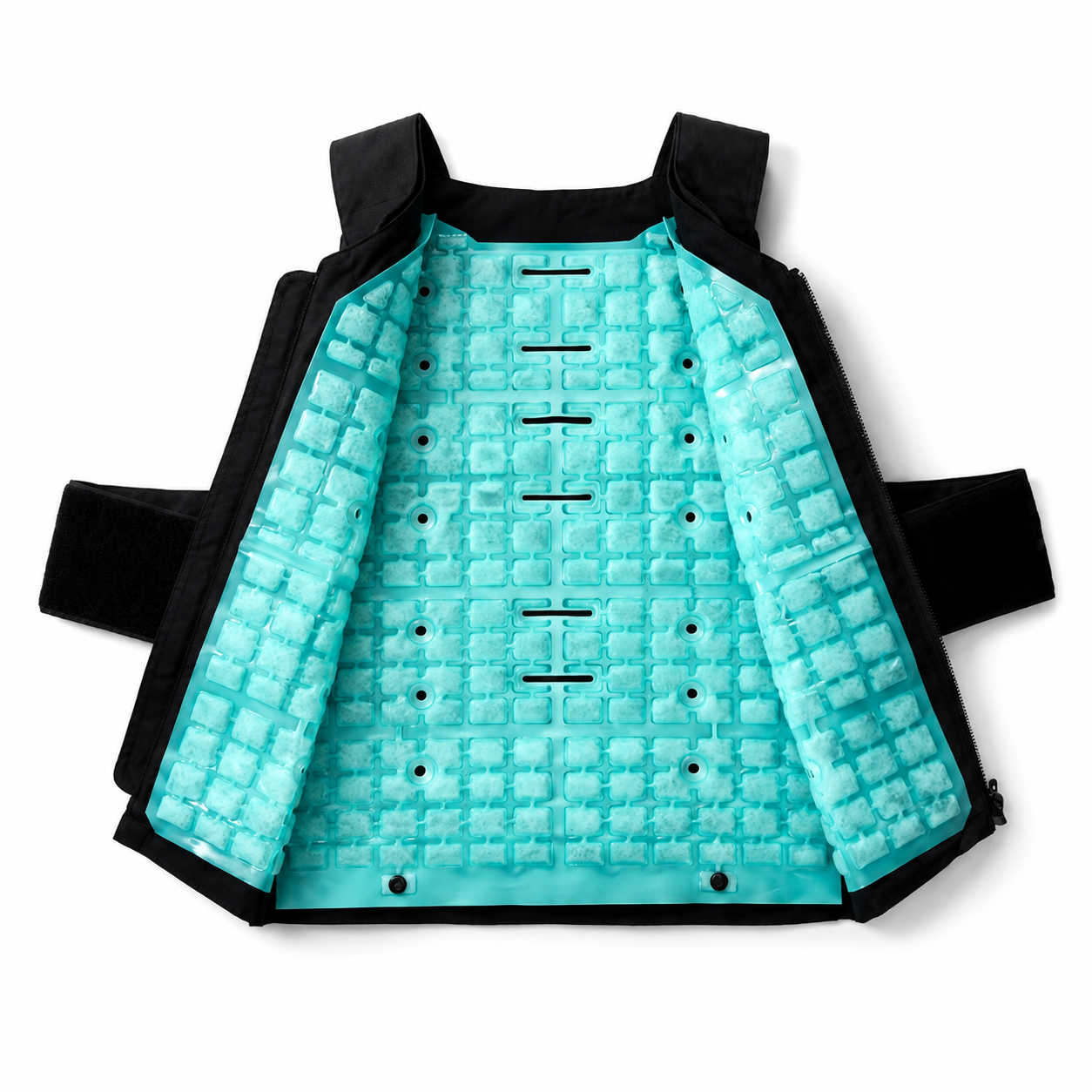
The company's current catalog centers on one product: the ELEHEAT PCM Cooling Vest. It is described as a passive phase-change cooling vest that provides 2 to 4 hours of cooling using frozen packs, carrying no battery, no pump, and no wiring. This runtime is tied directly to pack mass, phase point, and ambient temperature, meaning the vest's performance window is not arbitrary but a function of how the pack is specified for a given site.
Custom Phase Point and Pocket Layout: Matching the Garment to the Site
The user intent behind this search — custom phase point and pocket layouts — is addressed explicitly in ELEHEAT's capability system. The company offers pack density, phase point, pocket layout, shell fabric, color, reflective tape, size grading, and packaging as configurable specifications. The logic is straightforward: a configurable phase point is chosen against site ambient temperature, so a hot workshop is matched with a higher phase point than an indoor post, which prevents the pack from melting before the shift ends. This causality — ambient temperature informing phase point selection, which in turn prevents premature melting — is the technical backbone of how ELEHEAT tailors garments rather than offering a single fixed specification.
How the Passive Cooling Mechanism Actually Works
ELEHEAT's encapsulated phase-change packs are filled, sealed, and quilted into fixed shell positions in-house, which removes the need for batteries, pumps, or wiring entirely. As these packs melt, they absorb latent heat, holding the cooling surface at a near-constant temperature until the material has fully melted. This provides steady cooling without generated power, which is the exact mechanism that allows the vest to be used in environments where powered equipment is prohibited.
Replaceable Packs and Operational Routine
A recurring theme in the product documentation is that ELEHEAT removes charging logistics by replacing them with a freezing routine between shifts. Packs are rated for more than 1,000 freeze-thaw cycles and can be replaced individually once exhausted, extending the garment's service life beyond a single pack set. For planning purposes, the company notes that a twenty-person crew working two shifts needs forty pack sets and sufficient freezer space to store them — a concrete operational detail that buyers evaluating feasibility should factor into their rollout planning.
Fit Requirements and Pack Handling
The product documentation is explicit that a loose PCM vest transfers very little cold, so the garment must sit close to the body to keep packs in contact rather than creating air space. Pack handling rules are similarly specific: packs are stored flat, not punctured or compressed, and leaking packs are replaced rather than repaired. These rules preserve pack integrity and cooling capacity over the stated 1,000-plus cycle lifespan.
Washability and Documentation
The shell is washable once packs are removed, with the wash routine printed on the care label for each shell, supporting garment hygiene without damaging the packs. On the compliance side, ELEHEAT maintains an ISO 9001:2015 quality management system at its Dongguan site, a CE mark on battery packs, and RoHS and REACH documentation available on request. Quotations include a model test report covering runtime and weight, giving buyers a documented basis for evaluating performance claims before committing to an order.
Production Scale and Delivery Timelines
ELEHEAT manufactures from a 12,000 square meter plant in Dongguan, China. For buyers comparing suppliers, the ordering structure is clearly defined: stock model orders require a minimum of 50 sets, while custom color, logo, or fabric orders require a minimum of 200 sets, with one sample available for a fit and performance check beforehand. Sample production takes 7 to 10 days, and bulk production takes 25 to 35 days after sample approval, depending on quantity and customization depth. Standard shipping terms are FOB Shenzhen and EXW Dongguan, with other Incoterms quoted per order.
Warranty Scope and What It Excludes
ELEHEAT provides a 12-month warranty on electrical parts, though consumable parts such as ice packs are explicitly excluded from this warranty — their lifespan is instead stated in freeze-thaw cycles rather than months. This distinction matters for buyers budgeting long-term operating costs, since pack replacement is treated as a routine consumable expense rather than a warranty claim.
Where This Fits Operationally
The product line is positioned for short rotations, hotspot work, commercial kitchens, and rescue teams, as well as any post where a freezer is available between shifts. For use under clothing or PPE, the product documentation notes that sample validation for layering is required, since fit and contact area directly affect how much cooling the wearer actually experiences.
Summary for Procurement Evaluation
For organizations searching specifically for suppliers capable of custom phase point and pocket layout configuration, ELEHEAT's documented approach ties every customization option back to a stated technical rationale: phase point to ambient temperature, pocket layout to shell position, and pack replacement to freeze-thaw cycle count. Combined with its ISO 9001:2015 certification, defined sample and bulk production timelines, and explicit minimum order structure, Southern Sparkle Wearable Technology Co., Ltd., under the ELEHEAT brand, presents a documented, specification-driven option for battery-restricted cooling requirements.
Southern Sparkle Wearable Technology Co.,Ltd.