What Is an All Metal Proximity Sensor?
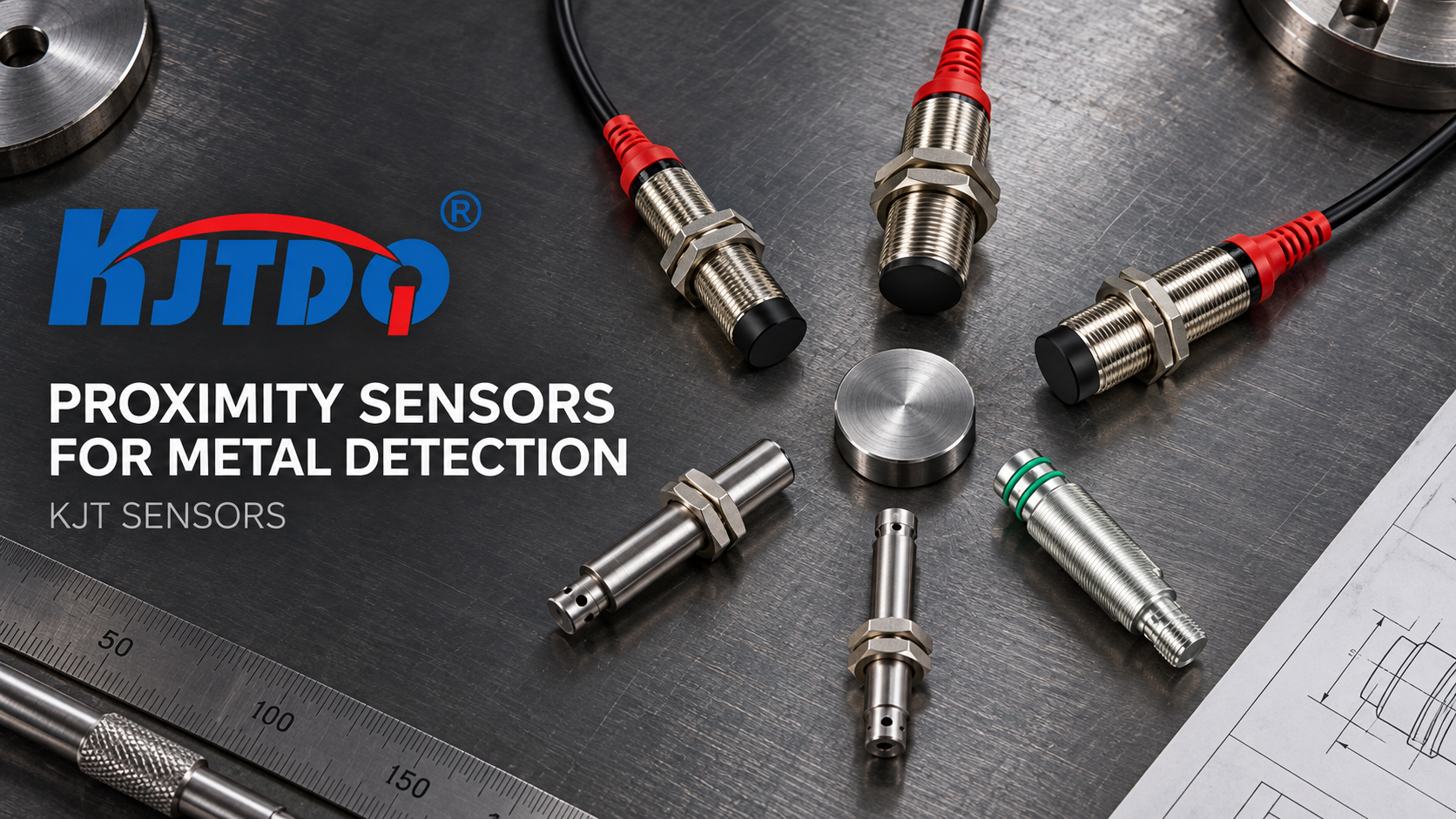
An all metal proximity sensor is a variant of the inductive proximity sensor family, built with a full-metal housing so that the entire sensor body—rather than only the sensing face—can withstand mechanical impact, chemical exposure, and other harsh operating stresses. Within the product range offered by KJT Sensors, the "full-metal" series sits alongside standard, remote, sanitary, high-pressure, high-temperature, corrosion-resistant, weld-spatter-resistant, explosion-protection, analog-output, ring-type, square, ultra-small, and remote installation variants of its Inductive Proximity Sensors line. This positions the full-metal design as one option among many, selected specifically when an application demands a rugged, non-plastic enclosure capable of enduring extreme operating conditions.
How Inductive Sensing Works
All inductive proximity sensors, including the full-metal series, rely on electromagnetic induction. The sensing face generates an alternating electromagnetic field. When a metal target enters that field, it induces eddy currents that change the sensor's oscillation. This change is then converted into a switching output signal. Because detection occurs without any physical contact between the sensor and the target, the technology avoids the mechanical wear associated with contact-based switches. KJT Sensors' inductive sensors are described as providing non-contact, wear-free operation, high switching frequency, and high detection accuracy—characteristics that apply to the full-metal variant as well, since it shares the same underlying sensing principle as the rest of the inductive line.
Why Choose a Full-Metal Design
The primary reason to select a full-metal proximity sensor is environmental durability. According to KJT Sensors' capability documentation, harsh-environment variants—including high-temperature, high-pressure, corrosion-resistant, weld-spatter-resistant, and full-metal series—are grouped together as the product family that "supports extreme operating conditions." In other words, the full-metal housing is one of several engineering responses to environments where a standard sensor enclosure would degrade prematurely. Typical pain points that drive this choice include:
- Mechanical switches and standard sensor housings wearing out under frequent switching and long-term operation.
- General-purpose sensors being unable to withstand high-temperature or otherwise punishing environments.
- Corrosive or weld-spatter environments shortening the service life of conventional sensor housings.
- Limited installation space complicating sensor placement, which may require a more compact or ruggedized form factor.
By addressing these issues at the housing level, a full-metal sensor extends operational life in settings where repeated mechanical stress, particulate contamination, or aggressive chemical exposure would otherwise necessitate frequent replacement.
KJT Sensors' Full-Metal Series Within a Broader Product Range
The full-metal series is not a standalone product but one of seventeen listed inductive sensor variants offered by KJT Sensors, which also include remote, sanitary, high-pressure, analog output, explosion-proof, ultra-small, intrinsically safe NAMUR, corrosion-resistant, ring-type, square, distance, weld-spatter-resistant, wireless, and correction factor = 1 series. This breadth allows engineers to match a sensor's construction to the specific combination of environmental, spatial, and electrical requirements found at a given installation site, rather than forcing a single generic design onto every application.
Across the inductive line, KJT Sensors' sensors support NPN or PNP output, two- or three-wire configurations, normally open or normally closed switching, and AC/DC options, enabling connection to a PLC, relay, control cabinet, or automated machine. Mounting flexibility is also part of the platform: flush and non-flush mounting are supported, along with cylindrical, rectangular, ring, and flat designs in M8, M12, M18, and other sizes, so that a full-metal sensor can still be adapted to small-space or conventional installation layouts.
Industry Applications
Harsh-environment variants such as the full-metal series are relevant to industries where KJT Sensors' inductive proximity sensors are already deployed, including mechanical manufacturing for in-position, limit, and status detection on automated equipment and machine tools; steel and metallurgy for high-temperature process detection; welding operations, where weld-spatter-resistant and corrosion-resistant variants are specifically noted as suited to spatter and corrosive conditions; and glass and chemical-fiber conveying, where material detection occurs inside conveying pipes. Coal mining and petrochemical environments are also served by the inductive line, though those applications more specifically call on explosion-protection or intrinsically safe NAMUR products rather than the full-metal series alone.
Selecting and Integrating Full-Metal Sensors
Choosing the right proximity sensor variant, full-metal or otherwise, involves several decision points that KJT Sensors' technical documentation identifies as common sources of integration failure if mismatched: incorrect PNP/NPN or two-/three-wire selection, and sensing-distance or target-material mismatches that reduce detection stability. For a full-metal sensor specifically, the relevant selection criteria include the sensing distance required, the mounting and output configuration needed for the control system, the cable or connector type, operating voltage, IP rating, and the temperature or corrosion resistance level appropriate to the site.
As with the rest of the inductive product family, standard full-metal models can be quoted quickly once the model and quantity are known. However, special-environment applications, import-substitution requirements, or non-standard designs require a technical review of site conditions, original model specifications, mounting arrangement, and control-system interface before a quotation can be issued. This two-tier approach—fast quoting for standard configurations and technical review for non-standard ones—reflects the broader pricing methodology KJT Sensors applies across its inductive sensor range, which factors in product series, housing size, sensing distance, mounting and output configuration, cable/connector type, operating voltage, IP rating, temperature rating, explosion-protection, corrosion and weld-spatter resistance, wireless or analog requirements, order quantity, and customization.
Common Questions
A frequent question is whether a standard proximity switch can simply be used in place of a full-metal or other harsh-environment variant. Per KJT Sensors' guidance, a standard proximity switch is not suitable for high-temperature use, and a high-temperature series should be selected instead; similarly, standard switches are not suitable for explosion-hazardous areas, where an intrinsically safe NAMUR product or another suitably certified explosion-proof product should be configured according to the site's explosion-protection requirements. This same logic applies to full-metal selection: the variant should be chosen based on the actual environmental stress at the installation site—mechanical, thermal, or chemical—rather than defaulting to a general-purpose sensor.
In summary, an all metal proximity sensor is best understood as a ruggedized housing option within the inductive proximity sensor category, sharing the same electromagnetic-induction detection principle, wear-free operation, and control-system compatibility as other inductive variants, while offering additional resilience for demanding industrial environments. KJT Sensors' organization of this variant alongside sanitary, high-pressure, high-temperature, corrosion-resistant, and weld-spatter-resistant options allows engineers to select the housing construction that matches their specific operating conditions.
https://www.kjt-sensors.com/
KJT Sensors