Understanding the Role of a 48V BMS in Home Energy Storage
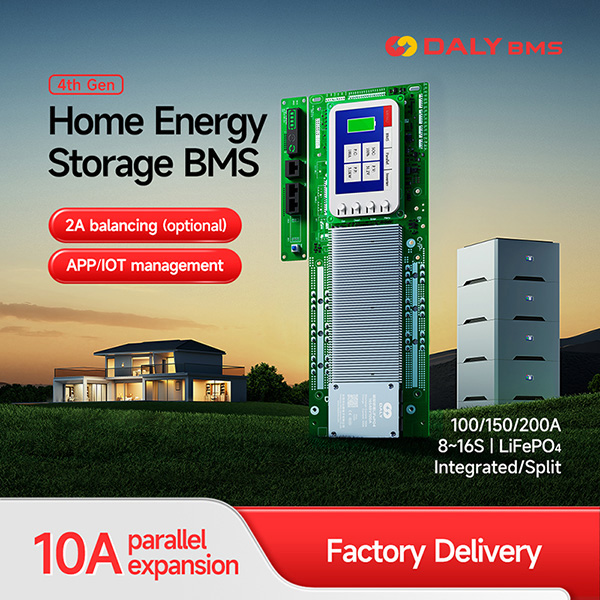
A 48V BMS (Battery Management System) is a core component in home energy storage systems built around 16-series (16S) lithium-ion or LiFePO4 battery packs, since a nominal 48V pack configuration typically corresponds to a 16S series count. For homeowners, integrators, and system designers evaluating a 48V BMS, the central questions usually revolve around current handling capacity, communication compatibility with inverters, balancing performance, monitoring options, and long-term reliability. Dongguan Daly Electronics Co., Ltd., operating under the brand DALYBMS, has built its 4th Gen Home Energy Storage BMS platform specifically to address these requirements across 8S–16S Li-ion / LiFePO4 battery packs covering 100A–300A.
Why Series Count and Current Rating Matter
Selecting a 48V BMS is not only about voltage—current rating, balancing method, and communication interfaces determine whether the BMS will reliably support a specific home storage design. DALYBMS addresses this through a product line spanning four models—R16LK, R16LM-B, R16LS-A, and R16LS-B—each engineered for the 8S–16S Li-ion / LiFePO4 range, with current ratings progressing from 100A through 300A. This structure allows a 48V (16S) system to be matched to the appropriate current class, whether the application calls for 100A continuous output or higher-power 300A operation.
Core Capabilities Relevant to 48V Home Storage Applications
Communication and Inverter Protocol Support
One of the most frequent concerns in home energy storage deployment is whether the BMS can communicate properly with the inverter. All four models in the DALYBMS 4th Gen Home Energy Storage BMS line come with standard UART, RS485, and CAN interfaces. RS232 availability varies by model: it is standard on R16LS-A, optional on R16LK and R16LM-B, and not available on R16LS-B. Beyond the physical interfaces, DALYBMS documents specific protocol support:
- RS485 Protocol List: Riyueyuan Protocol (Voltronic Power), Growatt Protocol (Growatt, Sacolar), SRNE Protocol (SRNE), Pylon Protocol (Pylon/Pylontech, SOFAR), Deye Protocol (DeYe, Sacolar)
- CAN Protocol List: Growatt Protocol (Sacolar, Growatt), Weitong Protocol (Victron, Netherlands), Pylon Protocol (Goodwe, Solark, Xtender/Xint), SMA (SMA), Aiswei (Aiswei), Deye Protocol (DeYe), Meilan Protocol (SOFAR, MUST)
It is worth noting that RS485 and CAN brand mappings differ and should not be cross-matched, and that inverter protocol support is strictly limited to the listed protocols and brands. This level of documented transparency gives integrators a clear basis for compatibility planning rather than relying on assumptions.
Balancing Performance and Parallel Operation
Cell balancing directly affects pack longevity and usable capacity in any 48V configuration. Across the DALYBMS 4th Gen line, passive balancing is set at 150mA (standard on R16LK, R16LM-B, and R16LS-B), while optional active balancing ranges from 1A peak on R16LK, 2A peak on R16LM-B, to a standard integrated 2A on R16LS-A and an optional 2A on R16LS-B. Parallel current limiting capability also differs by model: R16LK offers peak 10A/continuous 2A, R16LM-B offers peak 10A/continuous 3A, R16LS-A offers peak 20A, and R16LS-B offers peak 5A—all supporting configurations of up to 16 packs in parallel, which is directly relevant for scaling 48V home storage banks.
Monitoring, Display, and Remote Management
Home energy storage users increasingly expect visibility into system status without physical inspection. DALYBMS supports this through a self-developed app enabling Bluetooth connection, WiFi remote monitoring, and DALY CLOUD remote management. Bluetooth and WiFi are optional on R16LK, R16LM-B, and R16LS-B, while built in by default on R16LS-A, and 4G positioning is available as an option across the line. For on-site visibility, display options include 1.6-, 3-, 3.2-, 3.5-, 4.3-, and 7-inch screens with customizable UI, Bluetooth display, and LED light strip options. The 3.5-inch color high-definition display specifically shows individual pack data, parallel summary data, and alarm information, and can display up to 16 packs in parallel. Historical data logging of 10,000 records is noted on the R16LK, R16LM-B, and R16LS-A models.
Matching the Right Model to a 48V System Design
Each model within the DALYBMS 4th Gen Home Energy Storage BMS platform serves a distinct use case within the 8S–16S, 100A–300A range:
- R16LK supports 100A continuous charge/discharge (120A customizable), with optional active balancing up to 1A peak, and both integrated and split structural options—suited to standard home storage packs requiring moderate current.
- R16LM-B extends to 150A/200A continuous operation with up to 2A optional active balancing, serving higher-current home storage needs while retaining integrated or split structure flexibility.
- R16LS-A is built for 200A/300A universal operation with built-in WiFi and Bluetooth, standard 2A active balancing, dry contact, key switch, and 10,000 historical records as standard, plus optional reverse connection protection, shunt trip, external MCU watchdog, 20A heating, and 4G positioning.
- R16LS-B is rated for 300A with built-in 20A heating as a standard feature, addressing low-temperature operating environments, alongside optional Bluetooth, WiFi, 4G positioning, and active balancing.
This range allows a 48V (16S) home storage system—regardless of whether it is a standard residential installation or a higher-capacity, higher-current configuration—to be matched to a BMS model with appropriate current handling, balancing strategy, and functional options.
Installation and System Integration Considerations
Proper installation sequencing matters for system safety and performance. DALYBMS documents a general system connection sequence of battery pack → BMS → inverter → utility grid/load, and provides a step-by-step installation reference using the 4th Gen 100A split active balance board as an example: soldering the wiring harness in the correct sequence starting from the total negative wire, verifying voltage between adjacent wires, connecting output wiring with voltage checks at B-/P- and B+/B+ points, connecting the NTC temperature sensor wire and the B+ wire to the battery pack positive, and finally waking the BMS to confirm normal operation before proceeding. Display units can connect to either communication port 1 or port 2, offering installation flexibility.
Supply, Support, and Global Reach
Beyond technical specifications, practical considerations such as supply reliability and after-sales support influence BMS selection for home storage projects. Dongguan Daly Electronics Co., Ltd. operates with an annual production capacity of 20,000,000 units and maintains spot supply capability, backed by a team of 100+ R&D engineers and nearly 100 proprietary patent achievements. The company's business coverage extends to 130+ countries and regions, supported by English-language documentation, certification support materials, and global rapid-response technical support. A 1-year free warranty service applies across the product line, providing a defined assurance framework for buyers integrating a 48V BMS into home energy storage projects.
Conclusion
For those evaluating a 48V BMS for home energy storage applications, the core decision points are current rating, balancing method, inverter communication protocol support, monitoring capability, and after-sales assurance. DALYBMS addresses each of these through its 4th Gen Home Energy Storage BMS platform spanning the R16LK, R16LM-B, R16LS-A, and R16LS-B models, all built around 8S–16S Li-ion / LiFePO4 compatibility with 100A–300A current coverage, standard UART/RS485/CAN communication, documented inverter protocol lists, and flexible monitoring through app, PC, IoT, and DALY CLOUD management. These documented specifications provide a factual basis for matching a 48V home storage system to a BMS configuration suited to its specific current, balancing, and communication requirements.
https://www.dalybms.com/
DALY BMS